
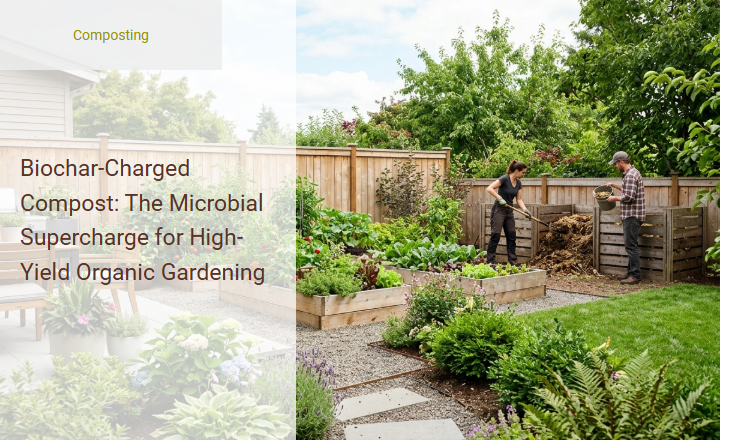
Many organic growers pour endless effort and resources into their soil, only to face stagnating crop yields and rapid nutrient depletion by mid-season. While traditional compost provides an initial biological boost, its volatile nutrient profile often leaches away during heavy rains before plants can fully utilize it.
Introducing biochar-charged compost solves this structural limitation by granting your soil a permanent, highly porous microbial sanctuary. However, a key distinction must be made: raw biochar must be properly inoculated-or "charged"-with active biology first, as adding raw, sterile biochar can temporarily strip nutrients from your garden. When executed correctly, this synergistic amendment drastically improves mycorrhizal root colonization in heavy feeders like heirloom tomatoes and dramatically increases water retention in sandy soils.
In this guide, we will examine the science of co-composting, detail the step-by-step inoculation process, and outline how to apply this supercharged medium to achieve unprecedented yields.
Read also: Pitchfork vs Compost Turner for Pile Aeration
Introduction: The Symbiotic Revolution in Organic Gardening
Modern organic gardening is undergoing a profound paradigm shift, driven by the discovery of how ancient soil practices intersect with modern biological science. At the forefront of this movement is the creation of biochar-charged compost, a revolutionary soil amendment that delivers unparalleled ecological benefits. Individually, raw biochar and organic compost are highly beneficial; however, when combined, they undergo a structural and chemical metamorphosis.
This pairing creates a powerful synergy where the whole is vastly greater than the sum of its parts. Compost provides a rich, diverse engine of microbial life and raw nutrients, while biochar supplies an indestructible, highly stable physical framework. By bringing these two components together, gardeners unlock a self-sustaining system that continuously feeds plants, retains water, and fosters a thriving underground ecosystem far more effectively than standard organic matter alone.
Understanding Biochar: The Ultimate Microbial Housing
To appreciate this material, one must examine its origins and physical structure. Biochar is a highly stable, carbon-rich form of charcoal produced through pyrolysis-the thermal decomposition of biomass under oxygen-depleted conditions. This specialized manufacturing process prevents the organic material from burning, leaving behind an incredibly complex, honeycomb-like skeletal structure that resists biological decay for centuries.
The defining feature of high-quality biochar is its astounding microscopic architecture. It contains millions of tiny pores, or micro-cavities, that yield a massive internal surface area. A single gram of high-quality biochar can have a surface area equivalent to several tennis courts. This complex layout functions as:
- A permanent physical refuge where beneficial fungi and bacteria can shelter from predators.
- Microscopic reservoirs that hold plant-available moisture against the pull of gravity.
- Safe havens that shield delicate mycorrhizal networks from mechanical soil disruptions.
Because biochar is chemically stable, this structural habitat remains in the soil permanently, creating a forever home for generations of soil organisms.
The Critical Step: Why Raw Biochar Must Be Charged
While biochar is incredibly beneficial, raw or "fresh" biochar should never be added directly to garden soil. Because of its massive, unpopulated surface area and empty chemical binding sites, raw biochar acts like a powerful sponge. When placed straight into the earth, it immediately absorbs water, beneficial microbes, and existing plant-available nutrients from the surrounding soil. This phenomenon temporarily depletes the root zone of essential nutrients, leading to stunted plant growth and yellowing leaves during the first season.
To avoid this initial nutrient deficit, the biochar must be "charged" or inoculated before it reaches your plants. The most efficient and biologically active way to charge biochar is to run it through an active composting process. As the compost heats up and breaks down, the biochar pores are saturated with moisture, soluble nutrients, humic acids, and diverse communities of microorganisms. Composting transforms the biochar from a hungry, empty sponge into a fully saturated delivery system ready to nourish your garden.
The Science of Microbial Supercharging
The magic of this combination occurs within the biological furnace of an active compost pile. When biochar is mixed with decomposing organic matter, a complex biological transformation takes place.
Nitrogen Retention and Microbial Colonization
During normal composting, significant amounts of nitrogen escape into the atmosphere as ammonia gas. Biochar alters this dynamic by physically adsorbing ammonium ions onto its surface. This process retains vital nitrogen in the pile, preserving it for future plant uptake. Additionally, mycorrhizal fungi readily colonize the internal pores of the biochar, spreading their hyphal networks throughout the composting material.
"The presence of highly porous carbon materials during the active thermophilic phase of composting acts as a buffer, lowering toxic ammonia concentrations and accelerating the proliferation of diverse, beneficial aerobic bacteria."
Step-by-Step Guide to Charging Biochar in Your Compost Pile
Creating your own biochar-charged compost at home is a straightforward process that fits naturally into standard backyard composting routines. Follow this simple guide to maximize the structural and biological quality of your final product:
- Acquire Raw Biochar: Obtain high-quality, sustainably sourced raw biochar, ensuring it is crushed into small, pea-sized pieces to maximize surface area contact.
- Determine the Ideal Ratio: Aim for a blend of 10% to 20% biochar by volume relative to your total compost raw materials. For example, add one bucket of biochar for every four to nine buckets of green and brown compost materials.
- Integrate into the Pile: Thoroughly mix the raw biochar with your nitrogen-rich "greens" and carbon-rich "browns" as you build or turn your compost pile. This ensures even distribution and immediate contact with decomposing matter.
- Maintain Moisture and Aeration: Keep the compost pile damp, resembling a wrung-out sponge, to allow microbes to easily migrate into the biochar's micro-pores. Turn the pile regularly to keep it aerated.
- Allow to Cure: Let the compost fully finish its heating and cooling cycles. A curing period of at least two to four weeks after decomposition ensures the biochar is completely saturated and chemically stabilized.
Boosting Nutrient Retention and Cation Exchange Capacity
To understand why this amendment keeps plants healthy over the long term, we must look at the soil chemistry. Soils rely on Cation Exchange Capacity (CEC) to hold onto positively charged nutrient ions like calcium, magnesium, potassium, and ammonium. Sandy soils and poor soils have low CEC, meaning rainwater easily washes these vital minerals away before plants can use them.
Biochar inherently possesses a high CEC, which is further amplified as it ages and interacts with compost. During composting, the surfaces of the biochar oxidize, creating highly reactive organic compounds that permanently bond with nutrients. This process prevents nutrient leaching, locking essential minerals into the root zone. Instead of washing away, nutrients remain chemically bound to the biochar surface, waiting for plant roots to extract them through cation exchange.
Improving Soil Structure and Water Conservation
The combination of biochar and compost works wonders on the physical characteristics of your garden soil. Because it does not break down, biochar provides a permanent structural framework that counteracts the negative traits of both heavy clay and loose, sandy soils.
When mixed into garden beds, this amendment improves the soil in several key ways:
- It breaks up heavy, dense clay soils, improving aeration and allowing plant roots to penetrate deeper.
- It reduces compaction, which prevents waterlogging and allows excess moisture to drain away freely.
- It increases water retention in sandy soils by holding moisture inside millions of microscopic compartments.
- It encourages the formation of stable soil aggregates, creating a crumbly, spongy soil texture.
How to Apply Biochar-Charged Compost to Your Garden
Once your biochar-charged compost has finished curing, it is ready to be applied across your garden. Because it is highly concentrated, a little goes a long way toward revitalizing tired soils.
Application Recommendations
Use the following table to determine the best application rates and methods for your specific gardening needs:
| Garden Area | Application Rate | Depth & Timing |
|---|---|---|
| Vegetable Beds | 1 to 2 inches spread over the surface | Gently work into the top 4-6 inches of soil in early spring. |
| Perennial Plants & Shrubs | 1-inch layer around the drip line | Apply as a top-dress in autumn and cover with organic mulch. |
| Potted Containers | 10% to 15% of the total potting mix volume | Thoroughly blend with potting soil prior to planting or repotting. |
| Lawn Top-Dressing | 1/4-inch layer evenly distributed | Spread across the lawn after aeration in spring or early autumn. |
Environmental Impact: Carbon Sequestration and Sustainability
Beyond producing abundant harvests and beautiful flowers, utilizing biochar-charged compost is an act of active environmental stewardship. When organic waste decomposes naturally in a landfill or standard compost pile, a significant portion of its carbon is released back into the atmosphere as carbon dioxide or methane. Pyrolyzing biomass into biochar stabilizes this carbon into a highly resistant, solid form.
Incorporating biochar into your compost locks carbon into the earth for hundreds, if not thousands, of years, transforming your garden into a highly efficient carbon sink.
"By capturing carbon that would otherwise escape as greenhouse gases and storing it permanently in agricultural soils, home gardeners play a direct role in mitigating global emissions while building resilient, fertile ecosystems."
Conclusion: Cultivating a High-Yield Future
Embracing biochar-charged compost represents a commitment to the long-term vitality of your land. By combining the permanent structural advantages of biochar with the biological wealth of active compost, you establish a self-regulating, nutrient-dense ecosystem directly beneath your plants. This simple addition reduces water consumption, prevents nutrient runoff, and builds a thriving microbial community that gets better with each passing year.
Begin integrating biochar into your compost pile this season to witness the remarkable transformation in your soil structure and harvest yields. Your investments in soil health today will pay dividends in organic abundance for decades to come.
Summary
The article "Biochar-Charged Compost: The Microbial Supercharge for High-Yield Organic Gardening" explores how combining biochar with compost revolutionizes soil health and crop productivity. While raw biochar is highly stable, it acts as an empty sponge that can initially deplete soil nutrients. However, when "charged" or co-composted with organic matter, it becomes a permanent habitat for beneficial microbes.
The highly porous structure of biochar absorbs water and essential nutrients, preventing them from washing away while slowly releasing them to plant roots. This microbial supercharge drastically improves soil structure, moisture retention, and nutrient cycling. By integrating biochar-charged compost, organic gardeners can build resilient soil ecosystems, reduce the need for external fertilizers, and achieve significantly higher, more sustainable crop yields while contributing to long-term carbon sequestration.
Leave a comment