
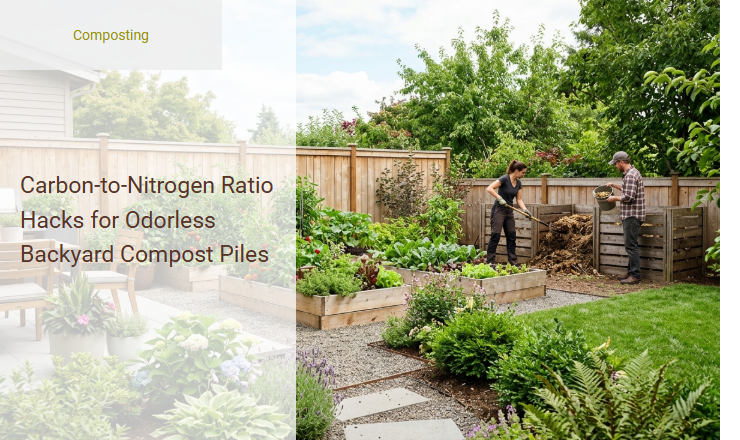
Many backyard gardeners struggle with a foul, ammonia-like stench emanating from their compost bins, quickly turning a sustainable hobby into a neighborhood nuisance. Before addressing this unpleasant odor, however, we must view the compost pile as a dynamic biological ecosystem. Mastering the precise chemical balance within this system grants you a rapid, highly efficient, and completely odorless decomposition process.
Of course, this requires a basic stipulation: successful composting demands active management rather than passive dumping. You must deliberately balance nitrogen-rich green materials, like kitchen scraps and coffee grounds, with carbon-heavy brown materials, such as dried leaves and sawdust, to keep odor-causing anaerobic bacteria at bay.
In this article, we will detail practical carbon-to-nitrogen (C:N) ratio hacks, explore high-yield ingredient pairings, and provide troubleshooting strategies to guarantee a sweet-smelling, highly productive backyard pile.
Read also: Sawdust vs Wood Shavings for Carbon Balance
The Science of Odorless Composting
Many backyard gardeners abandon composting because of the dreaded, lingering stench of rot. When a pile begins to smell like sewage, it is experiencing anaerobic conditions-meaning oxygen-depleted bacteria have taken over the decomposition process. To transform this stinky mess into a sweet-smelling powerhouse, you must manage the Carbon-to-Nitrogen (C:N) ratio, which is the foundational secret to maintaining aerobic decomposition.
Decoding the Golden 30:1 Ratio
The golden standard for a healthy compost pile is a carbon-to-nitrogen ratio of 30:1. This means for every single part of nitrogen you add to your pile, you need thirty parts of carbon. Maintaining this balance keeps microbial decomposers active and highly efficient. When the ratio is correctly balanced, microorganisms completely digest organic matter without releasing foul gases like ammonia or sulfur.
High-Carbon "Browns" That Neutralize Odor
The Airflow Masters
High-carbon materials, often called "browns," act as structural supports and natural moisture sponges inside your compost bin.
- Autumn Leaves: Provide a balanced carbon boost and light structural loft.
- Straw and Hay: Excellent for creating tiny air pockets that invite oxygen.
- Shredded Cardboard: Absorbs excess liquid while maintaining an open texture.
High-Nitrogen "Greens" to Fuel Decomposition
The Energy Igniters
Nitrogen-rich materials, or "greens," provide the protein and energy that composting microbes need to multiply rapidly. However, adding too many greens at once creates a slimy, oxygen-deprived heap.
- Kitchen Scraps: Vegetable peels and fruit cores must be integrated slowly.
- Fresh Grass Clippings: Highly potent nitrogen sources that must be mixed thoroughly to prevent matting.
- Coffee Grounds: Highly acidic and dense, which requires immediate dilution with dry browns.
Hack 1: The Lasagna Layering Technique
Maintaining the perfect balance does not require a laboratory scale. Using the lasagna layering method naturally keeps your pile aerated and perfectly proportioned.
- Start with a three-inch base of coarse branches or twigs at the very bottom.
- Add a two-inch layer of nitrogen-rich green materials.
- Cover immediately with a six-inch layer of dry, brown carbon materials.
Hack 2: Shredding for Rapid, Smell-Free Breakdown
Large chunks of cardboard, leaves, and twigs decompose slowly and tend to mat together, trapping moisture and cutting off oxygen supply. To combat this, pre-shredding your carbon materials dramatically increases the overall surface area available to helpful bacteria.
By breaking down large materials into tiny fragments, you prevent the compaction that breeds foul-smelling anaerobic pockets.
Hack 3: The Carbon Cap Instant Fix
The Bio-Filter Shield
Whenever you toss fresh kitchen waste into your bin, you risk attracting pests and emitting odors. The Carbon Cap technique solves this instantly. Simply throw a thick, four-inch blanket of dry leaves, sawdust, or shredded paper directly over the fresh nitrogen. This acts as a physical barrier and a biological filter, trapping odors before they escape into the air.
Hack 4: The Squeeze Test for Moisture Balance
Water plays a massive role in regulating your C:N ratio's efficiency. Too much water drives out oxygen, creating a rotten marsh, while too little water stalls decomposition completely. You can easily monitor this using the squeeze test.
Grab a handful of compost from the center of the pile and squeeze it. It should feel exactly like a wrung-out sponge, leaving only a couple of drops of water on your palm.
Hack 5: Troubleshooting Odors with the Sniff Test
| Smell Detected | Root Cause | Instant C:N Fix |
|---|---|---|
| Rotten Eggs / Sewage | Anaerobic conditions, too wet, lack of oxygen | Turn the pile to introduce air and mix in dry, coarse browns. |
| Sharp Ammonia / Urine | Too much nitrogen (excessive greens) | Mix in a heavy dose of shredded cardboard or dry autumn leaves. |
Reaping the Benefits of a Balanced Pile
By mastering the 30:1 carbon-to-nitrogen ratio, backyard composting becomes a clean, odorless, and deeply rewarding habit. With these simple adjustments, your waste will transform into a nutrient-dense, earthy humus that smells just like a fresh forest floor. Your garden will thrive, and your neighbors will thank you.
Summary
Managing the carbon-to-nitrogen (C:N) ratio is the ultimate secret to maintaining a healthy, odorless backyard compost pile. Ideally, composters should aim for a C:N ratio of roughly 30:1, balancing "browns" (carbon-rich materials like dry leaves, cardboard, and straw) with "greens" (nitrogen-rich materials like kitchen scraps and fresh grass clippings). When this balance is disrupted-particularly with an excess of nitrogen-the pile becomes anaerobic and emits an unpleasant odor.
To easily hack this ratio without complex calculations, composters can apply the simple rule of thumb of adding two to three parts brown materials for every one part green. Shredding carbon sources also accelerates decomposition and neutralizes smells. Ensuring proper aeration through regular turning and covering exposed food scraps with a thick layer of dry browns will keep your backyard bin smelling fresh and earthy while efficiently producing nutrient-rich soil.
Leave a comment