
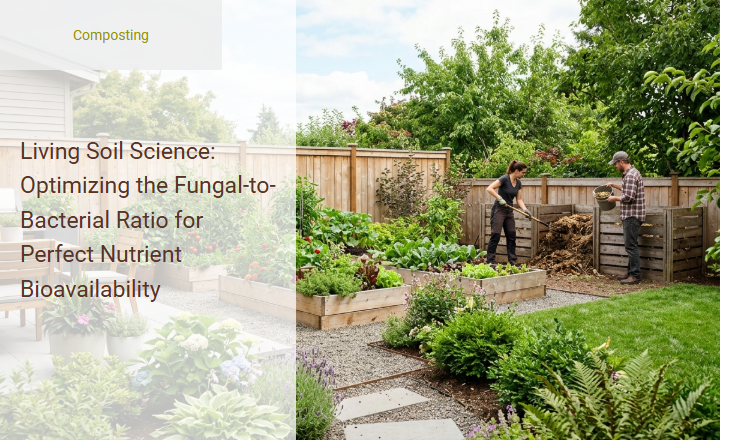
Many growers struggle with persistent nutrient lockout, watching premium fertilizers fail to translate into crop vigor despite precise NPK dosing. Before addressing biological inputs, we must recognize that soil is not a sterile holding medium, but a dynamic, living digestive tract. Mastering this subterranean ecosystem grants plants autonomous access to locked minerals, drastically reducing synthetic input costs and runoff.
However, achieving this biological efficiency requires a crucial caveat: soil biology must match the specific evolutionary stage of your crop. For example, while brassicas thrive in bacteria-dominated soils, high-value orchards and conifers require a highly fungal network to mobilize tightly bound phosphorus.
In this article, we will analyze the science of the Fungal-to-Bacterial (F:B) ratio, map the biological preferences of key plant groups, and outline actionable protocols to optimize your soil's microbiome for peak nutrient bioavailability.
Read also: Manure vs Leaf Mold for Nitrogen Boost
Introduction to the Soil Food Web and Nutrient Bioavailability
The ground beneath our feet is not a sterile medium; it is a complex, thriving ecosystem known as the living soil food web. This intricate web consists of billions of microscopic and macroscopic organisms-including bacteria, fungi, protozoa, nematodes, and microarthropods-all interacting within the rhizosphere. Traditional agriculture often views soil as a passive container to be filled with synthetic fertilizers. However, true fertility is driven by biological processes. Biological activity, rather than chemical inputs, holds the key to unlocked nutrient bioavailability. When we rely solely on chemical inputs, we bypass the natural digestive processes of the soil, often locking up essential elements in insoluble chemical bonds and leaving plants vulnerable to pests and diseases.
By shifting our focus from feeding the plant directly to feeding the soil biology, we initiate a self-sustaining cycle of fertility. Soil microbes act as microscopic miners and chemists, converting atmospheric gases and mineralized rock into water-soluble, bioavailable compounds that plants can readily assimilate. Without this living network, expensive synthetic fertilizers quickly leach into groundwater or gas off into the atmosphere, causing environmental degradation while depleting the natural resilience of the soil.
The Bacterial Dominion: Nitrogen Cycling and Rapid Decomposition
The Pioneers of the Rhizosphere
Bacteria are the single-celled powerhouses of the soil, possessing an astonishing rate of reproduction that allows them to rapidly colonize organic matter. Under optimal conditions, bacterial populations can double in a matter of minutes, allowing them to immobilize highly soluble nutrients in their bodies before they can wash away. This fast-turnover biomass acts as an organic nutrient sponge, keeping critical compounds in the upper root zone.
Driving the Nitrogen Cycle
Bacteria play a fundamental role in converting inert nitrogen into forms that support plant growth. Through the process of mineralization, specific bacterial groups transform organic nitrogen into plant-usable ammonium and nitrate. Because of their fast lifecycle, they dominate early-successional soils-such as disturbed lands, annual vegetable beds, and agricultural fields-where rapid flushes of nutrients are needed to support fast-growing, opportunistic plant species.
- Nitrogen-fixing bacteria form symbiotic relationships with legume roots to capture atmospheric nitrogen.
- Nitrifying bacteria convert ammonium into nitrites and nitrates, which are highly soluble plant nutrients.
- Decomposing bacteria break down simple sugars and green organic matter, returning carbon to the immediate food web.
The Fungal Network: Mycorrhizae and Long-Term Carbon Storage
The Living Internet of the Soil
While bacteria thrive on simple carbon compounds, soil fungi specialize in breaking down complex, woody structures. Mycorrhizal fungi form intimate, symbiotic alliances with plant roots, effectively expanding the root surface area by hundreds of times. These microscopic fungal threads, or hyphae, navigate through minuscule soil pores that plant roots could never reach, transporting water and accessing locked-up phosphorus that is otherwise unavailable to the plant.
Building Soil Structure and Humic Reserves
Fungal networks are the primary architects of long-term soil structure. Saprophytic fungi decompose tough lignins and cellulose, turning raw organic waste into stable humus. During this process, mycorrhizal fungi produce a sticky, carbon-rich glycoprotein called glomalin. Glomalin binds tiny soil particles into stable aggregates, creating a porous soil matrix that resists erosion, improves water infiltration, and secures long-term carbon storage deep within the earth.
Decoding the Fungal-to-Bacterial (F:B) Ratio
The Fungal-to-Bacterial (F:B) ratio is a measurement of the relative biomass of fungi compared to bacteria within a given soil sample. Rather than a static metric, this balance is dynamic and dictates the biological succession of soil environments. As soils transition from highly disturbed, bacterial-dominated states toward mature, undisturbed, and fungal-dominated forest systems, the vegetation that thrives in those soils changes accordingly.
"The balance between fungi and bacteria determines the form of nitrogen present in the soil, which in turn dictates which plant communities can successfully colonize and dominate the landscape."
Understanding this ratio allows growers to manipulate their soil biology to match the specific evolutionary preferences of their crops. By managing inputs to favor either fungi or bacteria, we can optimize nutrient uptake and suppress weeds naturally without relying on chemical interventions.
Tailoring the F:B Ratio to Your Specific Crops
Different plant categories have evolved to thrive in specific stages of ecological succession, meaning they require distinct F:B ratios to perform at their genetic potential. Weeds and brassicas thrive in highly bacterial soils where nitrate nitrogen is abundant. Conversely, perennial shrubs and trees require highly fungal soils rich in ammonium nitrogen.
| Plant Category | Preferred F:B Ratio | Primary Nitrogen Source | Soil Succession Stage |
|---|---|---|---|
| Weeds & Brassicas (e.g., Broccoli, Kale) | 0.1:1 to 0.5:1 | Nitrates (NO3-) | Early Successional / Disturbed |
| Row Crops & Vegetables (e.g., Tomatoes, Peppers) | 1:1 | Balanced Nitrate & Ammonium | Mid-Successional |
| Perennial Berries & Vines | 2:1 to 5:1 | Ammonium (NH4+) | Late Successional |
| Conifers & Deciduous Trees | 100:1 to 1000:1 | Ammonium (NH4+) | Old-Growth Forest |
The Chemistry of Bioavailability: pH and Exudate Interplay
Plants are not passive consumers; they actively direct the biological activity in their root zone through the release of root exudates. These exudates-composed of simple sugars, carbohydrates, and proteins-are pumped out of the roots to attract specific microbial populations. When a plant requires phosphorus, it releases compounds that stimulate mycorrhizal fungi. When it requires nitrogen, it targets specific bacterial communities. This localized biological activity temporarily alters the rhizosphere pH, allowing the plant to manipulate its immediate environment.
The true magic of bioavailability occurs when these attracted microbes are consumed by their predators. When protozoa, nematodes, and microarthropods ingest bacteria and fungi, they must excrete the excess nutrients they do not need. Because bacteria and fungi are incredibly nutrient-dense, their predators release excess elements as plant-available ions like NH4+ (ammonium), HPO4(2-) (phosphate), and K+ (potassium). This predator-prey interaction is the biological engine that continuously fuels plant nutrition.
Assessing Your Soil: Lab Tests vs. Microscopic Analysis
Direct Microscopy
Direct microscopy allows growers to inspect their soil food web in real-time. By preparing a simple soil dilution and viewing it under a compound light microscope, you can immediately identify the presence and activity of bacteria, fungi, protozoa, and nematodes. This method provides instant feedback on the biological diversity and physical structure of your soil biology.
Professional Laboratory Assays
For quantitative data, professional laboratory testing offers high-precision analysis of the biological communities living within your soil. These tests help remove the guesswork, providing a clear roadmap for soil amendments.
- Phospholipid Fatty Acid (PLFA) Analysis: This test measures the living microbial biomass and provides a detailed breakdown of the functional groups present, including the exact F:B ratio.
- Solvita CO2 Respiration Test: Measures the carbon dioxide burst produced by soil microbes, indicating the overall activity and vitality of the biological population.
Strategies for Boosting Soil Bacteria
If your soil analysis reveals a deficiency in bacterial biomass-common in heavily degraded, sandy, or over-compacted soils-you can jumpstart these populations using specific, carbon-simple inputs. Because bacteria excel at digesting easily accessible sugars, applying simple carbohydrates will trigger a rapid population boom.
- Apply diluted unsulfured blackstrap molasses to feed active bacterial populations.
- Incorporate fresh, green manures and cover crops directly into the top layer of soil.
- Brew and apply high-nitrogen compost teas using vermicompost and alfalfa meal as catalysts.
Cultivating Soil Fungi: Carbon-Rich Inputs and No-Till Practices
Building a robust fungal network requires patience and a hands-off approach. Fungi are highly sensitive to physical disruption, meaning that mechanical tillage tears apart the delicate hyphal networks that take months to establish. To foster fungal growth, we must mimic the natural forest floor by applying complex, carbon-dense organic matter and protecting the soil profile from disturbance.
- Apply thick layers of wood chips, bark, or shredded leaves as a surface mulch to feed saprophytic fungi.
- Incorporate humic and fulvic acids to provide complex carbon structures that bacteria cannot easily decompose.
- Utilize diverse cover crops with living roots to maintain symbiotic mycorrhizal networks during the off-season.
- Adopt strict no-till or low-till agricultural practices to keep the existing fungal hyphae completely intact.
Sustaining the Balance: Long-Term Management of Living Soil
Achieving agricultural abundance without synthetic chemicals relies entirely on our ability to cultivate and sustain a balanced, living soil food web. By shifting our focus from feeding plants to nurturing the biological communities within the rhizosphere, we tap into millions of years of evolutionary efficiency. Managing the fungal-to-bacterial ratio allows us to tailor the soil environment to the exact requirements of our crops, naturally suppressing weeds, retaining water, and unlocking vast reserves of mineral nutrition. Commit to managing your soil as a living organism, protect its delicate biology from unnecessary disturbances, and allow the natural cycle of life to drive your fertility, yields, and long-term agricultural sustainability.
Summary
The article "Living Soil Science: Optimizing the Fungal-to-Bacterial Ratio for Perfect Nutrient Bioavailability" explores the critical role of the soil microbiome in plant nutrition. It highlights how managing the balance between soil fungi and bacteria-known as the fungal-to-bacterial (F:B) ratio-directly influences soil structure, pH, and nutrient cycling.
Different plant species thrive under distinct F:B ratios; for instance, annual vegetables prefer bacteria-dominated soils, whereas trees and perennial crops demand highly fungal environments. By understanding and manipulating this ratio through targeted organic amendments, actively aerated compost teas, and minimal tillage, growers can unlock bound-up nutrients naturally. This biological approach drastically reduces reliance on synthetic chemical fertilizers, enhances soil water retention, and strengthens plant immunity. Ultimately, fostering a balanced, living soil food web is presented as the definitive pathway to sustainable, high-yield agriculture and vibrant plant health.
Leave a comment