
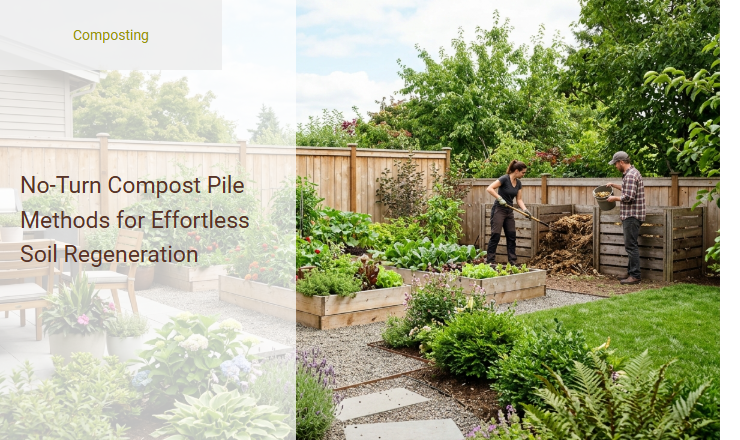
Traditional composting is highly beneficial for soil health, yet the grueling physical labor of constantly turning heavy organic piles deters many dedicated gardeners. Fortunately, transitioning to a "no-turn" methodology grants you rich, biologically active humus without the backbreaking strain, effortlessly regenerating your soil health while preserving your valuable time and energy.
However, successful passive composting requires a shift in expectations; this nature-first approach stipulates a precise balance of materials rather than physical intervention. To ensure adequate passive aeration, one must construct the pile using specific bulky materials-such as coarse wood chips, dry straw, and hollow twigs-which naturally maintain essential internal oxygen pockets.
In this guide, we will examine the biological science of passive decomposition, evaluate the most effective self-aerating structural designs, and provide a step-by-step blueprint to establish your own highly efficient, low-maintenance compost pile.
Read also: Vinegar vs Baking Soda for pH Adjustment
Introduction to Effortless Soil Regeneration
Nature never relies on a pitchfork to create fertile soil. In the depths of an ancient forest, fallen leaves, decaying wood, and organic debris accumulate on the ground, decomposing slowly over time without any human intervention. This natural cycle is the foundation of no-turn composting, a passive methodology designed to regenerate your garden soil with minimal physical effort.
By mimicking the forest floor, you can create a highly productive compost pile that requires zero turning. Instead of constantly breaking your back to aerate a heavy pile, you let gravity, time, and biology do the heavy lifting. This hands-off philosophy preserves the delicate structural layers of the compost, allowing a diverse community of soil organisms to thrive undisturbed while converting waste into black gold.
The Science Behind No-Turn Composting
While traditional hot composting relies on mechanical turning to force oxygen into the pile, static composting utilizes the biological process of passive aeration. As organic materials decay, they naturally create chimney-like drafts. Warm air rises from the center of the pile, drawing cooler, oxygen-rich air inward through the sides. This continuous, slow movement of air sustains aerobic bacteria without manual disruption.
Leaving the pile undisturbed allows for a fungal-dominant decomposition process. Unlike bacteria, beneficial fungi develop extensive, fragile networks of threads known as hyphae. In a turned compost pile, these structures are repeatedly shattered, resetting the biological clock. In a static pile, these mycorrhizal networks grow unchecked, creating a finished product that is structurally superior and highly effective at boosting plant immunity and nutrient uptake when applied to your garden.
Core Benefits of Static Composting
Embracing a static, no-turn composting system offers profound ecological and practical advantages over high-maintenance turned piles. By allowing organic matter to decay naturally, you achieve a more resilient and biologically diverse soil amendment.
- Significant Labor Reduction: Eliminates the physically demanding task of lifting, flipping, and mixing heavy, saturated organic material.
- Superior Moisture Retention: The undisturbed structure of the pile prevents rapid evaporation, keeping the internal environment consistently damp.
- Preservation of Nitrogen: Turning compost releases valuable nitrogen into the atmosphere as ammonia gas; static piles retain this essential nutrient.
- Enhanced Soil Biodiversity: Minimizes disruption to earthworms, beneficial insects, and delicate fungal networks, cultivating a more complex soil food web.
Method 1: The Lasagna Composting Technique
How Sheet Mulching Builds Topsoil
Lasagna composting, also known as sheet mulching, is a highly effective no-turn method built directly over your existing soil. By layering nitrogen-rich and carbon-rich materials, you create a slow-release decomposition zone that kills weeds and builds premium topsoil simultaneously.
- Lay down a thick layer of cardboard or newspaper directly over grass or weeds to suppress growth and form a decomposing base.
- Thoroughly wet the cardboard layer to encourage earthworms to migrate upward from the deep soil.
- Spread a two-inch layer of nitrogen-rich green materials, such as vegetable scraps, fresh grass clippings, or manure.
- Add a four-inch layer of carbon-rich brown materials, such as shredded leaves, straw, or pine needles.
- Repeat these alternating green and brown layers until the bed reaches a height of approximately two feet.
- Finish the pile with a thick layer of clean straw or shredded leaves to prevent odors and insulate the decomposing layers beneath.
Method 2: Hügelkultur-Style Base Piles
Woody Foundations for Long-Term Fertility
Hügelkultur-style base piles adapt ancient German forestry practices to create a self-watering, long-term no-turn composting system. By constructing your compost pile on top of a foundation of decaying logs, branches, and woody debris, you create a permanent reservoir for nutrients and moisture.
The thick woody base acts as a giant sponge, absorbing heavy rainfall and slowly releasing moisture upward into the composting mass during dry spells. As the buried wood slowly breaks down over several years, it creates pocketed air spaces that ensure the pile remains aerobic. This continuous structural support prevents the compost from collapsing and compacting under its own weight, ensuring excellent passive airflow without any need for physical aeration.
Method 3: The Static Aerated Pipe Method
Passive Convection Aeration
The static aerated pipe method, inspired by industrial aerated static pile systems, uses simple physics to deliver oxygen deep into the core of a stationary compost heap. By integrating perforated pipes into the foundation of your pile, you create an effortless path for air to circulate.
As the microbes in the center of the pile generate heat, the warm air naturally rises and escapes through the top. This thermal movement creates a vacuum that pulls fresh, oxygenated air through the perforated PVC or drainage pipes located at the base. This continuous cycle of passive convection keeps the pile completely aerobic, preventing bad odors and speeding up decomposition without requiring a pitchfork.
Selecting the Perfect Balance of Materials
To ensure a static compost pile decomposes efficiently without turning, you must establish an optimal balance of carbon-rich "browns" and nitrogen-rich "greens." Because you are not mixing the pile manually, avoiding compactable materials is crucial for maintaining natural air pockets.
| Material Type | Common Examples | Role in Static Compost |
|---|---|---|
| Carbon (Browns) | Shredded cardboard, dry leaves, clean straw, woodchips | Provides structural support, creates air pockets, prevents compaction |
| Nitrogen (Greens) | Kitchen scraps, coffee grounds, fresh grass, garden waste | Feeds the microbial population, heats the pile, accelerates decay |
Managing Moisture and Temperature Passively
Maintaining the correct moisture level is vital for static composting success. A healthy compost pile should have the moisture consistency of a wrung-out sponge. To manage this passively, you can utilize a thick straw cap on top of your pile, which acts as a barrier to lock in rising moisture while protecting the pile from heavy downpours that could wash away nutrients.
Temperature control in a static system is similarly hands-off. By building your pile to a minimum size of three feet cubed, the pile insulates itself naturally. This mass retains enough ambient heat in its core to support thermophilic bacteria during the early stages, ensuring weed seeds and pathogens are deactivated while the outer edges remain cool enough for beneficial fungi to thrive.
Troubleshooting No-Turn Compost Issues
Static composting is incredibly forgiving, but occasionally the system can fall out of biological balance. Because you are not turning the pile, corrections must be targeted and non-disruptive to avoid ruining the fungal mycelium.
- Foul, Putrid Odors: This indicates anaerobic conditions, usually caused by excess water or compacted greens. Correct this by inserting a broomstick into the pile to create vertical chimney vents and covering the top with dry straw.
- Decomposition Has Stalled: If the pile is dry and inactive, it lacks nitrogen or moisture. Gently pour water or liquid seaweed extract over the top and let gravity carry the hydration through the layers.
- Unwanted Pests and Rodents: Pests are drawn to exposed food scraps on the surface. Always bury kitchen waste at least six inches deep under a thick layer of carbon-rich browns like dry leaves or sawdust.
Harvesting and Applying Your Regenerative Compost
Your no-turn compost is ready for use when the bottom layers have transformed into a dark, crumbly, sweet-smelling soil amendment. Because static piles decompose from the bottom up, you can simply pull back the undecomposed top layer to reveal the rich, finished humus underneath. This process yields a highly fungal-dominant compost teeming with life.
To maximize the health of your soil microbiome, apply this finished compost directly to the surface of your garden beds as a top-dressing. Avoid digging or tilling it into the soil. By laying it on top, you mimic nature's replenishment cycle, allowing earthworms and rain to naturally integrate the nutrients and mycorrhizal fungi deep into the root zones of your crops.
Summary
The article "No-Turn Compost Pile Methods for Effortless Soil Regeneration" highlights how gardeners can create nutrient-rich compost with minimal physical labor. Unlike traditional composting, which requires regular, strenuous turning to aerate the pile, no-turn methods rely on smart layering and passive aeration. By utilizing techniques such as lasagna gardening (sheet mulching) or inserting perforated PVC pipes into the heap, gardeners can maintain vital oxygen levels naturally. Starting the pile with a coarse base of twigs or straw also ensures steady airflow from the bottom up.
This hands-off approach not only saves significant time and energy but also protects the delicate soil food web. Undisturbed compost piles allow beneficial fungal networks, such as mycorrhizae, to thrive and multiply. Ultimately, no-turn composting offers an efficient, sustainable path to soil regeneration, yielding high-quality humus that enhances moisture retention and boosts overall garden fertility.
Leave a comment