
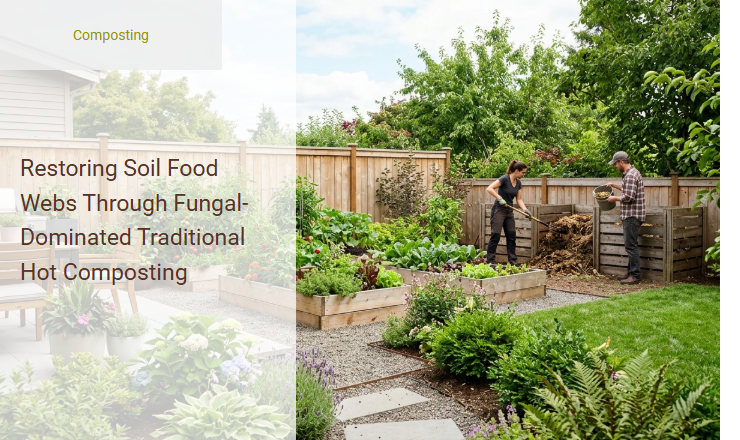
Many professional growers struggle with compacted, lifeless soils that demand increasingly expensive synthetic inputs just to maintain baseline crop yields. While traditional organic amendments are frequently proposed as a remedy, standard high-turnover composting methods typically yield bacteria-dominant matter that fails to rebuild the complex subterranean biology crops require to thrive.
Transitioning to fungal-dominated hot composting offers a definitive solution, granting land managers self-sustaining soil fertility and a drastic reduction in annual input costs. However, successfully restoring a depleted soil food web requires a shift in expectations; this is a precise biochemical process rather than a passive waste-disposal pile, demanding strict monitoring of moisture and aeration.
By utilizing specific feedstocks-such as a 4:1 ratio of woody carbon to nitrogenous green waste-and maintaining thermal phases between 135°F and 160°F, you actively cultivate beneficial saprophytic fungi and predatory nematodes while eliminating pathogens. This article will outline the science of fungal propagation, step-by-step pile formulation, and critical monitoring protocols.
Read also: Static Pile vs Turned Pile for Labor Saving
The Invisible Engine: Understanding the Soil Food Web
Beneath our feet lies a complex, highly coordinated ecosystem known as the soil food web. This subterranean network of bacteria, fungi, protozoa, nematodes, and microarthropods functions as the biological engine of terrestrial life. In undisturbed natural habitats, this web cycles nutrients seamlessly, feeding plants in exchange for carbon-rich exudates. However, modern agricultural practices-characterized by intensive tillage, synthetic fertilizers, and chemical fungicides-have severely disrupted this delicate balance.
Among the hardest-hit organisms are mycorrhizal and saprophytic fungi. Mycorrhizal fungi form essential symbiotic relationships with plant roots, acting as an extended root system to access deep water and phosphorus reserves. Saprophytic fungi serve as nature's primary decomposers, breaking down complex lignified organic matter to build stable humus. The depletion of these fungal communities in modern agricultural soils leaves the ground compacted, structurally weak, and dependent on artificial inputs. Restoring these critical fungal pathways is not merely an option but a necessity for true soil regeneration.
Fungal vs. Bacterial Soils: The Ecological Succession Spectrum
Soils exist on a biological spectrum that correlates directly with ecological succession. Disturbed or early-successional soils are heavily dominated by bacteria. These bacterial-dominated soils tend to have alkaline to neutral pH levels and cycle nitrogen rapidly into nitrates, which favors fast-growing weed species. Conversely, late-successional forest soils are dominated by fungi, creating acidic to neutral conditions where nitrogen is stored as ammonium, a form preferred by woody perennials and mature plants.
Understanding the target Fungal-to-Bacterial (F:B) ratio is essential for matching soil biology to specific crop groups:
- Weeds and Brassicas (F:B 0.1:1): Thrive in highly bacterial soils with high nitrate levels.
- Vegetables and Row Crops (F:B 1:1): Prefer a balanced ratio of bacteria and fungi, requiring an even mix of ammonium and nitrate.
- Shrubs, Vines, and Fruit Trees (F:B 5:1 to 100:1): Require strongly fungal-dominated soils where ammonium is the predominant form of nitrogen.
Designing the Recipe: High-Carbon Inputs for Fungal Dominance
To cultivate a compost pile that actively favors fungal development, we must modify the standard carbon-to-nitrogen (C:N) ratio. While bacterial composts thrive on a low C:N ratio of 25:1 or 30:1, a fungal-dominated pile requires a much higher starting ratio of 40:1 or 50:1. This is achieved by feeding the pile highly lignified materials that bacteria struggle to digest, but which serve as the ideal food source for saprophytic fungi.
| Material Type | Primary Function | Estimated C:N Ratio |
|---|---|---|
| Hardwood Wood Chips | Provides structural aeration and long-term lignin food source | 400:1 to 700:1 |
| Clean Sawdust | Fills small gaps, offering dense surface area for mycelial colonization | 325:1 to 500:1 |
| Dry Wheat/Oat Straw | Easy-to-digest carbon that builds immediate pile volume | 80:1 |
| Alfalfa Meal / Green Waste | Acts as the nitrogen catalyst to kickstart biological activity | 15:1 to 20:1 |
The Biological Spark: Inoculating Your Pile with Native Mycelium
While high-carbon ingredients provide the necessary fuel, we must also introduce the correct biology to ignite the decomposition process. Rather than relying on commercial, lab-grown strains that may not adapt to your local microclimate, the most effective approach is to harvest native, locally adapted fungal spores and active mycelium from healthy local forest floors.
"By sourcing diverse, wild strains of indigenous decomposers from nearby old-growth forests, you introduce organisms that are already structurally adapted to your local temperatures, rainfall patterns, and native plant exudates."
To responsibly gather this inoculum, gently peel back the leaf litter layer on a healthy forest floor to locate active, white mycelial mats growing on decomposing wood. Take only small, palm-sized handfuls from multiple locations to avoid disrupting the forest floor. Blend this gathered material directly into your compost recipe during the initial building stage to distribute the wild fungal strains evenly throughout the pile.
Constructing the Pile: Layering for Aeration and Moisture
Constructing a fungal-dominated compost pile requires a physical layout that balances moisture retention with oxygen access, ensuring fragile fungal hyphae can expand without being crushed or suffocated by compaction.
- Establish a coarse base: Lay down a 6-inch layer of thick, woody brush or branches at the bottom of the pile to allow passive air entry from below.
- Integrate passive aeration chimney pipes: Insert vertical, perforated PVC pipes into the center of your footprint before building upward, allowing heat and carbon dioxide to escape while drawing oxygen deep into the core.
- Apply the high-carbon layers: Alternate 4-inch layers of wood chips, sawdust, and straw with thin, 1-inch layers of green nitrogenous materials and your native forest inoculant.
- Moisten as you build: Spray water on each layer individually; the materials should feel like a wrung-out sponge, releasing only a few drops of water when firmly squeezed.
- Top off with a protective skin: Cover the entire completed pile with a 4-inch layer of straw or wood chips to protect the inner fungal networks from drying out and from UV damage.
Navigating the Heat: Managing the Thermophilic Phase without Killing Fungi
While thermophilic (hot) composting is vital for killing weed seeds and neutralizing potential human pathogens, excessive heat can destroy the very fungal networks we are trying to propagate. Active vegetative fungi begin to die off at temperatures above 135°F (57°C).
During the initial phase, keep a close watch on your compost thermometer. Let the pile reach the regulatory threshold of 131°F (55°C) to 140°F (60°C) for a minimum of three consecutive days to ensure sanitation. However, do not allow the temperature to climb past 145°F (63°C).
The Curing Phase: Where the Fungal Magic Happens
The true transformation of our high-carbon pile occurs during the extended, cool curing phase, which should last anywhere from three to twelve months. As the high-temperature thermophilic bacteria exhaust their simple food sources and the temperature drops below 100°F (38°C), specialized actinomycetes and diverse saprophytic fungi initiate a massive colonization of the stabilized organic matter.
During these quiet months, the pile must remain completely undisturbed. Turning the pile during this phase would physically shear and destroy the delicate, expanding web of fungal hyphae. This long, undisturbed curing period allows the fungi to break down tough lignified structures, converting them into highly stable humic substances that will persist in agricultural soils for decades.
From Pile to Pasture: Application Methods for Fungal Compost
Once your compost has cured into a dark, rich, woodsy-smelling humus, it is ready to be applied to degraded agricultural soils. Because fungal hyphae are physically delicate, application methods must be chosen carefully to avoid destroying the biology.
- Direct Top-Dressing: Spread a 1/4-inch to 1/2-inch layer of cured compost directly onto pasture or crop surfaces, allowing rain to wash the organic matter into the soil profile naturally.
- Root Zone Incorporation: Place a small handful of compost directly into the planting hole during transplanting, ensuring the beneficial fungi make immediate contact with the emerging root system.
- Non-Aerated Fungal Extracts: Gently steep the compost in clean, chlorine-free water for 12 to 24 hours without vigorous bubbling, producing a liquid drench rich in fungal spores and humic compounds that can be sprayed directly onto compacted soils.
Monitoring Progress: Microscope Analysis and Soil Indicators
To verify the biological quality of your compost, it is highly recommended to perform regular biological assessments using a compound light microscope at 400x magnification.

Look specifically for wide-diameter, highly septate, and deeply colored hyphae (golden-brown, dark brown, or black), which signal the presence of beneficial humifying fungi. Beyond microscopy, you can monitor biological progress in the field by testing soil aggregate stability-healthy fungal soils form stable crumbs held together by glomalin. Keep an eye out for indicator plants as well; a reduction in annual weeds and an increase in perennial grasses signal that the F:B ratio is successfully shifting.
Regeneration Realized: The Long-Term Impact of Fungal Restoration
Rebuilding fungal-dominated communities within our soils delivers massive, compounding ecological benefits that extend far beyond simple plant nutrition. Soils rich in fungal hyphae develop a highly resilient, porous structure that drastically improves water infiltration, moisture retention, and drought resistance. These biologically active systems naturally suppress crop diseases, making the farm far less reliant on synthetic chemical inputs.
Fungal-rich networks act as highly efficient carbon sinks, transforming unstable carbon compounds into stable, long-lasting soil humus. Cultivating a thriving fungal community creates a vibrant, self-healing, and self-sustaining ecosystem capable of yielding highly nutrient-dense crops for generations to come.
Summary
The article "Restoring Soil Food Webs Through Fungal-Dominated Traditional Hot Composting" highlights the critical role of soil biology in sustainable agriculture. Modern farming has severely degraded soil food webs, particularly depleting essential fungal networks. To address this, the text explains how traditional thermophilic (hot) composting can be scientifically optimized to favor fungal growth over bacterial dominance.
By carefully adjusting the carbon-to-nitrogen ratio with high-carbon woody materials, and precisely managing temperature and moisture, practitioners can produce compost rich in beneficial fungi. When applied, this specialized compost reintroduces vital fungal spores and hyphae to degraded land. This process successfully restores the soil food web, which in turn enhances nutrient cycling, improves soil structure and water retention, and sequesters carbon. Ultimately, fostering fungal-dominated soils allows farmers to decrease their reliance on synthetic fertilizers while building highly resilient, productive agricultural ecosystems.
Leave a comment