
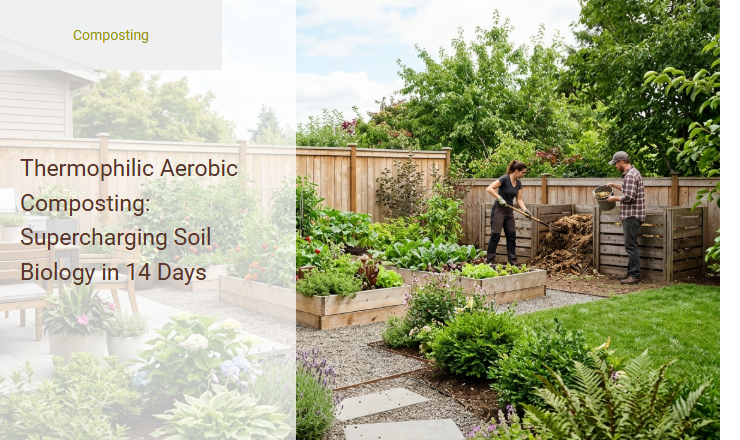
Gardeners and commercial growers alike often face the frustrating reality of sluggish soil regeneration, waiting six months or more for traditional compost piles to break down. While passive cold composting is the standard, it frequently fails to destroy pathogens or weed seeds, leaving growers with substandard soil amendments.
Thermophilic aerobic composting solves this by granting growers the ability to unlock highly active, disease-suppressing microbial communities in just 14 days. However, achieving this rapid transformation requires a commitment to precise moisture management and strict thermal monitoring to sustain temperatures between 135°F and 160°F.
By balancing specific feedstocks-such as nitrogen-rich poultry manure with carbon-heavy wheat straw and wood chips-you initiate a rapid biological heat cycle. This guide will detail the thermodynamic phases, optimal carbon-to-nitrogen ratios, and aeration schedules needed to master this accelerated biological process.
Read also: Tumblers vs Bins for Backyard Composting
The 14-Day Miracle: Unleashing Thermophilic Composting
Traditional composting is a slow, passive process that can take up to a year to produce usable soil. In contrast, thermophilic aerobic composting accelerates this timeline into a rapid 14-day cycle. By cultivating the ideal environment for heat-loving microorganisms, this active method generates intense biological activity that processes organic matter at a blazing pace. Rather than waiting months for decomposition, you can cultivate a process that supercharges soil biology, transforms garden waste rapidly, and yields nutrient-rich, pathogen-free compost in a fraction of the time.
Meet the Microbes: The Science of Heat-Loving Bacteria
As organic materials are piled together, the decomposition process begins with mesophilic bacteria, which thrive in moderate temperatures up to 104°F. However, as these initial microbes consume easy-to-digest sugars and generate metabolic heat, the interior temperature of the pile rises. Once the environment climbs past 113°F, a biological shift occurs, and thermophilic bacteria take over the colony. These heat-loving organisms thrive in extreme heat, accelerating the biological breakdown of more complex organic structures.
- Bacillus subtilis - Highly active in breaking down complex carbohydrates and proteins.
- Thermus species - Extremely heat-tolerant bacteria that thrive at the peak temperature of the cycle.
- Actinobacteria - Filamentous bacteria that specialize in decomposing tough cellulose, lignin, and chitin.
The Golden Ratio: Balancing Carbon and Nitrogen
To keep thermophilic bacteria fueled and actively reproducing, you must provide them with the perfect balance of food. This is achieved by targetting a 30:1 Carbon-to-Nitrogen (C:N) ratio. Carbon-rich materials, or "browns," provide the energy source for the microbes, while nitrogen-rich materials, or "greens," supply the raw protein building blocks required for rapid cellular division and population growth.
| Material Type | Examples | Primary Function |
|---|---|---|
| Nitrogen-Rich (Greens) | Fresh grass clippings, kitchen scraps, manure, green garden waste | Fueling microbial reproduction and generating initial heat |
| Carbon-Rich (Browns) | Dry leaves, straw, wood chips, shredded cardboard | Providing energy, structural support, and maintaining aeration |
Constructing the Pile: Size and Structure Matter
For a thermophilic compost pile to successfully generate and retain its own heat, physical dimensions are incredibly critical. A pile that is too small will lose heat to the surrounding air faster than the microbes can produce it. To achieve the self-insulating thermal mass required for high-temperature composting, you must construct a pile with a minimum size of 3x3x3 feet (one cubic yard).
Building the pile involves alternating layers of greens and browns, watered thoroughly as you build. This deliberate structure ensures that moisture and nutrients are distributed evenly, giving the heat-loving bacteria immediate access to their food sources while preserving structural integrity.
Oxygen and Water: The Dual Life Support Systems
Thermophilic composting is a strictly aerobic process. Without a constant supply of oxygen, the pile will quickly turn anaerobic, shifting the microbial population to slow-moving, foul-smelling bacteria. Water is equally crucial, as microbes require a thin film of moisture to move, feed, and reproduce. The ideal moisture level is between 50% and 60%, which feels like a damp, wrung-out sponge.
"Aeration and moisture are the twin engines of the thermophilic process. Neglect either, and the heat-generating biological engine will stall instantly."
Regular physical turning introduces fresh oxygen into the core of the pile, while replenishing moisture during turning prevents the extreme heat from completely drying out the organic matter. This maintains optimal metabolic function throughout the active cycle.
Tracking the Heat: The Critical Temperature Phases
Monitoring the core temperature of your pile with a long-stem compost thermometer is the only way to verify that the thermophilic process is working correctly.
- The Mesophilic Phase (68°F to 113°F): The initial 24 to 48 hours where moderate-temperature bacteria kickstart the breakdown.
- The Thermophilic Phase (113°F to 160°F): The active biological window. You must maintain temperatures between 135°F and 160°F for several consecutive days.
- The Decline Phase (Below 113°F): The temperature begins to fall as the easily digestible food sources are exhausted.
It is vital to monitor the upper limit of the thermophilic phase. If temperatures climb above 160°F, you must turn the pile to cool it down, as excessive heat can kill off the beneficial microbes and stall the entire decomposition cycle.
The Berkeley Method: A 14-Day Turning Schedule
Developed by the University of California, Berkeley, this highly structured turning method maximizes oxygenation and heat distribution, compressing the composting process into exactly two weeks. By adhering to a strict schedule, you ensure that every part of the pile spends time in the high-heat center core.
| Day of Cycle | Required Action | What is Happening |
|---|---|---|
| Days 1 to 4 | Do Not Turn | The pile is left alone to build up heat and transition to the thermophilic phase. |
| Day 4 | First Turn | Move the outside materials to the inside core and water if dry to redistribute microbes. |
| Days 6, 8, 10, 12 | Turn Every 2 Days | Keep turning the pile every other day to sustain peak oxygen levels and prevent overheating. |
| Day 14 | Harvest | The pile has cooled down, turned rich brown, and is ready for use or a brief cure. |
Sterilization in Action: Eliminating Pathogens and Weed Seeds
One of the greatest advantages of thermophilic composting is its ability to sanitize your garden inputs naturally. Traditional cold composting methods fail to reach the temperatures required to neutralize biological threats, meaning weed seeds and plant diseases can survive and spread when the compost is applied.
By keeping the core temperature of the pile above 131°F for a minimum of 3 to 15 days, you create an environment that is lethal to pathogens like Salmonella and E. coli. This sustained heat also breaks down the protective coatings of weed seeds, rendering them sterile and incapable of germinating in your garden beds.
Curing and Stabilization: The Crucial Final Transition
Once the active 14-day turning cycle is complete, the temperature of the pile will permanently drop. Although the material may look like finished compost, it must undergo a brief curing and stabilization phase before it is safe to apply directly to sensitive plant roots.
This final step stabilizes the organic compounds, ensuring that the compost will not rob your soil of nitrogen when applied. The raw, energetic compounds are transformed into a mature, stable, and incredibly rich humus.
Supercharged Soil: Applying Your Microbial Gold
Your finished 14-day compost is a biological powerhouse, ready to transform your garden beds. Because it was created through high-heat aerobic processes, it is packed with a highly diverse community of active, beneficial microorganisms that will immediately colonize your soil.
- Improves Soil Structure: Helps bind sandy soils and opens up passages in heavy clay.
- Boosts Nutrient Delivery: Microbes convert organic elements into plant-available nutrients.
- Enhances Disease Resistance: Beneficial bacteria suppress harmful soil-borne pathogens.
Apply a one-to-two-inch layer of this microbial gold directly to the surface of your garden beds as a top dressing, or gently scratch it into the root zone to give your plants an immediate, sustained biological upgrade.
Summary
The article "Thermophilic Aerobic Composting: Supercharging Soil Biology in 14 Days" details a rapid, high-heat composting method-commonly known as the Berkeley method-that transforms raw organic matter into nutrient-rich humus in just two weeks. By maintaining an optimal carbon-to-nitrogen ratio of roughly 30:1, ensuring consistent moisture, and frequently turning the pile to introduce oxygen, composters fuel a population explosion of beneficial, heat-loving (thermophilic) microorganisms.
This intense biological activity drives internal pile temperatures to a critical 135–160°F (57–71°C). At these sustained high temperatures, weed seeds, plant pathogens, and larvae are effectively destroyed while organic materials rapidly decompose. The resulting premium compost is highly stable and teeming with diverse microbial life. Applying this active amendment immediately supercharges soil biology, enhances moisture retention, and provides crops with a diverse suite of bioavailable nutrients without the typical months-long wait.
Leave a comment