
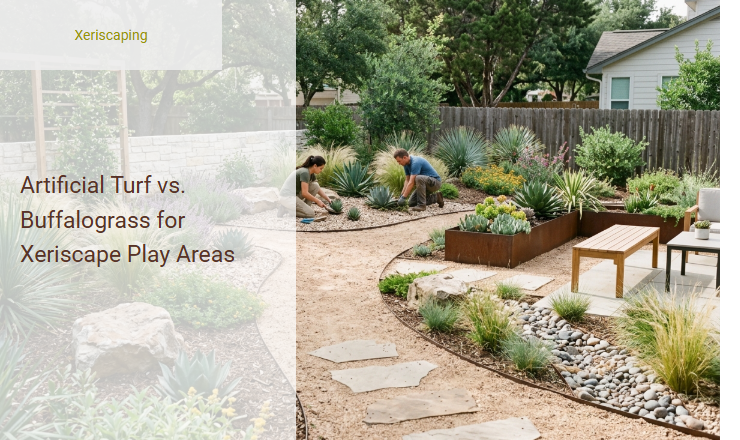
Homeowners and facility managers often struggle to maintain a soft, resilient play surface without draining their budgets on soaring water bills and constant weekend upkeep. As municipal water restrictions tighten across arid regions, traditional high-water lawns are no longer viable options for sustainable landscaping. Choosing the right xeriscape alternative grants property owners a durable, year-round play space while significantly slashing irrigation costs.
However, it is vital to establish a realistic stipulation: "low-water" or "synthetic" does not mean entirely zero-maintenance, as both materials require distinct care regimes. For instance, while artificial turf with a 30-inch-per-hour drainage capacity handles heavy traffic effortlessly, native Buffalograss cultivars like 'Legacy' offer a living, self-healing turf that thrives on minimal seasonal watering.
This article compares artificial turf and Buffalograss across key performance metrics, including installation costs, heat retention, safety, and long-term environmental impact, to help you choose the ideal surface for your project.
Introduction: The Play Area Dilemma in Xeriscaping
Designing a low-water landscape often feels like a balancing act, especially for families with active children and pets. Traditional high-water lawns are no longer viable in arid regions, prompting many homeowners to transition to xeriscaping. However, a purely rock-and-succulent garden lacks a soft, resilient surface for tag, soccer, or playground equipment. To resolve this tension, two major contenders have emerged for play-friendly zones: artificial turf and buffalograss. Each offers a unique way to conserve water while preserving a functional play space, but they represent entirely different philosophies of modern landscaping.
Artificial Turf: The Low-Maintenance Modern Alternative
Artificial turf has rapidly evolved from the abrasive plastic grass of the past into a highly sophisticated, multi-layered synthetic surfacing option. Composed of polyethylene, polypropylene, or nylon fibers tufted into a backing material, modern turf mimics the look and feel of real grass blades. It is engineered specifically for immediate, high-intensity usability without the need for establishment periods.
For modern, low-water play zones, synthetic grass offers several distinct advantages:
- Zero Water Required for Growth: Aside from occasional rinsing to clean off dust or pet waste, artificial turf requires no irrigation.
- Instant Usability: Once installed, children can run, jump, and play on the surface immediately without waiting for seeds to sprout or sod to root.
- Mud-Free Play: Even after rare, heavy downpours, the backing and infill drain quickly, preventing muddy footprints from entering the home.
Buffalograss: The Eco-Friendly Native Turfgrass
On the opposite side of the spectrum lies buffalograss, a native warm-season turfgrass that has carpeted the North American Great Plains for millennia. Unlike thirstier cool-season grasses, buffalograss has evolved deep root systems-sometimes reaching up to eight feet deep-making it incredibly drought-tolerant and resilient in dry climates.
This low-water living alternative stands out for several reasons:
- Minimal Water Requirements: Once established, it can survive on natural rainfall alone in many regions, needing only minimal supplemental irrigation during severe droughts.
- Low-Growing Nature: It naturally stops growing at a height of about four to six inches, meaning it requires very little mowing to look neat.
- Drought-Induced Dormancy: It possesses a natural survival mechanism that allows it to go dormant and survive prolonged dry spells without dying.
Visual Appeal: Evergreen Perfection vs. Natural Seasonal Transitions
The Year-Round Flawless Look of Synthetic Turf
Artificial turf offers an unyielding, pristine green aesthetic that remains completely unchanged regardless of the weather. Rain, snow, intense heat, or prolonged drought will not fade its color. For homeowners who prioritize a manicured, emerald-green lawn 365 days a year, synthetic turf delivers a consistent visual backdrop that never looks patchy, weed-infested, or dry.
The Dynamic, Organic Cycle of Native Buffalograss
In contrast, buffalograss embraces the natural rhythm of the seasons. During its active growing season in late spring and summer, it displays a soft, blue-green hue that blends beautifully into a native xeriscape design. When the first hard frost arrives in autumn, the grass transitions to a warm, straw-colored dormant brown, remaining inactive until the soil warms again in the spring. This seasonal transition offers a more organic, dynamic aesthetic that shifts naturally with the environment.
Upfront Investment: Installation and Establishment Costs
The initial financial commitment and physical labor required for these two options differ significantly. Artificial turf demands a high up-front cost due to synthetic material manufacturing and intensive professional site preparation, including grading, base-rock installation, compaction, and turf laying. Buffalograss, on the other hand, is established through seeding, plugging, or sodding, which incurs lower material costs but requires patience during the establishment phase.
| Cost Factor | Artificial Turf | Buffalograss |
|---|---|---|
| Material Costs | High (Synthetic rolls, infill, weed barriers) | Low to Moderate (Seed, plugs, or live sod) |
| Installation Labor | Extensive (Professional excavation and grading) | Moderate (Soil prep, seeding, and initial watering) |
| Time to Usability | Immediate (Ready for play on day one) | Gradual (Weeks to months for strong roots) |
Ongoing Maintenance: Mowing and Irrigation Needs
While artificial turf requires a massive upfront investment, its long-term maintenance is exceptionally low. Homeowners can virtually eliminate watering and mowing from their weekly chores. It only requires occasional leaf blowing to remove organic debris, grooming with a stiff brush to keep the fibers standing upright, and rinsing to manage pet odors.
Buffalograss requires slightly more active care, though it remains a fraction of the work demanded by traditional lawns. Homeowners must provide occasional deep irrigation during peak summer heat to maintain a green color, along with periodic mowing every few weeks if a manicured look is preferred. However, many choose to leave it unmowed, allowing it to form a soft, waving meadow that requires zero mowing whatsoever.
Durability: Withstanding Heavy Foot Traffic and Active Play
Play spaces must withstand high-impact activities, including children running, pets chasing toys, and heavy backyard play equipment. Synthetic turf is built for resilience, utilizing heavy-duty fibers designed to bounce back after weight pressure. It does not suffer from wear patches, bare dirt spots, or yellowing pet urine stains, making it highly durable for continuous heavy traffic.
Because synthetic turf lacks living tissue, it cannot heal itself; if a sharp object punctures the backing or a section is melted by reflected sunlight, it requires physical patching rather than natural recovery.
Buffalograss handles moderate foot traffic incredibly well due to its dense, sod-forming stolons. It is highly resilient against pet activity, though concentrated, repeated traffic in a single path can cause wear over time. Unlike synthetic alternatives, however, buffalograss is a living organism that possesses the natural ability to self-heal and regrow over damaged areas once traffic subsides.
Safety and Comfort: Heat Retention and Fall Cushioning
Thermal Safety and Heat Absorption
One of the most critical considerations for sunny, arid climates is how the play surface handles heat. Synthetic turf absorbs solar radiation intensely, and on hot summer days, its surface temperature can rise to levels that are uncomfortable or even unsafe for bare feet and paws. Shading, lighter infill options, or frequent water spraying can mitigate this, but thermal retention remains a notable drawback.
Natural Cooling and Fall Protection
Buffalograss excels at temperature regulation. Because it is a living plant that undergoes transpiration, it remains cool to the touch even in the heat of July, creating a naturally pleasant playing environment. While synthetic turf can be installed over shock pads to provide superior cushioning for high playground falls, buffalograss provides a soft, forgiving natural surface that is gentle on bare skin during everyday play.
Environmental Impact: Carbon Footprint and Biodiversity
The environmental choices behind these two surfaces reflect contrasting ecological paths. Artificial turf is a petroleum-based product that contributes to plastic waste at the end of its lifespan, which usually occurs after ten to fifteen years. It also exacerbates the local heat-island effect, radiates heat back into the surrounding air, and does not support local biological life.
Buffalograss acts as a functional ecological asset within a xeriscaped yard. It captures and stores carbon dioxide, releases oxygen, and cools the immediate microclimate through transpiration. Furthermore, its root system prevents soil erosion and filters rainwater runoff, while its natural pollen and seed heads support local beneficial insects, birds, and pollinators, enhancing biodiversity.
Conclusion: Choosing the Right Surface for Your Family
Deciding between synthetic turf and a native grass lawn depends on a family's unique priorities. Families who require immediate, year-round usability, have very high-traffic pets, and prefer to avoid mowing entirely will find artificial turf to be a highly convenient and visual-pleasing solution. It solves the play area dilemma by removing the maintenance chores associated with living lawns.
Conversely, those who prioritize ecological sustainability, a naturally cool playing surface, lower initial costs, and a dynamic, seasonal look will find buffalograss to be the ideal native alternative. By selecting the surface that aligns with your regional climate, childhood play needs, and maintenance desires, you can design a beautiful, water-wise yard that serves your family for years to come.
| Feature | Artificial Turf | Buffalograss |
|---|---|---|
| Water Requirement | Zero irrigation (requires occasional spraying to clean or cool). | Very low (requires 50–75% less water than standard turfgrass). |
| Durability & Traffic | Extreme durability; withstands heavy, continuous play without wear. | Moderate durability; tolerates light-to-medium play; slow to recover from damage. |
| Surface Temperature | Absorbs heat; can become dangerously hot (up to 150°F) in direct sun. | Naturally cool; transpires moisture to maintain safe touch temperatures. |
| Maintenance Needs | Low; requires debris blowing, infill grooming, and pet waste sanitization. | Low-to-moderate; requires minimal mowing (2-3 times/year) and weeding. |
| Lifespan & Ecology | 10–15 years; synthetic waste destined for landfills at end of life. | Perennial (permanent); native plant that supports local biodiversity. |
| Upfront Cost | High (materials, excavation, sub-base preparation, professional installation). | Low-to-moderate (seeding, plugging, or sodding). |
Leave a comment