
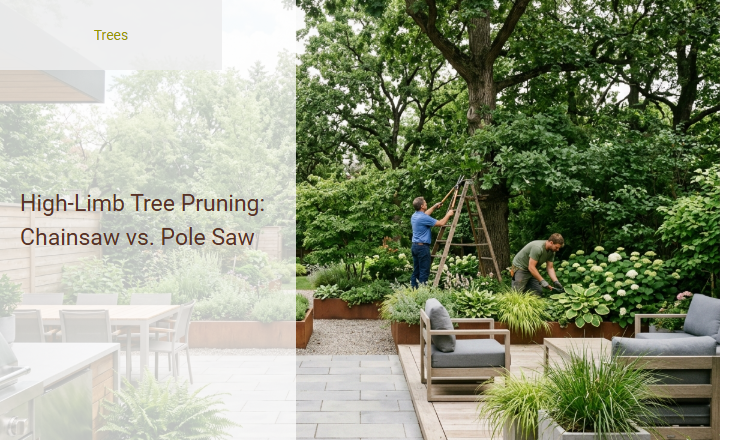
Tending to mature trees often leaves property owners facing a precarious dilemma: how to safely and effectively prune high-reaching limbs without risking severe injury or damaging the canopy. Before scaling a ladder or investing in expensive gear, establishing a clear understanding of overhead cutting dynamics is essential. Mastering the distinction between your tooling options grants you the ability to execute clean, disease-preventing cuts independently, ultimately saving thousands of dollars in professional arborist fees.
To set realistic expectations, we must stipulate that tool selection is not one-size-fits-all; safety thresholds and tool efficiency vary wildly based on limb thickness and user experience. For example, while a lightweight telescoping pole saw is ideal for safely clearing 2-inch oak lateral branches from the ground, a heavy-duty chainsaw remains the standard for bucking dense, 6-inch maple limbs.
This comparative analysis evaluates chainsaws and pole saws across reach, cutting capacity, safety, and physical strain to help you select the optimal tool for your property maintenance needs.
Introduction to High-Limb Tree Pruning Challenges
Maintaining the structural integrity and aesthetic appeal of mature trees often requires navigating the demanding task of high-limb pruning. Removing dead, diseased, or overgrown branches at elevated heights is not merely a matter of curb appeal; it is a vital practice for tree health and property protection. However, working high above the ground introduces significant challenges, turning routine yard work into a complex undertaking where safety and efficiency must be prioritized.
When faced with limbs hanging far overhead, homeowners and landscapers face a critical tool selection dilemma: the traditional chainsaw versus the specialized pole saw. While one offers raw power and versatility, the other is engineered specifically to overcome the physical limitations of height. Choosing the right tool determines not only how quickly the job gets done, but also how safely the operator returns to the ground.
Defining the Competitors: Chainsaw vs. Pole Saw
To make an informed choice, one must understand what makes each tool distinct. A chainsaw is a portable, motorized saw that cuts with a set of teeth attached to a rotating chain run along a guide bar, designed primarily for heavy-duty timber cutting, felling, and bucking at waist or ground level. It provides immense cutting power but requires two hands on the body of the tool, limiting its safe vertical reach.
In contrast, a pole saw is a specialized pruning instrument featuring a smaller chainsaw-like cutting head mounted to the end of an elongated, often telescoping shaft. This design allows the operator to stand firmly on the ground while the cutting apparatus reaches high into the canopy, specifically targeting hard-to-reach individual branches without requiring the user to ascend the tree.
Reach and Accessibility: Getting to the High Branches
Reach is the most obvious differentiator when tackling high-altitude limbs. A pole saw acts as an extension of the operator's arms, with many models telescoping from 8 to 15 feet. This design allows individuals to easily access branches up to 20 feet overhead while keeping their feet planted firmly on solid ground. This ground-based reach eliminates the physical exertion of climbing and keeps the operator out of the immediate fall zone of the cut debris.
A standard chainsaw, possessing no built-in extension, relies on the user to close the distance to the branch. To cut high limbs with a chainsaw, an operator must ascend using ladders, climbing harnesses, or bucket lifts. This requirement adds significant preparation time, physical strain, and complexity to what might otherwise be a straightforward pruning job.
Safety Analysis: Minimizing Risks at Heights
Operating cutting machinery always carries inherent risk, but working at heights compounds these dangers exponentially. The physical dynamics of kickback, falling wood, and operator balance shift dramatically depending on the tool selected.
- Chainsaw Safety: Requires absolute stability, a clear escape path, and two-handed control at waist level to manage sudden kickback forces. Using it overhead or on unstable platforms bypasses these fundamental safety protocols.
- Pole Saw Safety: Keeps the operator on the ground, but demands careful positioning to avoid falling branches. Users must wear helmets and safety glasses, standing at an angle to the cut rather than directly underneath the limb.
- Footing and Control: A pole saw allows the operator to maintain a stable, wide stance on flat ground, whereas a chainsaw at height often forces the operator into awkward, unbalanced positions.
Power and Cutting Capacity: Dealing with Thick Wood
When it comes to raw cutting capacity, the standard chainsaw reigns supreme. Powered by high-displacement gas engines or high-voltage battery systems, chainsaws utilize long guide bars (often 14 to 24 inches or more) and heavy-duty chains. This construction enables them to chew through thick hardwoods and massive limbs measuring over a foot in diameter with minimal resistance.
Pole saws, by necessity of their design, feature smaller, lighter motors and shorter guide bars, typically ranging from 8 to 10 inches. This limits their cutting capacity to branches under 8 inches in diameter. Attempting to cut thick, heavy limbs with a pole saw can result in the motor stalling, the chain binding in the cut, or the long shaft bending under the extreme weight.
Precision, Control, and Cut Quality
Good pruning is an art that respects tree biology. To ensure quick healing and prevent decay, cuts must be made precisely outside the branch collar-the swollen area where the branch meets the trunk. Making a clean, flush cut without tearing the bark is crucial for the tree's long-term health.
A chainsaw provides excellent close-up control, allowing the operator to see the exact angle of the cut and apply precise pressure. However, maneuvering a heavy chainsaw around tight branch unions at height can be clumsy. A pole saw offers the leverage to reach tight spots, but the distance between the operator's hands and the cutting head can reduce tactile feedback. This distance makes it harder to execute advanced techniques, such as the three-cut method, without practice, occasionally leading to bark stripping if the tool is allowed to bounce.
Ergonomics and Physical Fatigue
The physical toll of tree care is frequently underestimated. Holding any tool for extended periods causes muscle fatigue, which directly degrades operating safety and precision.
Operating a chainsaw requires lifting its heavy engine block and bar, often weighing between 10 and 15 pounds, and keeping it close to the body. While heavy, the weight is kept near the operator's center of gravity. A pole saw may weigh less overall (often 7 to 12 pounds), but because that weight is suspended at the end of a long pole, the leverage multiplies the perceived weight. Holding a pole saw overhead forces the shoulders, back, and arms to work continuously against gravity, leading to rapid physical fatigue during extended sessions.
| Tool Type | Average Weight | Leverage Strain | Primary Fatigue Points |
|---|---|---|---|
| Standard Chainsaw | 10 - 16 lbs | Low (kept close to body) | Lower back, forearms |
| Telescoping Pole Saw | 7 - 13 lbs | High (weight at end of pole) | Shoulders, upper back, neck |
Maintenance and Long-Term Costs
Both tools require ongoing maintenance to remain safe and operational, but their mechanical configurations yield different long-term cost structures. Whether you opt for gas, corded electric, or lithium-ion battery power, keeping the chain sharp and oiled is paramount.
| Tool & Power Type | Key Maintenance Tasks | Long-Term Cost Profile |
|---|---|---|
| Gas Chainsaw / Pole Saw | Spark plugs, fuel mixing, air filters, carburetor tuning, chain sharpening. | Moderate to High (fuel, oil, engine parts wear over time). |
| Battery Chainsaw / Pole Saw | Battery health checks, bar oil replenishment, chain sharpening. | Low maintenance, high upfront cost (battery replacements eventually needed). |
| Electric (Corded) Pole Saw | Bar oil replenishment, cord integrity inspection, chain sharpening. | Very Low (minimal moving parts, no fuel or batteries to buy). |
Choosing Your Tool: Scenario-Based Recommendations
The decision of which tool to buy or rent should be driven by the specific parameters of your property and the scale of your project. Below are common scenarios to guide your choice.
- Scenario 1: Routine maintenance of ornamental and fruit trees
- Use a pole saw. These tasks involve cutting branches under 4 inches in diameter at heights up to 15 feet. A pole saw offers the reach and safety required to shape these trees quickly from the ground.
- Scenario 2: Clearing heavy storm damage and fallen trunks
- Use a chainsaw. Heavy storm debris consists of large, tangled, fallen limbs and compromised trunks resting on the ground or leaning at low angles. The cutting speed and raw power of a chainsaw are necessary to process this thick wood safely.
- Scenario 3: Removing high, dead oak limbs overhanging a roof
- Use a pole saw for smaller, accessible limbs. For larger limbs exceeding 8 inches in diameter overhanging structural property, do not attempt to use either tool yourself. These complex scenarios require the expertise of a professional arborist with rigging equipment.
Conclusion: Elevating Your Tree Care Strategy
When managing mature trees, matching the right tool to the height and thickness of the wood is the cornerstone of responsible property maintenance. The standard chainsaw remains an unrivaled powerhouse for ground-level clearing and tackling large-diameter trunks. However, when the work shifts into the canopy, the specialized engineering of the pole saw provides an indispensable layer of protection by keeping your feet on the ground.
By assessing the diameter of your target branches and honestly evaluating your comfort level with heights, you can cultivate a beautiful, healthy canopy without putting yourself in harm's way. Prioritizing personal safety over raw speed ensures that your property maintenance remains a rewarding, accident-free endeavor.
| Feature | Chainsaw (For High Limbs) | Pole Saw (For High Limbs) |
|---|---|---|
| Reach & Elevation | Limited to operator arm-span; requires ladder, bucket truck, or climbing. | Extended reach (8 to 15+ ft); operated safely from ground level. |
| Cutting Capacity | Heavy-duty power; easily cuts thick branches and trunks >6 inches. | Light-to-medium power; optimized for small-to-medium branches <6 inches. |
| Safety Profile | High risk; danger of falls, one-handed operation, and overhead kickback. | Moderate risk; main hazard is falling debris; operator remains grounded. |
| Tool Weight & Control | Heavy (10–15 lbs); requires close-range, two-handed physical control. | Lightweight (7–12 lbs) but top-heavy; leverage increases fatigue at full extension. |
| Best Use Case | Felling, bucking fallen trees, and professional-grade aerial rigging. | Routine pruning, thinning high canopies, and basic yard maintenance. |

Leave a comment