
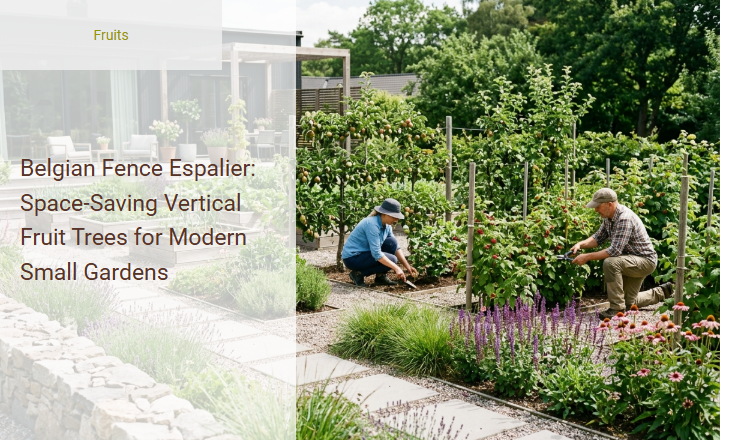
Many urban gardeners dream of harvesting fresh, home-grown fruit but find themselves restricted by the realities of limited outdoor space. Traditional, sprawling fruit trees demand a footprint that modern residential yards and paved courtyards simply cannot accommodate.
To bridge the gap between suburban spatial constraints and agricultural ambition, horticulturists have long turned to intensive training techniques. The Belgian fence espalier is a premier solution, a living lattice that grants growers both high-yield fruit production and a striking, sculptural focal point along bare walls or property lines.
While this method yields spectacular results with pome fruits like apples and pears, it does require a foundational commitment to patient training and precise, bi-annual pruning to maintain its signature diamond lattice.
This guide will detail the essential steps to design, plant, and maintain your own Belgian fence, transforming a flat boundary into a highly productive vertical orchard.
Read also: Espalier vs Standard Pruning for Pear Trees
Introduction to the Belgian Fence Espalier
The Belgian Fence espalier is a breathtaking fusion of horticulture and architectural design. Originating in Europe centuries ago, this classic technique involves training fruit trees along a flat, two-dimensional plane to form a living, diamond-patterned lattice. It has transitioned from historic walled estate gardens to modern backyards, where it offers an elegant solution to spatial limitations.
For the contemporary gardener working with limited acreage, maximizing vertical space is key. The Belgian Fence turns a plain wall, fence, or boundary line into a productive, ornamental feature. This method not only showcases the *sculptural beauty* of deciduous trees throughout the seasons but also yields a bountiful harvest in areas where standard orchards could never fit.
Choosing the Best Fruit Trees for Your Lattice
Success with a Belgian Fence begins with selecting the correct tree species and rootstocks. Pome fruits are the traditional favorites because their pliable wood and spur-bearing growth habits lend themselves perfectly to intensive training.
When selecting your plants, keep the following guidelines in mind:
- Apples and Pears: These species are highly responsive to pruning and produce abundant fruit on long-lived spurs.
- Dwarf or Semi-Dwarf Rootstocks: Choosing trees grafted onto dwarfing rootstocks is essential to control vigor and keep the lattice manageable.
- Self-Fertile Cultivars: If space only allows for a small fence, select self-fertile varieties to ensure pollination without needing multiple companion trees nearby.
Designing Your Espalier Lattice Grid
Before any digging begins, careful planning is required to ensure the symmetry of your living wall. The hallmarks of a Belgian Fence are the perfect interlocking diamonds formed by adjacent trees crossing one another at exact angles.
Calculating Measurements and Spacing
To establish a balanced pattern, space your young trees precisely 18 to 24 inches apart along the planting line. This close spacing ensures that as the branches grow outward at opposing angles, they will cross each other at the ideal intervals to create the grid.
Plotting the 45-Degree Pattern
The core of this design is the *45-degree angle* at which each branch is trained. Using a physical guide, such as wooden battens or string lines tacked to your support frame, will help you visualize and maintain this precise angle as the shoots develop over the coming seasons.
Constructing a Sturdy Trellis Support System
Because fruit-heavy branches require significant structural support, a robust wire trellis is non-negotiable. This framework will hold the weight of the trees throughout their lifetime.
- Install heavy-duty wooden or metal end posts deeply into the ground, reinforcing them to withstand the tension of the wires.
- Run strong, galvanized steel horizontal wires across the posts, spacing them roughly 12 to 18 inches apart vertically.
- Attach turnbuckles or wire tensioners to each line to keep the wires taut and prevent sagging under the weight of growing wood.
Planting and Angling Your Young Trees
When it is time to plant, you can use either bare-root trees in late winter or container-grown specimens in early spring. Prepare a continuous planting trench along your trellis line, amending the soil to ensure excellent drainage and nutrient availability.
Place each tree directly beneath the vertical axis of your planned diamond grid. To kickstart the formal pattern, plant the trees so their main stems can easily be trained or angled. If using whips that already have two strong lateral branches, align these shoots directly with your 45-degree guide wires to establish the foundation of the lattice right from day one.
First-Year Training and the Vital 'Y' Cut
The first year is about establishing the initial split that forms the base of each diamond. This requires a brave cut that sets the course for all future growth.
Executing the Heading Cut
In late winter or early spring, cut the main vertical stem of each young whip back to a point roughly 18 inches above the ground. Ensure this cut is made just above *two healthy, active buds* pointing in opposite directions along the plane of the trellis.
Guiding the Lateral Branches
As these two buds break and grow during the spring, gently guide them outward to form a sharp "Y" shape. Tie these emerging shoots to your diagonal guide lines at a 45-degree angle, allowing them to extend while suppressing any unwanted vertical shoots that try to emerge from the trunk.
Weaving the Diamond Pattern in Year Two and Beyond
As the primary branches grow longer, they will begin to cross paths with branches coming from neighboring trees. This is where the mesmerizing lattice design truly comes to life.
Carefully overlap the crossing branches to weave a continuous diamond pattern. Where two branches intersect, secure them gently but firmly to the wire framework using soft plant ties. It is crucial to monitor these *intersections* regularly to ensure the ties do not constrict the expanding wood. Over time, the pressure of the crossing branches can cause them to graft naturally together, creating an incredibly strong, interlocking living fence.
Seasonal Maintenance: Summer and Winter Pruning
Maintaining the crisp lines of a Belgian Fence requires a two-phase pruning regime. Each season demands a different approach to balancing vegetation and fruit production.
Summer Pruning for Fruitfulness
Summer is the time to manage vegetative vigor. By pruning back new, leafy shoots to three or four leaves in mid-to-late summer, you redirect the tree's energy away from excessive growth.
- Encourages the formation of short, stubby fruit spurs.
- Allows sunlight to penetrate the foliage, ripening the fruit.
- Maintains the clean, geometric silhouette of the lattice.
Winter Pruning for Structural Clarity
Winter pruning is performed when the tree is dormant and the skeletal frame is fully visible. This is your opportunity to focus on structural integrity.
- Remove dead, diseased, or damaged wood.
- Cut back any wayward shoots that deviate from the 45-degree plane.
- Thin out congested fruiting spurs to ensure high-quality fruit in the coming season.
Overcoming Common Espalier Challenges
While highly rewarding, maintaining a structured living wall presents unique challenges that require proactive management to keep the trees healthy and productive.
- Managing Uneven Vigor: Sap naturally flows faster to the highest points of a tree. To balance growth, temporarily lower exceptionally vigorous branches to slow them down, or elevate weaker branches to encourage more rapid growth.
- Pest and Disease Management: Because the foliage is kept thin and open on a flat plane, air circulation is naturally excellent, which reduces fungal issues. However, stay vigilant for common pests like aphids or codling moths, which can easily be managed due to the easy accessibility of the branches.
- Preventing Bark Damage: Where branches cross and rub against each other, friction can cause open wounds that invite disease. Use flexible, soft ties at these junctions to keep them completely stable until they naturally graft together.
Harvesting the Fruits of Your Vertical Garden
The culmination of your planning, planting, and precise training is a magnificent, living architectural feature that pays off in both visual beauty and delicious rewards. Walking along your custom lattice in late summer and autumn, you will find the branches loaded with easily accessible, sun-drenched fruit that is simple to thin, protect, and harvest.
The Belgian Fence is a testament to what can be achieved when horticultural science meets creative design. By turning a flat boundary into a highly productive orchard, you create a garden feature that offers unparalleled beauty and structural utility for decades to come.
Summary
The Belgian fence espalier is a sophisticated and highly efficient gardening technique designed to maximize fruit production in modern, space-constrained gardens. This method involves training multiple young fruit trees-typically apples or pears-along a flat, multi-tiered trellis to form a striking, diamond-patterned living fence.
By growing vertically, these trees require only a fraction of the ground space needed for traditional orchards, making them ideal for urban yards, narrow pathways, or property boundaries. Beyond its dramatic aesthetic appeal, the Belgian fence architecture ensures optimal sunlight penetration and airflow, which promotes healthier growth, reduces disease, and simplifies harvesting. This innovative approach beautifully merges landscape design with utility, proving that even the smallest outdoor spaces can yield a bountiful and visually stunning harvest of fresh fruit.
Leave a comment