
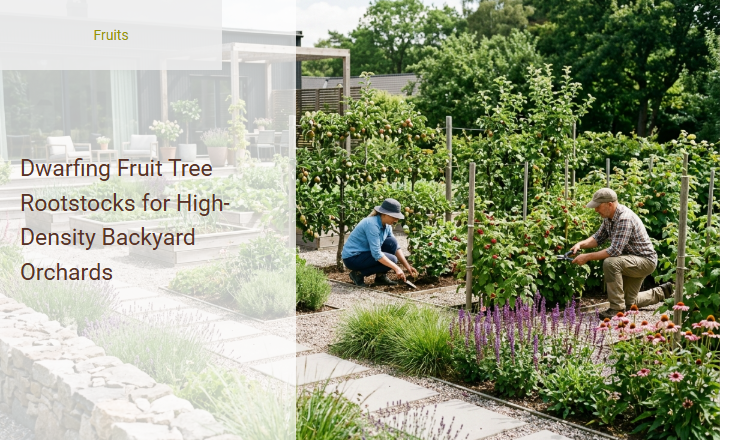
Many home gardeners dream of a bountiful orchard but find themselves limited by small suburban yards, struggling to manage sprawling, standard-sized trees that quickly become impossible to prune or harvest safely. Historically, fruit cultivation relied on vast agricultural acreage to accommodate these massive, natural root systems.
Fortunately, modern intensive planting techniques grant growers the ability to harvest premium, full-sized crops from trees maintained at a convenient head-height. However, achieving this high-yield density stipulates a careful understanding of graft compatibility, as highly dwarfed trees often require permanent staking and diligent watering. Utilizing specific rootstocks, such as the M9 for apples or Gisela 5 for sweet cherries, provides the precise vigor control needed to make these tight spaces viable.
In this guide, we will examine how to select the ideal dwarfing rootstocks for your soil, calculate optimal planting densities, and master the structural training required for a successful high-density backyard orchard.
Read also: Dwarf vs Semi-Dwarf Rootstock for Small Gardens
Introduction to High-Density Backyard Orchards
Imagine harvesting crisp apples, juicy pears, and sweet cherries from a space no larger than a backyard patio. For generations, growing fruit trees required vast acreage, but high-density backyard orcharding has changed the rules of home gardening. By utilizing innovative planting techniques and specialized dwarfing rootstocks, you can cultivate a highly productive orchard in a remarkably small footprint. This method allows suburban and urban gardeners to maximize their limited space, turning fences, walkways, and small garden beds into abundant food-producing zones.
The secret behind this space-saving revolution lies in the biology of the trees themselves. Rather than planting standard-sized trees that quickly outgrow domestic yards, modern orchardists pair desired fruit varieties with specialized root systems. These rootstocks control the tree's size, allowing for high-density plantings where multiple trees thrive in the space traditionally occupied by just one. The result is a manageable, highly aesthetic, and incredibly productive backyard ecosystem.
Understanding Rootstocks: The Foundation of Your Fruit Tree
To understand how high-density orcharding works, one must look below the soil line. A grafted fruit tree is actually a combination of two distinct plants. The upper portion, known as the scion, determines the variety of fruit you will harvest, such as a Honeycrisp apple or a Bartlett pear. The lower portion, known as the rootstock, comprises the root system and the lower trunk. These two components are joined together at the graft union, a swollen scar visible near the base of the tree's trunk.
The rootstock serves as the biological foundation, dictating the tree's final height, its adaptability to different soil types, and its overall resistance to pests and soil-borne diseases. While the scion focuses on leaf and fruit production, the rootstock manages water uptake and nutrient absorption. Selecting the right rootstock ensures the tree survives harsh winters, tolerates clay or sandy soils, and wards off devastating diseases like fire blight or root rot.
The Science of Dwarfing: How Rootstocks Control Tree Size
The ability of a rootstock to dwarf a tree is a fascinating biological process. The graft union acts as a physical and physiological bottleneck. At this junction, the vascular tissues-the xylem and phloem-of the scion and the rootstock do not align perfectly. This misalignment restricts the flow of water and essential nutrients ascending from the soil, as well as the downward flow of photosynthetic sugars and growth hormones produced in the canopy.
Specifically, the restriction of gibberellins and auxins, which are key plant hormones responsible for cell elongation and vegetative growth, tricks the scion into believing it is much older and larger than it actually is. Instead of expending energy on growing tall branches and thick wood, the tree redirects its resources toward flower bud differentiation and early fruiting. Consequently, the tree remains small while producing fruit much sooner than a standard tree.
Top Dwarfing Rootstocks for Apple Trees
Apple growers have access to some of the most thoroughly researched rootstocks in the world. Choosing the right one allows you to tailor your trees to your specific garden dimensions and soil conditions:
- M27: This is an extremely dwarfing rootstock, producing a tree that reaches only 15 to 20 percent of standard size. It is perfect for container growing or very tight spaces, but it requires highly fertile soil and constant watering.
- M9: The industry standard for high-density commercial orchards, M9 keeps trees at 25 to 35 percent of standard size. It induces early fruiting, though it has brittle roots that require permanent physical support.
- Bud.9 (Budagovsky 9): Originating from Russia, Bud.9 offers comparable size control to M9 (around 25 to 35 percent) but provides exceptional winter hardiness and excellent resistance to collar rot.
Dwarfing Options for Pear Trees
Pear trees are historically vigorous growers, making dwarfing rootstocks essential for backyard orchards. European and Asian pear varieties utilize different root systems to achieve size control, though compatibility must be carefully managed:
- Quince C: A highly popular choice for European pears, Quince C restricts growth to about 50 percent of standard size and encourages rapid fruit production. However, some pear varieties suffer from graft incompatibility with quince, requiring a compatible interstem to prevent the graft from failing.
- Pyrodwarf: A specialized pear rootstock that provides excellent winter hardiness and compatibility across most Asian and European pear varieties. It produces a slightly larger tree (around 60 percent of standard size) but tolerates a wider variety of soil conditions.
Stone Fruit Dwarfing Rootstocks: Cherries, Plums, and Peaches
Stone fruits present unique challenges, but modern breeding programs have introduced excellent dwarfing rootstocks that make backyard cherry, plum, and peach trees highly manageable:
- Gisela 5: This rootstock reduces sweet cherry tree size to about 50 percent of standard, inducing heavy crops early in the tree's life and displaying excellent frost tolerance.
- Gisela 6: Slightly more vigorous than Gisela 5, it produces a tree around 60 to 70 percent of standard size, making it ideal for less fertile soils where a bit more vigor is needed to sustain fruit production.
- Krymsk 1: An outstanding dwarfing option for plums, peaches, and apricots, producing a compact tree with improved cold hardiness and fruit size.
- Pixy: A classic dwarfing rootstock for plums that limits tree height to about 50 percent, making netting for birds and fruit harvesting exceptionally easy.
The Benefits of Planting a High-Density Orchard
Transitioning to a high-density backyard orchard offers numerous practical benefits that extend far beyond simply saving space. Homeowners can experience the joy of orcharding without the overwhelming labor historically associated with large fruit trees.
"High-density planting systems maximize sunlight interception and optimize labor efficiency, transforming backyard spaces into highly productive food zones."
One major advantage is precocity, or early fruiting. Standard fruit trees can take up to seven years to produce their first harvest, whereas trees on dwarfing rootstocks often begin bearing fruit in their second or third year. Additionally, smaller trees are much easier to prune, net, spray, and harvest, reducing the need for dangerous ladder work. Lastly, planting dwarf trees allows you to grow multiple varieties with staggered ripening dates, ensuring a continuous supply of fresh fruit throughout the season.
Essential Support and Trellising for Dwarf Trees
Why Dwarf Trees Cannot Stand Alone
Unlike standard trees that develop deep, anchor-like taproots, dwarfed fruit trees have shallow, fibrous root systems. Combined with a brittle graft union, these trees cannot support the weight of a heavy fruit load or withstand strong winds without physical assistance. Without support, the trunk can snap at the graft union, or the entire tree may tilt and uproot.
Common Support Systems
- Individual Wood or Metal Stakes: A simple, heavy-duty conduit or treated wood stake driven deep into the ground next to each tree provides adequate support for single-tree plantings.
- Multi-Wire Trellis Systems: For high-density rows, a wire trellis system (similar to vineyard configurations) provides the structural support while allowing you to train branches horizontally for optimal sun exposure.
Irrigation and Nutrient Management for Shallow Root Systems
Watering Strategies for Shallow Roots
Because dwarf rootstocks concentrate their root mass in the top twelve to eighteen inches of soil, they have very limited access to deep soil moisture. These trees are highly vulnerable to drought stress, which can quickly stunt growth, cause fruit drop, or even kill the tree. Installing a drip irrigation system with a timer ensures consistent moisture, which is critical during the fruit-sizing period in mid-summer.
Fertilization and Weed Prevention
The shallow root zone also means dwarf trees must compete directly with grass and weeds for nutrients. Keeping a clean, weed-free circle (mulched with wood chips) around the base of the tree is essential. Applying a balanced, organic fertilizer in early spring helps sustain healthy vegetative growth and supports high-quality fruit development.
Common Pitfalls in Dwarf Orchard Management
Managing a high-density dwarf orchard requires attention to detail. One of the most common and devastating mistakes is planting the tree too deeply and burying the graft union. If the scion wood makes contact with the soil, it will send out its own roots. Over time, these scion roots will bypass the dwarfing rootstock, causing the tree to revert to its standard, massive size.
Another critical pitfall is failing to thin the young fruit. Dwarf trees are highly precocious and will often set far more fruit than their young branches can physically or nutritionally support. Neglecting to thin the fruit in late spring can lead to broken branches, small and tasteless fruit, or cause the tree to enter a cycle of biennial bearing, where it only produces fruit every other year.
Summary
This article details how home gardeners can utilize dwarfing rootstocks to establish highly productive, high-density backyard orchards. By grafting desired fruit varieties onto size-controlling rootstocks, growers can cultivate compact trees that fit easily into limited residential spaces. This method offers several distinct advantages, including precocity-meaning trees produce fruit much earlier in their lifespan-and significantly easier maintenance, such as simplified pruning, pest control, and harvesting.
The article highlights that while dwarfing rootstocks allow for a diverse selection of fruit in a small footprint, they also require specialized care. Because of their smaller, shallower root systems, these trees typically demand permanent structural support, consistent irrigation, and protection from environmental stressors. Ultimately, selecting the appropriate rootstock for specific soil types and climates is essential for successfully growing a manageable and bountiful home harvest.
Leave a comment