
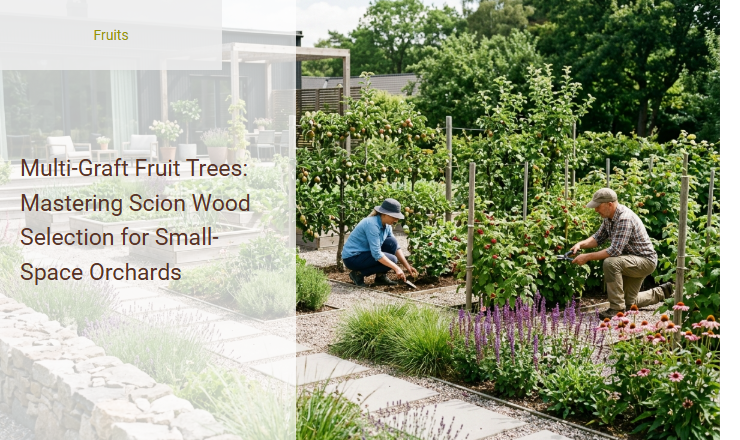
For urban growers and backyard orchardists, the dream of cultivating a diverse harvest often clashes with the reality of limited square footage. Simply put, standard yards lack the space for a traditional multi-tree orchard. While multi-grafting offers an elegant solution, success hinges entirely on the foundational step of scion wood selection.
Mastering this selection process grants you the extraordinary ability to harvest a continuous succession of fresh fruit-from early-season peaches to late-season plums-all from a single rootstock's footprint. However, this is not a trial-and-error endeavor; it stipulates strict botanical compatibility and balanced growth vigor. For example, grafting a high-vigor 'Santa Rosa' plum alongside a weaker peach cultivar on the same rootstock will result in one dominant branch starving out the other.
In this guide, we will explore the essential rules of scion compatibility, detail how to source and store dormant wood, and provide a blueprint for managing multi-graft canopy balance for long-term productivity.
Read also: Seed vs Graft for Apple Propagation
Introduction to Multi-Graft Fruit Trees
Multi-graft fruit trees represent a major leap forward for home orchardists, allowing a single tree to produce multiple distinct varieties of fruit. Imagine harvesting sweet cherries, tart pie cherries, and rich plums all from a single trunk rooted in your backyard. These innovative plants are created by joining branches, known as scions, from different varieties onto one foundational root system.
By combining multiple cultivars onto a single tree, growers can bypass the space limitations that traditionally prevented home orchards from thriving. Multi-graft trees are a revolutionary solution for modern backyard growers who want diverse, high-yielding crops without devoting entire acres to separate trees.
The Power of Multi-Grafts in Small-Space Orchards
Backyard growers often face the limitation of small yards, making standard orchards impractical. Multi-graft trees overcome this hurdle by consolidating a diverse orchard experience into a single planting site.
These trees offer several dynamic benefits for small-scale spaces:
- Continuous Harvest: By selecting varieties with staggered ripening times, you can enjoy fresh fruit over several months rather than all at once.
- Self-Pollination Solutions: Many fruit trees require a different variety nearby for pollination. A multi-graft tree solves this by housing compatible pollinators on the exact same trunk.
- Space Optimization: You can grow up to four or five different cultivars in the footprint of a single standard tree.
What is Scion Wood? Core Concepts for Success
To succeed with multi-grafting, you must first understand the concept of scion wood. In grafting terms, the scion is a young, dormant twig cut from a parent tree of a specific variety that you wish to propagate. This piece of wood carries the genetic blueprint for the fruit. Whether you desire a crisp Honeycrisp apple or a juicy Bartlett pear, the scion wood dictates the exact flavor, color, and characteristics of the final crop.
While the scion determines the fruit variety, the rootstock controls the overall size, pest resistance, and vigor of the tree. When these two parts are fused, they function as a single biological unit. This relationship ensures that even a dwarfing rootstock can support several high-quality fruit varieties on its branches.
Rules of Compatibility: Choosing Your Varieties
Successful multi-grafting relies on biological compatibility between the host tree and the scions. You cannot simply graft any branch onto any tree; the plants must be closely related botanically to ensure the graft takes and thrives over time. This means pome fruits (like apples and pears) and stone fruits (like peaches and plums) cannot be cross-grafted onto one another due to structural and genetic differences.
To ensure compatibility, organize your grafting projects within the following closely related species groups:
- The Pome Family: Apples can only be grafted onto other apples, while pears are compatible with other pear varieties and occasionally quince.
- The Stone Fruit Family: Peaches, plums, nectarines, apricots, and almonds are generally compatible with one another and can be grafted onto a single peach or plum rootstock.
- The Cherry Family: Sweet cherries and sour cherries can be grafted together, but they generally do not cross-graft successfully with other stone fruits like peaches or plums.
Synchronizing Bloom Times and Chilling Hours
When planning a multi-graft tree, physical compatibility is only the first step. You must also consider the environmental needs of each variety, specifically their chilling hours and bloom times. If you graft a low-chill variety that blossoms in late winter onto a tree with high-chill varieties that bloom in late spring, the early blossoms may freeze, or the tree may struggle to balance its energy.
Matching these physiological cycles is essential for cross-pollination and uniform growth across the tree canopy.
A well-balanced multi-graft tree features varieties that bloom simultaneously to facilitate easy pollination by local bees, while having similar chilling requirements to ensure all branches wake up from winter dormancy at the same time.
How to Identify and Harvest Premium Scion Wood
The success of your grafting depends largely on the quality of the scion wood you harvest. Collecting wood during the deep winter dormancy period ensures the buds are asleep and ready to be stored until spring grafting.
Follow these guidelines to harvest premium wood:
- Identify one-year-old wood, which is the growth from the previous spring and summer, characterized by smooth bark and prominent, healthy buds.
- Look for twigs that are the thickness of a standard pencil, as this size is easy to manipulate and match with host branches.
- Avoid wood from water sprouts or diseased branches, selecting instead from the outer, sunlit canopy of a healthy donor tree.
- Cut pieces that are about 8 to 12 inches long, containing at least three to five viable vegetative buds.
Best Practices for Storing Scion Wood
Once you have harvested your scions, keeping them completely dormant and moist is critical until grafting day arrives. If the wood dries out or experiences warm temperatures, the buds will wake up prematurely, leading to graft failure.
To store your scions properly, gently clean the wood with a mild disinfectant solution to remove mold spores. Next, wrap the bundles in a damp paper towel-making sure it is moist, not soaking wet. Place the wrapped scions inside a sealed plastic bag labeled with the variety name using a permanent marker. Store the bag in a standard refrigerator at a temperature between 34 and 38 degrees Fahrenheit. Keep them away from ripening fruits like apples or bananas, which release ethylene gas that can damage the buds.
Essential Grafting Techniques for Multi-Graft Trees
Creating a multi-graft tree requires specialized cuts to join the vascular systems of the host branch and the scion. The goal is to align the cambium layers-the thin green ring of growing tissue just under the bark-so they can fuse together.
The Whip-and-Tongue Graft
This technique is highly reliable and is best used when the host branch and the scion wood are of the exact same thickness. By creating interlocking "tongues" on both pieces, you establish a very strong physical connection with maximum cambium contact, ensuring a high rate of healing success.
The Cleft Graft
The cleft graft is the preferred method when you want to insert a smaller scion into a larger host branch. You split the thicker host branch down the center, shape the bottom of the scion into a wedge, and slide it into the split, aligning the outer cambium layers on at least one side.
The Bark Graft
Bark grafting is ideal for top-working older trees with thick limbs. In the spring, when the bark is slipping, you cut the host limb clean across, make a vertical slit in the bark, and slide a wedge-shaped scion under the bark flap. This allows you to add multiple scions to a single large branch.
Managing Limb Dominance and Post-Graft Care
Once your grafts have successfully taken, the real challenge of managing a multi-graft tree begins. Naturally, more vigorous varieties will attempt to dominate the tree by hogging nutrients and sunlight, which can cause slower-growing varieties to wither and eventually die off.
To keep all your varieties in perfect balance, practice the following management steps:
- Prune back the most vigorous branches during the active growing season to redirect energy to the weaker grafts.
- Remove any shoots or suckers that grow below the graft unions, as these will drain vital resources from your newly established varieties.
- Train branches outward using spreaders or weights to encourage a wide, open canopy that allows sunlight to reach every grafted limb.
Troubleshooting and Long-Term Maintenance
Over the lifetime of a multi-graft tree, issues like graft failure, uneven growth, and pests are bound to occur. Regular monitoring is key to keeping your multi-graft tree healthy and productive. If a graft fails to take in the spring, do not worry; you can cut the limb back and try again next season using a different technique.
Uneven growth is the most common issue, but it can be managed with strategic summer pruning. By pruning the fast-growing limbs in July or August, you stunt their growth slightly, allowing the weaker limbs to catch up. Maintaining equal light penetration to all sections of the tree ensures that every variety continues to blossom and bear fruit for years to come.
Summary
Multi-graft fruit trees offer a revolutionary solution for maximizing orchard diversity and yield in limited spaces. By grafting multiple varieties onto a single rootstock, gardeners can enjoy an extended harvest season and self-pollinating ecosystems. The key to unlocking this potential lies in the careful selection of scion wood.
Successful multi-grafting requires choosing compatible varieties within the same plant family, such as stone fruits or pomes. Additionally, growers must match the vigor of the scions; pairing a highly vigorous variety with a slow-growing one can lead to the dominant branch choking out the weaker graft. Selecting healthy, dormant, one-year-old wood with well-developed buds ensures optimal graft union and robust growth. Ultimately, mastering scion wood selection allows small-space gardeners to cultivate highly productive, space-saving "family trees" tailored to their microclimates and tastes.
Leave a comment