
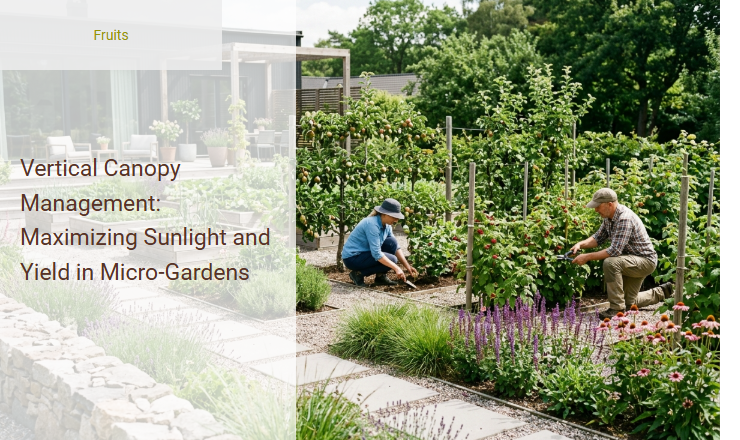
Many micro-gardeners face a frustrating bottleneck: limited square footage quickly leads to overcrowded beds, shaded foliage, and disappointing yields. While traditional horizontal spacing models work well in expansive suburban plots, they inevitably fail in confined urban environments where sunlight is a premium, highly contested commodity.
Transitioning to vertical canopy management solves this crisis by turning spatial constraints into a three-dimensional asset, granting growers up to 40% more photosynthetic efficiency. However, achieving these results requires a systematic approach; success is not merely about letting plants grow upward, but rather implementing strategic pruning and engineered structural supports to prevent self-shading.
For example, training indeterminate tomatoes and trellised cucumbers vertically ensures uniform sun exposure and drastically reduces pest vulnerability. In this guide, we will outline the core principles of vertical canopy design, the physics of light penetration, and the practical pruning techniques required to maximize your micro-garden's output.
Read also: Passion Fruit vs Dragon Fruit for Tropical Trellises
Introduction to Vertical Canopy Management
For urban growers and micro-gardeners, space is the ultimate luxury. Traditional gardening focuses on horizontal spread, which quickly leads to overcrowding on balconies, small patios, or windowsills. Vertical Canopy Management is a strategic agricultural technique adapted for small-scale environments that shifts the growing plane from horizontal to vertical. By deliberately arranging, training, and structuring plants upward, gardeners can maximize both limited floor space and available sunlight.
This method treats three-dimensional space as a multi-layered ecosystem. Instead of letting plants compete blindly for resources, you carefully curate their placement to ensure every leaf gets its fair share of light. Embracing this approach turns a cramped balcony into a high-yielding, green sanctuary, unlocking the full potential of your micro-garden.
The Physics of Light in Small Spaces
Light behavior in confined urban environments is highly complex. Sunlight rarely falls uniformly; instead, it is blocked by adjacent buildings, overhangs, and walls, creating deep pockets of shade. Understanding phototropism-the biological phenomenon where plants grow toward a light source-is essential for managing a vertical garden. Without intervention, plants in the back or bottom tiers will stretch unnaturally, becoming leggy and weak as they seek out photons.
When light hits a vertical surface, its intensity decreases with the square of the distance from the source. By analyzing how light penetrates your specific micro-environment, you can position plants according to their specific light saturation points. High-intensity light zones are reserved for sun-worshipping varieties, while the lower, diffused light areas host species that thrive in the understory, mimicking natural forest architectures.
Mapping Your Micro-Garden's Solar Footprint
Before assembling any structures, you must chart the movement of sunlight across your growing space. This step ensures you place your vertical racks and trellises where they can capture the most energy throughout the day.
- Observe your balcony, patio, or windowsill at three key times of day: early morning, midday, and late afternoon.
- Document which specific areas receive direct sunlight, partial shade, or full shadow during these observations.
- Note how structural obstructions like railings, roof overhangs, or nearby trees block light at different hours.
- Identify your high-yield "hot spots" where light is most consistent, which will serve as the anchor points for your tallest vertical systems.
Selecting Crops for the Vertical Strata
To optimize a vertical canopy, you must categorize your crops by their light requirements and growth habits. Placing the wrong plant in the wrong tier can lead to stunted growth or sunburned leaves.
The Upper Tier: Sun-Loving Giants
The top layer of your vertical system receives the most intense, direct sunlight. This zone is perfect for heat-tolerant plants that require maximum energy to produce fruit.
- Cherry tomatoes
- Bell peppers
- Bush beans
The Middle Tier: Agile Climbers
The intermediate zone receives filtered or moderate sunlight. Vining plants thrive here, climbing upward toward the light while offering partial shade to the layers below.
- Peas
- Cucumbers
- Pole beans
The Lower Tier: Shade-Tolerant Understory
The base of your vertical garden receives indirect light and runoff water. It mimics the forest floor, making it ideal for delicate, leafy greens and herbs.
- Spinach and kale
- Lettuce and arugula
- Mint and cilantro
Building the Framework: Trellises, Towers, and Shelves
Selecting the right physical infrastructure is crucial for supporting your vertical canopy. Your choice of hardware should align with the structural load limits of your space, wind exposure, and the specific growth habits of your chosen plant varieties.
"A well-designed vertical structure does not just support weight; it acts as a spatial organizer that distributes light and air evenly to every single leaf."
Vertical hydroponic or soil towers work exceptionally well for compact, fast-growing greens like strawberries and herbs because they maximize planting density. For climbing vegetables like squash or peas, lightweight wire trellises or netting secured to a wall provide the necessary vertical pathway. If you have a collection of potted plants, tiered shelving systems allow you to step your pots like stadium seating, preventing front plants from casting shadows on those behind them.
Training and Pruning for Maximum Light Penetration
Left to their own devices, plants will grow bushy and dense, self-shading their lower leaves and reducing overall yield. Active maintenance is required to shape your vertical canopy for optimal solar efficiency.
Essential Pruning and Training Methods
Implementing targeted pruning strategies keeps the canopy open and allows light to penetrate deep into the lower levels of your vertical garden setup.
- Single-Stem Training: Remove suckers from indeterminate vining plants, like tomatoes, to keep them growing along a single vertical main stem.
- Selective Defoliation: Carefully prune older, yellowing, or excessively large leaves that block sunlight from reaching developing flowers or lower-tier herbs.
- Horizontal Spreading: Gently tie flexible branches outward along your trellis to expand the surface area exposed directly to the sun.
Enhancing Sunlight with Reflective Surfaces and Supplemental Tech
Natural sunlight can be limited in urban micro-gardens, but you can use simple physics to multiply its effectiveness. By incorporating reflective surfaces, you can bounce lost light back into the darker, recessed zones of your vertical array. Painting nearby walls with a flat white paint is one of the easiest ways to diffuse light evenly, while Mylar sheets or specialized horticultural films can reflect up to 95% of available sunlight directly onto your lower-tier plants.
When natural light is still insufficient, supplemental technology bridges the gap. Modern, highly efficient LED grow lights can be mounted directly under shelves or along the sides of towers. These lights target specific photosynthetic wave spectrums, ensuring your crops receive the necessary energy without generating excess heat that could scorch delicate foliage.
Irrigation and Nutrition Strategies for Tiered Gardens
Water and nutrients behave differently in a vertical system due to the constant pull of gravity. In a stacked or tiered setup, water applied at the top naturally migrates downward. If your irrigation strategy does not account for this, your top-tier plants will dry out rapidly while your bottom-tier crops suffer from root rot, waterlogging, and nutrient leaching.
Nutrient delivery must also be managed carefully. Because top-down watering washes mobile nutrients downward, consider feeding your plants from bottom to top, or utilizing closed-loop hydroponic systems where nutrient-rich water is pumped to the top and cascades down a controlled pathway, ensuring equal access for all root systems.
Overcoming Common Vertical Canopy Challenges
Transitioning to vertical cultivation presents unique hurdles that can disrupt your micro-garden if left unaddressed. Recognizing these issues early allows you to make quick adjustments and keep your crops thriving.
- Top-Heavy Shading: Overgrown top-tier plants block light from reaching lower tiers. Solution: Regularly prune the top canopy and use tiered stepping to offset planter boxes.
- Poor Air Circulation: Dense vertical arrangements can trap humidity, leading to powdery mildew and fungal diseases. Solution: Space plants adequately and use small outdoor fans to maintain air movement.
- Structural Overload: Soil and wet containers are heavy, posing a risk to balcony railings or wall mounts. Solution: Use lightweight potting mixes (like coco coir and perlite) and verify load limits before building.
Reaching New Heights: The Future of Micro-Farming
Vertical canopy management represents a paradigm shift in how we view urban agricultural potential. By stepping away from traditional flat-bed gardening and looking upward, city dwellers can transform underutilized spaces into highly productive food hubs. This intentional spatial design maximizes every ray of sunlight, significantly boosting yields per square foot.
As urban density increases and food security becomes a pressing global issue, these high-efficiency micro-farming techniques offer a resilient, sustainable path forward. Cultivating edible plants vertically reduces transport emissions, conserves water, and fosters a deeper connection to our food systems, proving that massive yields can come from the smallest footprints.
Summary
The article "Vertical Canopy Management: Maximizing Sunlight and Yield in Micro-Gardens" explores innovative strategies for optimizing limited agricultural spaces to achieve peak productivity. In urban and micro-gardening environments, spatial constraints often restrict traditional horizontal crop growth. Vertical Canopy Management (VCM) addresses this challenge by strategically training, pruning, and structuring plants upward.
By organizing the plant canopy vertically, growers dramatically increase sunlight interception across all foliage layers, boosting overall photosynthetic efficiency. Additionally, this technique enhances air circulation, which significantly reduces the risk of humidity-related diseases and pests. Implementing methods such as trellising, staking, and selective defoliation allows gardeners to utilize three-dimensional space efficiently. Ultimately, VCM empowers small-scale growers to maximize their harvest yields and cultivate healthier, high-performing crops within a compact footprint.
Leave a comment