
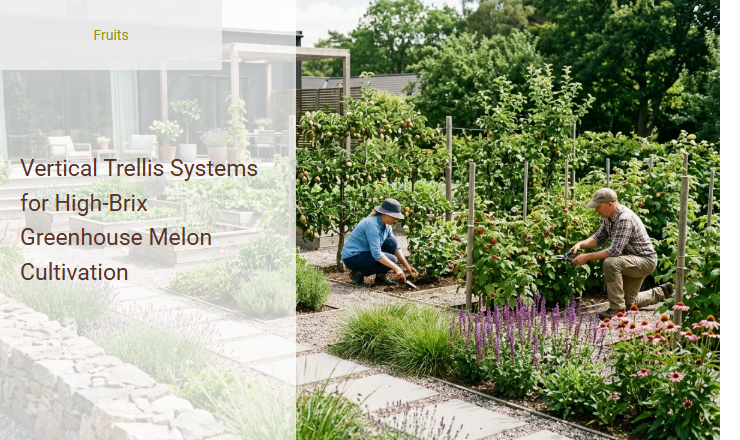
Greenhouse growers often struggle to balance high volume yields with the premium sugar profiles (Brix) demanded by modern markets, particularly when traditional sprawling vines crowd valuable under-glass floor space. While ground-level cultivation limits plant density and increases disease pressure, transitioning to controlled-environment verticality requires a strategic shift in structural crop management.
Adopting vertical trellis systems grants growers unparalleled control over canopy microclimates and light interception, directly accelerating sugar accumulation in the developing fruit. However, securing these high-Brix results stipulates rigorous pruning discipline and precise vertical weight-distribution mechanics.
Commercial trials with demanding cultivars, such as Cantaloupe and Galia melons, demonstrate that vertical training consistently yields superior fruit quality and Brix consistency compared to ground-grown counterparts. Below, we examine the essential trellis architectures, pruning protocols, and crop-load management techniques required to optimize your vertical melon program.
Read also: Hand vs Bee Pollination for Greenhouse Melons
Introduction to Vertical Trellis Systems for Greenhouse Melons
Cultivating gourmet melons inside a greenhouse presents unique challenges, primarily regarding space utilization and disease management. Traditional ground-crawling methods consume massive amounts of floor area, limiting overall yield potential and exposing delicate foliage to soil-borne pathogens. Implementing a vertical trellis system revolutionizes this dynamic, transforming horizontal sprawl into highly organized vertical structures that optimize every square foot of your growing facility.
By elevating the vines, growers can drastically increase planting density while fostering an environment that promotes pristine fruit development. The key objectives of this intensive cultivation strategy are to maximize greenhouse space efficiency, drastically reduce foliage disease susceptibility, and consistently produce high-Brix, premium-quality gourmet melons that command top market prices.
The Physiological Relationship Between Vertical Growth and High-Brix Levels
The accumulation of soluble solids, or Brix, in melon fruit is directly tied to the plant's capacity for photosynthesis. When vines are trained vertically, the spatial distribution of the leaves is optimized, creating a vertical canopy that intercepts solar radiation far more efficiently than a flat, ground-level mat. This three-dimensional leaf arrangement prevents lower leaves from becoming severely shaded, ensuring that nearly all foliage contributes actively to carbon assimilation.
With heightened exposure to light, the rate of photosynthesis spikes, driving the production of photoassimilates. These synthesized carbohydrates-predominantly sucrose, fructose, and glucose-are actively translocated from the source leaves through the phloem directly to the developing sink tissue, which in this case is the growing fruit. This constant, unobstructed downward and outward flow of sugars is what elevates the soluble solids content, leading to the exceptionally sweet profile characteristic of vertically grown gourmet melons.
Selecting and Constructing the Ideal Vertical Trellis Support Structure
Constructing a robust vertical trellis structure is essential, as mature melon plants carrying heavy fruit load place immense physical stress on greenhouse frames. The primary support network must be anchored to heavy-duty overhead support wires, typically 12-gauge or thicker, stretched tightly across the greenhouse bay. These overhead wires must be securely braced to withstand both the vertical weight of the plants and the tension created as the vines climb toward the ceiling.
To construct this high-wire system, growers drop vertical drop lines from the overhead wire down to the base of each plant. Roller hooks allow for easy tension adjustment and lowering of the vines if necessary, while sturdy nylon netting provides additional lateral support for climbing tendrils. Here are the essential structural materials required for a secure vertical trellis build:
- 12-Gauge Galvanized Steel Wire: High-tensile overhead support line to bear the entire crop load.
- Roller Hooks with Twine: UV-resistant polypropylene twine spooled on metal hooks for adjustable vertical support.
- Trellis Pegs or Ground Anchors: Heavy-duty stakes to secure the bottom of the twine near the plant stem.
- Heavy-Duty Nylon Netting (6-inch mesh): Optional lateral grid support to help distribute fruit weight.
- Tensioners and Turnbuckles: Mechanical devices to maintain constant high tension on the overhead wires.
Vertical Training and Single-Stem Pruning Techniques
To guide the plant's energy toward maximum sugar accumulation in a select few premium fruits, a strict single-stem training regimen is required. This method channels all nutrients and water through a single primary vine, eliminating the energy drain caused by excessive vegetative growth. By strategically selecting where the fruit sets on this primary stem, you ensure a direct and powerful pathway for carbohydrate translocation.
- Secure the young seedling to the vertical twine using specialized plastic plant clips just below the first true leaf.
- Regularly wind the growing tip of the primary stem gently around the support twine in a clockwise direction every few days.
- Prune away all lateral shoots, often called suckers, emerging from the leaf axils between nodes 1 and 10 to establish a clean base.
- Allow fruit set to occur exclusively on lateral branches between nodes 11 and 15, as this region has access to the most productive leaf surface area.
- Pinch off the growing tips of these fruit-bearing lateral branches two leaves beyond the developing female flower to halt lateral vegetative expansion.
- Remove all subsequent suckers above node 15, allowing the primary vine to continue growing vertically until it reaches the overhead support wire.
Implementing Fruit Support Slings and Nets
While a single-stem vine is highly efficient at photosynthesizing, its vascular system and lateral stems are not physically designed to suspend heavy melons in mid-air. As the fruit expands, the sheer gravitational pull can kink the peduncle, cutting off nutrient flow, or cause the melon to snap off the vine entirely. To prevent this, secondary fruit support systems must be introduced to take the physical load off the plant stem.
Growers use specialized elastic mesh nets, fabric hammocks, or plastic slings suspended from the overhead trellis wire. These supports must be applied as soon as the pollinated fruit reaches the size of a chicken egg, typically when it weighs between 150 to 200 grams. It is a critical safety measure to never tie the sling directly to the lateral stem carrying the fruit; instead, anchor the support clips or strings directly to the vertical main support twine. This ensures the weight of the growing melon is fully transferred to the overhead steel wire structure rather than the delicate plant tissue.
Optimizing the Greenhouse Microclimate for Trellised Canopies
Lifting melon plants off the ground completely alters the physical structure of the greenhouse microclimate. In ground-crawling systems, dense mats of leaves trap humid air close to the soil surface, creating an ideal breeding ground for fungal spores. A vertical canopy, by contrast, opens up the lower and middle zones of the greenhouse, facilitating unrestricted horizontal airflow. This increased ventilation aids in rapid leaf drying and maintains stable ambient temperatures throughout the vertical profile of the crop.
By eliminating stagnant air pockets, transpiration rates remain active and balanced, which assists the plant in continuous calcium uptake. Managing the relative humidity in a high-wire system is far more predictable, allowing environmental control systems to operate at maximum efficiency.
"To prevent fungal pathogens like powdery mildew from taking hold in a vertical melon canopy, relative humidity should ideally be maintained between 60% and 75%, coupled with a continuous air exchange rate that prevents moisture boundary layers from forming on the leaf surfaces." - Dr. Evelyn Vance, Greenhouse Horticulturalist
Precision Fertigation and Nutrient Management for Sugar Synthesis
To achieve peak Brix levels, nutritional inputs must be precisely adjusted based on the crop's physiological stage. During vegetative growth, nitrogen supports canopy development, but as the plant transitions to fruit set and sugar accumulation, the potassium-to-nitrogen (K:N) ratio must be significantly increased. Potassium acts as the primary engine driving sugar loading into the fruit. Additionally, calcium must be supplied continuously to ensure cell wall integrity and prevent blossom-end rot under high transpiration rates.
| Growth Stage | K:N Ratio Target | Calcium (Ca) ppm | Target EC (mS/cm) | Primary Purpose |
|---|---|---|---|---|
| Vegetative to Early Flowering | 1:1 to 1.2:1 | 150 - 180 | 1.8 - 2.0 | Build strong canopy and root system |
| Fruit Set & Early Development | 1.5:1 | 180 - 200 | 2.2 - 2.4 | Support cell division and prevent rot |
| Fruit Swelling & Netting | 2:1 | 150 | 2.5 - 2.8 | Accelerate sugar transport and build rind pattern |
| Late Ripening (Peak Sugar) | 2.5:1 | 100 | 3.0 - 3.2 | Maximize Brix and osmotic concentration |
Controlled Water Stress Strategies During Fruit Ripening
One of the most powerful tools a grower has to drive up sugar concentration is the deliberate application of controlled water stress, known as deficit irrigation. During the final 10 to 14 days before harvest, the melon fruit has finished growing in physical size and is strictly focusing on accumulating sugars. If the plant receives excess water during this critical window, the fruit will absorb this moisture, diluting the accumulated sugars and resulting in a watery, bland melon.
By systematically reducing the volume of irrigation, you induce a mild osmotic stress. This causes the plant to concentrate its cellular solutes, primarily sugars, inside the fruit cells. Growers must monitor soil moisture levels closely to ensure the stress is controlled and does not cause severe vine wilting or leaf drop. Keep irrigation to a minimum of 30% to 40% depletion of available soil water for a duration of 10 to 12 days before harvest to force the plant into sugar concentration mode without compromising vine viability.
Integrated Pest and Disease Management in Vertical Canopies
Managing pests and diseases in a vertical trellis system is significantly more effective than in traditional ground setups. By training the plants upward, the undersides of the leaves are far more accessible, which is where many pests colonize. Scouting becomes highly efficient because workers can inspect foliage at eye level without bending down. Furthermore, when spraying organic treatments or biological controls, the open canopy structure allows for complete coverage of both the upper and lower leaf surfaces, which is paramount for controlling persistent greenhouse pests.
Implementing an Integrated Pest Management (IPM) program in a vertical system leverages this accessibility to quickly deploy targeted solutions:
- Powdery Mildew: Controlled via improved air circulation and early, complete-coverage sprays of potassium bicarbonate or horticultural oils directly onto the upright foliage.
- Aphids: Managed by releasing beneficial predatory insects like lacewings or parasitic wasps directly into the open canopy, where they can easily navigate and hunt.
- Spider Mites: Controlled by targeted releases of predatory mites (such as Phytoseiulus persimilis) along the trellis line and maintaining localized humidity levels to disrupt mite breeding cycles.
Harvesting Protocols and Refractometer Brix Verification
Harvesting a gourmet melon at its absolute peak flavor profile requires careful observation of physical cues. Unlike some fruits, melons do not continue to accumulate sugars after they are detached from the vine. Therefore, timing the harvest correctly is paramount to securing the high-sugar rewards of your vertical growing efforts. Look for a well-defined, raised netting pattern on the rind, a change in ground color from green to creamy yellow, and the presence of a sweet, musky aroma at the blossom end. Many varieties will also show a slight cracking around the stem joint, signaling they are reaching the "slip stage" where they easily detach from the vine.
To ensure quality control and verify that your vertical management practices have succeeded, a digital refractometer should be used to measure the Brix percentage of the harvest. Follow these step-by-step instructions to accurately verify the sugar content:
- Clean the prism surface of the digital refractometer with distilled water and dry it completely with a soft, lint-free cloth.
- Place a few drops of pure distilled water on the prism, close the cover, and press the zero-calibration button to calibrate the device at room temperature.
- Wipe the prism dry, then cut a representative sample of melon flesh from the equatorial region of the harvested fruit, near the seed cavity where sugars are highly concentrated.
- Squeeze a few drops of clear melon juice onto the prism, ensuring there are no solid pulp particles or air bubbles trapped under the cover.
- Press the read button on the refractometer and record the Brix percentage; a premium high-Brix gourmet melon should register a minimum of 14% to 16% Brix.
Summary
This article explores the innovative application of vertical trellis systems in greenhouse melon cultivation, a technique designed to maximize spatial efficiency and enhance fruit quality. By training melon vines to grow vertically, growers can significantly increase planting density and improve light penetration throughout the canopy. This optimal light interception, combined with precise environmental control in greenhouse settings, directly boosts photosynthesis and carbohydrate accumulation, leading to melons with exceptionally high-Brix (sugar) levels. Additionally, vertical trellising elevates the fruit off the ground, reducing soil-borne diseases, improving air circulation, and facilitating easier harvesting and pest management. Ultimately, this system offers a highly efficient, sustainable pathway for commercial growers to meet the rising market demand for premium, sweet, and visually flawless melons year-round.
Leave a comment