
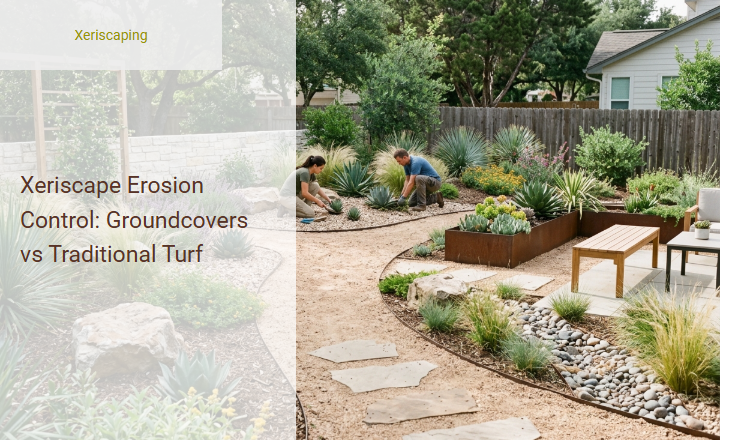
Managing sloped landscapes in arid regions often feels like a losing battle against soil erosion and skyrocketing water bills. While a lush, green lawn has historically been the default solution for stabilizing shifting soil, municipal water restrictions and changing climates now force us to re-evaluate the ecological and financial cost of traditional turfgrass.
Transitioning to a xeriscape design grants property owners both dramatic utility savings and robust soil stabilization, provided we acknowledge that these drought-tolerant alternatives require specific establishment periods and precise soil preparation to succeed. For instance, planting deep-rooting groundcovers like Creeping Rosemary (Rosmarinus officinalis 'Prostratus') or Myoporum parvifolium can bind soil far more effectively on a grade than thirsty Kentucky Bluegrass.
In this analysis, we will compare the structural integrity, water footprints, and long-term maintenance demands of xeriscape groundcovers versus traditional turf to help you implement the most effective erosion control strategy for your property.
The Battle for the Soil: Turf vs. Xeriscape Groundcovers
Modern landscapes face an increasingly quiet yet devastating adversary: the degradation of land through topsoil loss. As shifting weather patterns bring intense, erratic downpours alongside prolonged droughts, managing soil erosion has transformed from a rural agricultural concern into a critical challenge for urban and suburban properties alike. The traditional response has long been to blanket every square foot of open ground with turfgrass, but escalating resource scarcity demands a more resilient approach.
Homeowners, landscape architects, and municipal planners find themselves at a crossroads. While conventional lawns offer a familiar aesthetic, the rise of xeriscaping has introduced a powerful alternative. Drought-tolerant groundcovers are stepping into the spotlight, proving that we can conserve precious water resources while simultaneously shielding our valuable soils from the elements. This comparison explores how both systems perform when tasked with anchoring the earth beneath our feet.
Traditional Turf: The Classic Approach to Erosion Control
For decades, traditional turfgrass has served as the default vegetation for open spaces. Its ability to combat immediate erosion lies in its growth habit; it forms a dense, continuous vegetative carpet over the soil surface. This living mat acts as an immediate physical shield against wind and raindrop impact, preventing the displacement of loose soil particles before they can wash away. When properly established, a turf lawn distributes the energy of heavy rain across millions of tiny blades, greatly reducing surface disturbance.
However, this immediate defense comes with notable long-term vulnerabilities. Turfgrass relies on an incredibly dense but surprisingly shallow root network, frequently failing to penetrate deeper than two to six inches into the soil profile. Without deep anchoring roots, this vegetative layer remains susceptible to sliding on steep grades during prolonged wet periods. Furthermore, sustaining this superficial carpet requires immense volumes of water, frequent fertilization, and constant aeration, making its erosion-control benefits highly resource-dependent.
Xeriscape Groundcovers: Nature's Resilient Armor
Xeriscape groundcovers present a dynamic, self-sustaining alternative for stabilizing vulnerable landscapes. Unlike monoculture lawns, these drought-tolerant species have evolved to thrive in arid conditions and poor soils by utilizing diverse growth habits. From low-growing woody shrubs to creeping herbaceous perennials, these plants form a multi-layered barrier that intercepts rainfall while requiring minimal supplemental water once established.
By mimicking natural ecosystems, these resilient plants adapt seamlessly to local microclimates. Their survival strategies make them exceptional guardians of the soil in regions prone to extreme weather fluctuations.
"Native and climate-adapted groundcovers do not merely survive in challenging soils; they actively restructure the earth, creating a self-healing grid that shrugs off drought and stabilizes slopes far better than artificial intervention."
Beneath the Surface: Deep Roots vs. Shallow Nets
To truly understand how vegetation prevents soil loss, we must look beneath the surface. The mechanics of soil binding rely heavily on how root systems interact with different soil horizons. The structural differences between traditional lawns and xeriscape groundcovers dictate how well a landscape can withstand shearing forces from runoff and gravity.
The structural profiles of these two root systems reveal why their soil-binding capacities differ so dramatically:
- Traditional Turfgrass: Creates a dense, horizontal net in the topmost layer of soil. While excellent at preventing superficial sheet erosion, it lacks the vertical anchoring power needed to secure deeper soil layers.
- Xeriscape Groundcovers: Utilize deep-delving taproots, extensive lateral woody networks, or mining fibrous systems that penetrate several feet into the subsoil, locking structural layers together like subterranean rebar.
While a turf lawn behaves like a shallow surface blanket, deep-rooted xeriscape plants function as anchor piles. These deep roots bypass dry upper horizons to draw moisture from deep underground, ensuring the plant-and the soil it binds-remains structurally secure even during severe dry spells that would cause turf to die back and lose its grip.
Hydrology and Water Conservation: Managing Runoff
Erosion is primarily driven by water movement. When heavy rain falls on compacted or poorly vegetated soil, the water cannot infiltrate quickly enough, resulting in fast-moving surface runoff that strips away topsoil. Traditional turf lawns can absorb mild rainfall, but their soil often becomes compacted over time from heavy foot traffic and mowing equipment, reducing infiltration rates and increasing runoff volumes during severe storms.
In contrast, xeriscape installations naturally improve soil hydrology. Their diverse root structures break up compacted soil layers, creating natural macroscopic channels that facilitate rapid water infiltration. By keeping water on-site and routing it deep into the aquifer, xeriscaping reduces the volume and velocity of surface runoff. This approach yields remarkable resource savings, often resulting in reductions of 50% to 70% in outdoor water consumption compared to conventional turfgrass irrigation.
Enhancing Soil Biology and Structure
Healthy soil is not just a collection of mineral particles; it is a living ecosystem. The biological health of the soil directly influences its structural stability. Monoculture turfgrass, which is often treated with synthetic fertilizers and chemical pesticides, frequently lacks biological diversity. This chemical dependence can deplete the natural soil biology, leading to a reliance on artificial inputs to maintain basic soil structure.
Xeriscape groundcovers cultivate a thriving underground community by continually depositing diverse organic material into the earth. The decomposition of leaves, stems, and roots enriches the soil with OM, which acts as a natural glue binding soil particles into stable aggregates. Additionally, many drought-tolerant plants form crucial MA-symbiotic relationships with beneficial fungi-that extend the reach of root systems and further secure the soil matrix against erosive forces.
Maintenance, Mowing, and Environmental Costs
Maintaining a traditional turf lawn requires a continuous commitment of time, energy, and fossil fuels. The standard upkeep cycle involves constant mowing, edging, and fertilizing to keep the grass healthy enough to perform its erosion-control duties. When we calculate the environmental inputs required to sustain a standard lawn, the resource equation becomes highly unbalanced.
We can express the stark contrast in resource demands using a simple comparison of maintenance inputs:
Turfgrass Input = [Mowing * 30/yr] + [Synthetic Fertilizer * 4/yr] + [Supplemental Irrigation * 1" per week]
Xeriscape Input = [Pruning * 1/yr] + [Organic Mulch * 0.5/yr] + [Supplemental Irrigation * 0]
By eliminating the need for gas-powered lawnmowers and synthetic chemical runoffs, xeriscape groundcovers significantly lower the carbon footprint of your property. Once established, these resilient plants require little more than occasional weeding and seasonal pruning, protecting both your soil and your weekends.
Slopes and Terraces: Tackling High-Risk Erosion Zones
Steep slopes and terraces represent the highest-risk zones for soil loss. Gravity works continuously to pull down loose earth, and rain rapidly gains velocity as it flows down a grade. Attempting to establish and maintain traditional turf on a steep incline is both incredibly difficult and highly inefficient. The shallow roots of turfgrass are easily overwhelmed by the weight of saturated slope soils, sometimes leading to localized mudslides.
Xeriscape groundcovers excel in these challenging high-risk zones. Their trailing stems and cascading foliage drape over slopes, creating a living net that dampens the impact of falling rain. Simultaneously, their deep, woody root networks anchor the underlying slope structure far more effectively than any shallow-rooted grass ever could, preserving the hillside without requiring hazardous maintenance.
Top Xeriscape Groundcovers for Superior Soil Binding
Choosing the right plants is essential for building a successful, drought-tolerant erosion control system. Diverse species offer distinct growth habits, rooting depths, and environmental tolerances. Selecting a mix of these species ensures year-round protection and structural integrity for your soil.
The following curated selection of plants highlights some of the most effective options for natural soil stabilization:
- Creeping Thyme (Thymus serpyllum)
- A low-growing, mat-forming perennial that thrives in poor soils. It produces a dense cushion of foliage that blocks weed growth and prevents surface sheet erosion while requiring virtually no mowing.
- Stonecrop (Sedum album & varieties)
- A hardy succulent that stores water in its leaves, allowing it to survive in extremely shallow, rocky soils. Its creeping stems root wherever they touch the ground, quickly knitting loose soils together.
- Prostrate Rosemary (Rosmarinus officinalis 'Prostratus')
- A vigorous, woody evergreen groundcover with deep, tough roots. It is highly effective for draping over steep slopes, dry retaining walls, and embankments, providing heavy-duty structural anchoring.
Designing the Transition: Choosing Your Erosion Strategy
Transitioning your property away from resource-intensive turf does not have to be an all-or-nothing project. A thoughtful landscape design can integrate both systems effectively, utilizing turf in flat, high-traffic recreation areas while dedicating slopes, borders, and dry zones to deep-rooted xeriscape groundcovers. This hybrid approach allows you to maximize the functional benefits of each vegetation type.
By assessing your site's topography, soil composition, and water availability, you can design a landscape that functions as a balanced ecosystem. Replacing high-maintenance lawns with resilient, drought-tolerant plantings reduces water runoff, revitalizes soil biology, and creates a stable landscape that preserves your topsoil for generations to come. Embrace the natural strength of diverse plantings to build a sustainable, climate-resilient landscape that protects and enriches your soil.
| Erosion Control Metric | Groundcovers | Traditional Turf |
|---|---|---|
| Root Depth & Structure | Deep, diverse, and woody root networks (often 12–36+ inches) that anchor deep soil layers. | Shallow, fibrous root systems (typically 2–6 inches) limited to topsoil stabilization. |
| Slope Suitability | Excellent for steep, rugged, or inaccessible slopes; eliminates mowing hazards. | Poor for slopes >15%; high risk of turf sliding and dangerous maintenance requirements. |
| Runoff Mitigation | High; dense foliage intercepts rainfall impact while organic matter increases soil permeability. | Moderate-to-low; compacted soil under turf increases surface runoff volume and velocity. |
| Shear Strength | High; plant variety and root tensile strength prevent mass soil movement and landslides. | Low; vulnerable to sheet erosion and washouts during heavy, sustained rain events. |
| Maintenance & Inputs | Minimal once established; no mowing, low water requirements, and self-sustaining. | High; requires regular mowing, fertilization, and irrigation to maintain density. |
Leave a comment