
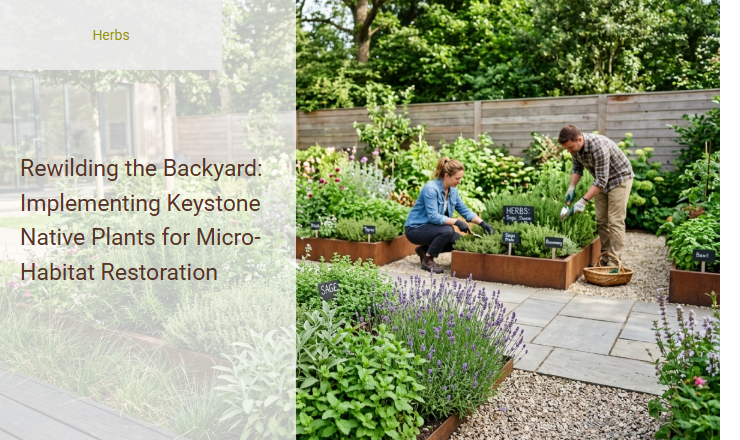
Many homeowners invest significant time and resources into eco-friendly landscaping, only to find their manicured yards remaining disappointingly devoid of local wildlife. This frustration often stems from a lack of ecological synergy; standard ornamental plants simply cannot support native food webs. Fortunately, by strategically integrating "keystone" native plants, you can dramatically accelerate biodiversity restoration, yielding maximum ecological impact within even a modest suburban plot.
To be clear, successful micro-habitat restoration is not about letting your yard run wild; rather, it requires structured, scientifically informed design. Introducing highly productive genus groups-such as native Oaks (Quercus), which host hundreds of essential insect species, or Wild Berries (Vaccinium)-serves as concrete proof that targeted botanical choices can rapidly revive local food webs.
In this article, we will examine the science of keystone species, guide you through identifying your specific ecological region, and provide a step-by-step framework for designing and maintaining your own high-functioning backyard sanctuary.
Read also: Bee Balm vs Echinacea for Wildlife Habitats
Introduction to Backyard Rewilding
Urban and suburban landscapes often consist of sterile lawns and non-native ornamental plants that offer little value to local wildlife. Backyard rewilding is a revolutionary approach that invites nature back into these managed spaces. By replacing manicured grass with native plants, homeowners can transform even the smallest patch of land into a thriving, self-sustaining micro-habitat.
This ecological restoration does not require acres of pristine wilderness. A simple suburban yard or a small urban garden bed can become a vital sanctuary for birds, insects, and small mammals, proving that intentional landscaping can heal fragmented environments.
The Power of Keystone Native Plants
Not all plants are created equal when it comes to supporting an ecosystem. Keystone native plants act as the botanical backbone of local food webs. Just as a physical keystone holds a stone arch in place, these specific flora species support the vast majority of local herbivorous insects and wildlife populations.
Without these essential plants, local ecosystems collapse. Research shows that a tiny fraction of native plant genera supports the majority of lepidoptera larvae, which in turn feed nesting birds. Integrating these heavy-lifters ensures that your garden serves as a highly productive ecological engine.
Assessing Your Backyard Ecosystem
Before planting, you must understand the unique physical conditions of your yard to match the right plants with the right places.
Analyzing Soil, Sunlight, and Moisture
By systematically evaluating these parameters, you can identify distinct micro-habitats within your property:
- Observe sunlight exposure throughout the day to map out areas of full sun, partial shade, and deep shade.
- Test soil texture and pH to determine if you have sandy, loamy, or clay-heavy earth.
- Monitor moisture levels after a rainstorm to locate dry upland zones and damp low-lying depressions.
Choosing Your Keystone Species
Selecting the right plants requires matching your specific regional ecosystem with the native species that have evolved there over millennia. A balanced selection should include a mix of structural types.
- Keystone Trees: Oaks (Quercus), cherries (Prunus), and birches (Betula) provide unmatched support for hundreds of caterpillar species.
- Keystone Shrubs: Blueberries (Vaccinium) and viburnums offer both nesting cover and nutrient-rich berries.
- Keystone Herbaceous Plants: Goldenrods (Solidago), asters (Symphyotrichum), and sunflowers (Helianthus) fuel late-season pollinators.
Preparing the Soil Without Disruption
Traditional gardening relies on tilling, which destroys the intricate subterranean networks of mycorrhizal fungi and beneficial microbes. To preserve this vital underground microbiome, we must utilize non-disruptive soil preparation methods.
Sheet mulching, or lasagna gardening, is an excellent alternative. By laying down layers of cardboard directly over grass and covering it with compost and wood chips, you smother unwanted weeds while allowing organic matter to decay naturally, feeding the soil life below.
Designing for Vertical Layering
In nature, forests and meadows are structured in complex, overlapping vertical zones. Mimicking this layering in your backyard maximizes the ecological niches available to wildlife, allowing different species to forage, nest, and seek shelter at varying heights.
The Structural Tiers of a Wildlife Garden
Designing a multi-tiered landscape involves planting a canopy layer, an understory layer, a shrub layer, and a ground cover layer to create a rich tapestry of habitats.

Fostering Pollinator and Insect Networks
Insects are the driving force behind terrestrial food webs. Specialist bees and native butterflies require specific host plants to survive and reproduce. Without these precise partnerships, these critical pollinators cannot complete their life cycles.
"90% of herbivorous insects are specialists, meaning they can only feed on the plant lineages with which they co-evolved." - Doug Tallamy, Entomologist
By prioritizing host plants like milkweed for Monarch caterpillars or native willows for early-emerging specialist bees, you directly sustain the delicate insect networks that keep our environment functioning.
Weed Management and Coexistence
Transitioning to a rewilded landscape requires redefining what we consider a weed. While aggressive, non-native invasive species must be managed, many native pioneer plants are highly beneficial and should be tolerated.
Effective, low-impact strategies for managing vegetation include:
- Hand-pulling invasive plants before they set seed to prevent future generations from taking root.
- Establishing dense plantings of native ground covers to naturally outcompete unwanted weeds.
- Allowing native pioneer plants, such as wild strawberries or fleabane, to temporarily occupy bare soil.
Documenting the Ecological Return
One of the most rewarding aspects of rewilding is watching life return to your landscape. Monitoring biodiversity helps you track the success of your efforts while contributing to global scientific research.
Keeping a simple journal or digital log of bird sightings, insect visitors, and plant bloom times allows you to witness the physical transformation of your micro-habitat season after season.
The Ripple Effect of Micro-Habitats
While a single backyard may seem small, its impact is multiplied when joined with others. Biological corridors are essential networks of green spaces that allow wildlife to travel safely through highly fragmented suburban and urban developments.
Your rewilded yard acts as a crucial stepping stone, bridging the gap between isolated parks and nature reserves. By transforming our private spaces, we collectively rebuild a resilient, interconnected web of life that spans across entire regions.
Summary
"Rewilding the Backyard: Implementing Keystone Native Plants for Micro-Habitat Restoration" explores how homeowners can transform traditional, resource-intensive lawns into thriving, biodiverse ecosystems. The core strategy centers on integrating "keystone" native plants-powerhouse species, such as native oaks, wild cherries, and goldenrods, that support an overwhelming majority of local wildlife.
By replacing ecologically sterile turfgrass and non-native ornamentals with these essential plants, individuals can successfully recreate complex micro-habitats. The article highlights that these localized restoration efforts are crucial for rebuilding collapsed food webs, supporting native pollinators, and mitigating widespread habitat loss. Ultimately, rewilding backyards empowers citizens to participate directly in conservation, demonstrating that collective small-scale efforts can foster resilient, interconnected ecological corridors right in our suburban and urban neighborhoods.
Leave a comment