
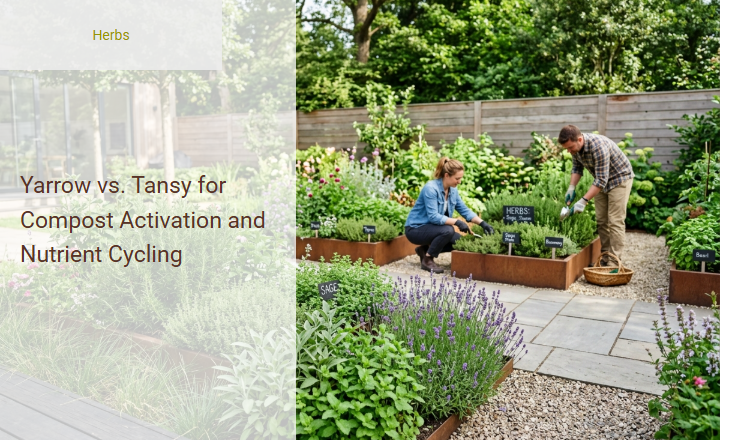
Many organic growers struggle with sluggish compost piles that stall during cooler months, ultimately resulting in nutrient-poor humus that fails to sustain demanding crops. Before turning to synthetic starters, it is essential to understand the ecological role of dynamic accumulators-deep-rooting plants that naturally mine subsoil minerals to revitalize depleted biological systems.
Integrating these botanical activators into your heap grants you a self-sustaining, cost-effective method to accelerate decomposition while drastically upgrading your soil's mineral diversity. However, we must stipulate that these herbal additives are not magic remedies; they still require a baseline of proper pile moisture, volume, and carbon-to-nitrogen ratios to function effectively.
When managed correctly, species like yarrow (Achillea millefolium) rapidly mobilize copper, sulfur, and potassium, while tansy (Tanacetum vulgare) excels at concentrating potassium and iron. In this guide, we will contrast yarrow and tansy across their biochemical acceleration properties, their specific nutrient-cycling profiles, and practical application strategies for your homestead.
Introduction: The Power of Herbal Compost Activators
In the quest for exceptional soil fertility, organic gardeners quickly learn that composting is far more than a simple exercise in balancing green and brown waste. While standard nitrogen-to-carbon ratios establish a functional foundation, they often lack the biochemical spark needed to produce truly dynamic humus. This is where botanical catalysts enter the equation. By introducing specific plants known as dynamic accumulators into the heap, you can transform a passive decay process into an accelerated, nutrient-dense biological reaction.
Plants like Yarrow and Tansy possess an extraordinary capacity to draw minerals from deep within the earth and concentrate them in their tissues. When these herbs are harvested and added to organic matter, they function as natural compost activators. Rather than merely adding mass, they introduce highly concentrated enzymatic triggers that stimulate decomposition at a cellular level, ensuring your finished compost is packed with bioavailable nutrients.
Botanical Profiles: Understanding Yarrow and Tansy
To leverage these plants effectively, we must first understand their physical nature. Yarrow, botanically known as Achillea millefolium, is a hardy perennial characterized by its feathery, aromatic foliage and flat-topped clusters of small flowers. Below the surface, Yarrow spreads via a creeping network of rhizomes and deep, fibrous roots that explore the upper soil horizons and penetrate deep subsoil fissures to extract vital trace minerals.
In contrast, Tansy, or Tanacetum vulgare, exhibits a much more robust and aggressive growth habit. It features deeply divided, fern-like leaves and button-shaped yellow flower heads. Tansy produces a dense, powerful crown and a deep, extensive root system capable of penetrating heavy clays. This muscular root architecture allows Tansy to mine substantial quantities of minerals that remain completely inaccessible to shallower-rooted garden vegetables.
Chemical Composition and Nutrient Profiling
The true magic of these botanical activators lies in their subterranean mining capabilities, which yield highly distinct chemical profiles. When these plants die back or are cut, the concentrated nutrition stored within their cells is released directly into the compost environment, providing essential building blocks for the microscopic soil food web.
- Tansy is an exceptional accumulator of potassium, outperforming many standard green manures and providing a crucial nutrient for flowering and fruiting crops.
- Both plants offer a clean, mineral-rich source of nitrogen that fuels the early stages of bacterial reproduction in the compost pile.
- Yarrow excels in concentrating trace metals, particularly copper and iron, which are vital catalysts for enzymic functions within both plants and soil microbes.
- Yarrow accumulates significant quantities of sulfur, a compound essential for protein synthesis and natural defense mechanisms in soil systems.
Mechanisms of Compost Activation: How They Speed Up Decomposition
The acceleration of compost decomposition by Yarrow and Tansy is not merely a product of their mineral content, but also of their complex organic compounds. These plants are rich in volatile oils, tannins, and flavonoids that act as biochemical stimulants. When introduced to the compost heap, these active compounds rupture and dissolve, feeding the local microbial population and triggering a rapid spike in biological activity.
The introduction of these aromatic herbs triggers a metabolic surge, prompting thermophilic bacteria to multiply exponentially, which rapidly raises the internal temperature of the compost heap and initiates a faster transition from raw organic matter to stable humus.
As these bacterial colonies flourish, they generate significant heat, driving the pile into its crucial thermophilic phase. Simultaneously, the tough cellulose-degrading fungal mycelium is nourished by the complex lignins and trace minerals present in the herbs, ensuring that even woody materials in the heap are systematically dismantled.
Deep Dive: Yarrow as the Compost Doctor
The Homeopathic Force of Achillea
Yarrow has earned a legendary reputation among biodynamic practitioners as the compost doctor. What makes this plant so unique is its efficacy in trace amounts; even a small handful of crushed Yarrow foliage can influence an entire cubic yard of compost. This remarkable efficiency stems from its ability to regulate the decomposition process, ensuring a balanced breakdown of raw organic matter.
One of Yarrow's most critical functions in the heap is its ability to prevent nitrogen loss. During rapid thermophilic phases, nitrogen is frequently lost to the atmosphere as ammonia gas. Yarrow's chemical constituents help bind these volatile nitrogen compounds, keeping them locked within the organic matrix. The resulting finished compost is not only produced more rapidly, but it also boasts a far higher concentration of stable, nutrient-rich humus that is immediately ready to nourish your crops.
Deep Dive: Tansy for Potassium and Pest Management
Potassium Accumulation and Natural Deterrence
While Yarrow excels at chemical regulation and stabilization, Tansy brings physical defense and structural nutrition to the heap. Tansy is a massive accumulator of potassium, a macro-nutrient essential for water regulation, root development, and disease resistance in the garden. By layering Tansy into your pile, you create a finished compost that acts as a slow-release potassium fertilizer, perfect for hungry nightshades and root crops.
In addition to its nutritional value, Tansy possesses a high concentration of intense aromatic compounds, including camphor and thujone. These volatile compounds act as a natural, non-toxic deterrent to unwanted pests like flies, ants, and rodents that might otherwise be attracted to a fresh compost pile. Crucially, these defense compounds target invasive pests without harming the beneficial decomposers, such as earthworms and microscopic organisms, which continue their vital work deep inside the heap.
Impact on Nutrient Cycling and Soil Structure
Integrating these dynamic accumulators into your composting routine yields benefits that extend far beyond the compost pile itself. When the resulting compost is applied to your garden beds, it acts as a long-term soil amendment that permanently improves soil health, structure, and bio-activity.
- The rich microbial diversity stimulated by the herbs helps solubilize locked-up phosphorus in the soil, making it accessible to plant roots.
- The high humic acid content of the finished compost binds tiny soil particles into stable aggregates, creating a crumbly structure that enhances oxygen penetration and water retention.
- The compost acts as a biological sponge, transferring a highly diverse array of beneficial bacteria and fungi directly into the rhizosphere of your crops.
Potential Drawbacks, Toxicity, and Management Risks
While Yarrow and Tansy are outstanding additions to the compost system, responsible gardeners must understand their unique risks. Tansy, in particular, contains thujone, a toxic compound that can be harmful to livestock, pets, and humans if consumed in large quantities. Caution must be taken to ensure that raw Tansy is handled with gloves if you have sensitive skin, and that it is kept away from grazing animals before it goes into the pile.
Furthermore, because of their vigorous spreading nature via underground runners, dynamic accumulators should be grown in dedicated zones of the garden where their root systems can be easily managed and prevented from encroaching on delicate crop beds.
Step-by-Step Guide: How to Apply Yarrow and Tansy to Your Pile
- Harvest at Peak Potency: Cut the foliage of Yarrow and Tansy during late spring or early summer when the plants are in active growth but before they have fully set seed, ensuring maximum nutrient concentration in the vegetative parts.
- Chop the Plant Material: Use shears or a lawnmower to chop the harvested leaves and stems into small, 2-to-3-inch pieces, which breaks the cell walls and exposes the volatile oils to the compost microbes.
- Layer or Blend: Distribute the chopped herbs evenly throughout your compost pile; you can mix them directly with your high-carbon brown layers or use them as thin, 1-inch activator blankets between your green and brown layers.
- Brew a Liquid Activator: To make a rapid liquid drench, stuff a bucket with fresh Yarrow and Tansy leaves, fill it with water, cover, and let it ferment for two weeks. Strain this nutrient-rich tea and pour it over a dry compost pile to kickstart decomposition.
The Verdict: Choosing the Ultimate Botanical Activator
Determining which of these two extraordinary plants to prioritize depends entirely on your specific garden objectives. Both plants bring exceptional qualities to the table, yet they serve distinct ecological and chemical roles. Selecting the right botanical catalyst will allow you to tailor your compost to the exact nutritional and physical needs of your soil food web.
Opt for Yarrow if your primary goal is to establish a balanced, highly regulated decomposition process, prevent nutrient volatilization, and produce a premium, microbe-rich humus designed for general vegetable cultivation. Yarrow acts as a gentle, stabilizing force that works beautifully in almost any composting system, helping to harmonize the relationship between green and brown organic matter.
Conversely, choose Tansy if you are cultivating heavy-feeding, potassium-hungry crops like tomatoes, potatoes, or squash, or if you require an organic mechanism to deter pests from nesting in your heap. Tansy provides a robust, nutrient-dense boost that infuses your soil with structural resilience. By understanding and utilizing these dynamic accumulators, you can move past simple waste management and step into the realm of active, botanical soil creation.
| Feature | Yarrow (Achillea millefolium) | Tansy (Tanacetum vulgare) |
|---|---|---|
| Nutrient Concentration | Highly concentrated in copper, sulfur, potassium, and phosphorus. | High in potassium, iron, nitrogen, and magnesium. |
| Activation Mechanism | Acts as a biological catalyst, rapidly accelerating bacterial decay in trace amounts. | Provides high-nitrogen green biomass to fuel thermophilic (hot) pile phases. |
| Secondary Benefits | Stimulates soil fungi and improves humus formation. | Volatile oils (thujone) deter pests and flies from the compost pile. |
| Application Method | Fresh bruised leaves, or brewed as a concentrated cold-water tea activator. | Coarsely chopped leaves and stems layered directly into the pile. |

Leave a comment