
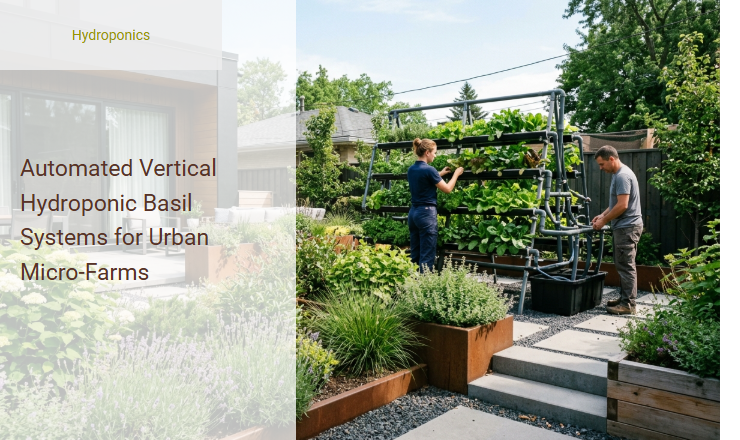
Urban micro-farmers constantly battle the dual constraints of limited city square footage and rising labor costs, making it exceptionally difficult to profitably meet the local demand for fresh herbs. Traditional horizontal layouts and manual irrigation methods simply cannot scale efficiently within these dense metropolitan environments.
Transitioning to vertical configurations offers a logical bridge, granting growers up to ten times the yield per square foot while slashing water consumption. However, capturing this value stipulates a shift in perspective: automated vertical farming is not a hands-off cure, but a system requiring precise technical calibration.
For instance, cultivating high-quality Genovese basil at scale relies on automated dosing pumps to strictly maintain an EC level of 1.6 dS/m and automated LED spectral scheduling. This article will detail the essential automation hardware, environmental parameters, and crop management strategies required to optimize your urban basil yield.
Read also: Rockwool vs Rapid Rooters for Basil Cuttings
The Dawn of Urban Micro-Farming with Vertical Hydroponics
The landscape of global agriculture is undergoing a profound transformation. As urban populations swell and arable land diminishes, traditional soil-based farming is no longer the sole solution for food production. Instead, cities are turning inward, utilizing unused vertical spaces to cultivate high-quality crops. Automated vertical hydroponics represents the vanguard of this agricultural revolution, bypassing the limitations of climate and space to grow food directly within metropolitan centers.
Among the various crops adapted to these soilless systems, sweet basil has emerged as the prime example of a high-yield urban crop. Its delicate nature, high market value, and rapid growth cycle make it the ideal candidate for vertical systems, allowing urban micro-farmers to produce premium-grade culinary herbs year-round with unprecedented efficiency.
Decoding Automated Vertical Hydroponic Systems
At its core, an automated vertical hydroponic system is a highly engineered environment where plants grow in a soil-free medium, with their roots suspended in or directly exposed to a nutrient-rich water solution. Automation acts as the central nervous system of these installations, monitoring and adjusting critical variables in real-time to mimic and enhance natural growing conditions.
- Automated Water Circulation: Timers and flow sensors manage the delivery of water, ensuring roots receive constant moisture without becoming waterlogged.
- Dynamic Nutrient Dosing: Computers adjust the concentration of essential minerals in the water stream based on the growth stage of the crop.
- Precision Light Cycles: Automated microcontrollers control the duration and intensity of the lighting arrays, ensuring plants receive the optimal amount of photosynthetically active radiation every day.
Why Basil is the Crown Jewel of Hydroponic Micro-Farms
Basil possesses a unique biological profile that makes it exceptionally well-suited for hydroponic cultivation. Unlike deep-rooting vegetables, basil features a shallow, fibrous root system that easily adapts to channels and grow cups. In a controlled hydroponic environment, basil experiences *exponential vegetative growth*, skipping the seasonal dormancy periods typical of outdoor field farming.
From an economic standpoint, sweet basil is highly lucrative. Because fresh basil wilts quickly and damages easily during long-distance transportation, local restaurants and grocery stores are willing to pay a premium for *hyper-locally grown, freshly harvested leaves*. The rapid turnaround time-often taking just 21 to 28 days from seed to harvest-allows urban micro-farmers to secure a consistent, high-frequency revenue stream with minimal waste.
Core Automation Components and Sensor Integration
To achieve hands-free operation and maintain perfect growing parameters, vertical hydroponic systems rely on an integrated network of specialized sensors and hardware. These components communicate continuously to prevent human error and stabilize the micro-climate.
pH Sensors: Continuously monitor the acidity levels of the water reservoir, triggering automated pumps to add pH-up or pH-down solutions when levels drift outside the optimal 5.5 to 6.5 range.Electrical Conductivity (EC) Meters: Measure the concentration of dissolved salts in the water, indicating when more raw nutrient concentrates need to be injected.Submersible Water Pumps: Relocate the nutrient solution from the reservoir to the top of the vertical towers, utilizing gravity to feed the plants as the water cascades downward.Microcontrollers: Serve as the central processor, running custom scripts on platforms like Raspberry Pi or Arduino to coordinate sensor data and trigger hardware responses.
Maximizing Urban Space Through Vertical Architecture
The defining advantage of vertical hydroponics is its spatial footprint. By shifting from a horizontal layout to vertical columns or multi-tier racks, urban farms can increase their yield per square foot by over ten times compared to traditional soil farming. This architectural shift allows farms to operate inside tight urban spaces, such as basements, shipping containers, and abandoned warehouses.

Precision Nutrient and Water Recirculation
Hydroponics is inherently more sustainable than traditional soil agriculture, utilizing up to 90% less water through closed-loop recycling. Instead of draining into the earth, water in a vertical hydroponic system flows from a central reservoir, bathes the plant roots, and drains back into the reservoir to be filtered, sterilized, and reused.
| Nutrient Element | Target Concentration (PPM) | Role in Basil Physiology |
|---|---|---|
| Nitrogen (N) | 150 - 200 | Promotes rapid vegetative leaf growth and vibrant green color. |
| Phosphorus (P) | 40 - 60 | Supports robust root system development and cellular energy transfer. |
| Potassium (K) | 200 - 250 | Enhances disease resistance and aids in essential oil synthesis. |
Optimizing Light Spectrums for Maximum Yield
In a windowless urban farm, artificial light entirely replaces the sun. LED grow lights have revolutionized this space by allowing growers to customize the specific light spectrum their plants receive. Rather than wasting energy on green light which plants largely reflect, LEDs focus energy on the precise wavelengths required for photosynthesis.
For basil, a spectrum dominant in blue light (around 450 nanometers) is essential during the early stages to encourage compact, bushy growth and prevent the plants from becoming leggy. As the plants mature, adding a balanced ratio of red light (around 660 nanometers) stimulates the production of volatile compounds and essential oils, which are directly responsible for the sweet, aromatic flavor profile that chefs demand.
Economic Feasibility and ROI of Automated Micro-Farms
Starting an urban vertical micro-farm requires a clear understanding of the initial capital expenditures versus the long-term operational costs. While high-quality sensors, LED lights, and structural framing demand upfront investment, the elimination of pesticide costs, minimal water bills, and reduced transportation logistics dramatically lower the day-to-day overhead.
"By focusing on quick-turnaround, high-value specialty herbs like basil, urban micro-farms can achieve complete return on investment (ROI) within 12 to 18 months of continuous operation, outperforming traditional cash crops grown in open fields."
Overcoming Common Hydroponic Challenges
Despite the high degree of automation, vertical micro-farms are not immune to operational disruptions. System failures can escalate quickly in a soilless environment because the plants lack the buffering capacity that soil naturally provides.
- Root Rot (Pythium): Caused by warm, stagnant water. Prevent this by keeping reservoir temperatures below 68°F (20°C) and maintaining high dissolved oxygen levels.
- Power Outages: A sudden loss of power can stop pumps and dry out roots within hours. Address this risk by integrating backup battery power supplies (UPS) for critical pumps and microcontrollers.
- Nutrient Imbalances: Inaccurate sensor calibration can lead to toxic nutrient buildups. Mitigate this by manually calibrating pH and EC probes weekly using standard reference solutions.
The Scalable Future of Hyper-Local Agriculture
The evolution of urban farming is moving toward total system autonomy. As technology advances, we are seeing the integration of artificial intelligence and machine learning algorithms capable of analyzing camera feeds to detect early signs of pest infestations or nutrient deficiencies long before they are visible to the human eye.
By producing food directly inside the urban centers where it is consumed, automated vertical hydroponic micro-farms eliminate thousands of food miles, slash carbon emissions, and secure food supply chains against external disruptions. The future of food is local, automated, and vertical.
Summary
This article explores the implementation of automated vertical hydroponic systems designed specifically for cultivating basil within urban micro-farms. As urban populations grow and arable land decreases, vertical farming offers a sustainable solution by maximizing spatial efficiency. The system integrates advanced automation technologies to monitor and regulate key environmental factors, including nutrient delivery, pH levels, LED lighting spectrums, and water recirculation.
By automating these processes, the system drastically reduces manual labor while optimizing crop yield, flavor profile, and growth rates compared to traditional soil-based farming. Furthermore, the localized nature of these urban micro-farms significantly cuts down on transportation emissions and food waste. Ultimately, the research demonstrates that automated vertical hydroponics presents a highly viable, resource-efficient, and scalable method for year-round local herb production in dense metropolitan areas.
Leave a comment