
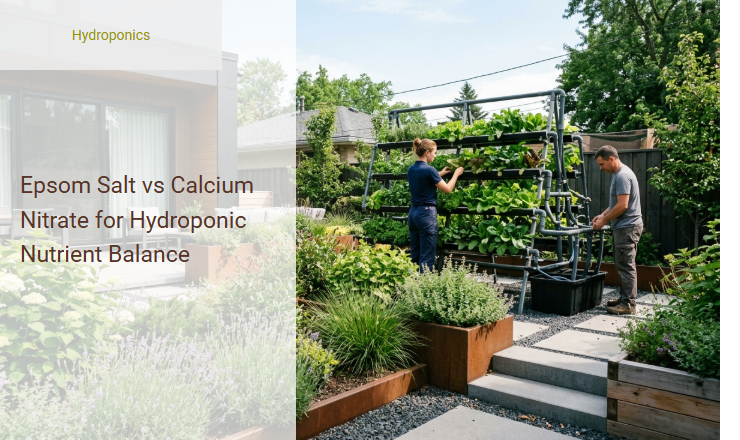
Balancing a hydroponic reservoir can feel like an endless tightrope walk, especially when leaf tip burn or stunted growth signals a sudden nutrient deficiency. Before diagnosing complex system failures, growers must first understand the critical relationship between secondary macronutrients-specifically calcium and magnesium-and how they interact within the root zone. Mastering the targeted application of these elements grants growers the ultimate leverage: absolute control over plant vitality and significantly reduced input costs.
Of course, this strategy assumes your system already maintains a stable pH baseline; these additives are designed to fine-tune, not replace, a balanced base regimen. For instance, heavy feeders like tomatoes demand precise calcium levels to prevent blossom end rot, while leafy greens require magnesium to optimize photosynthesis. Below, we will compare Epsom salt and calcium nitrate, analyze their synergistic relationship, and outline the exact mixing ratios needed to achieve perfect nutrient balance.
Introduction to Hydroponic Nutrient Balance
In soilless cultivation, the water reservoir acts as the sole life-support system for your crops. Achieving a precise hydroponic nutrient balance is not merely a goal; it is a fundamental requirement for plant survival and vitality. Unlike traditional soil gardening, where earth acts as a buffer, hydroponics leaves no room for error. Every single mineral must be dissolved in the water at exact ratios to ensure optimal uptake.
While primary macronutrients like nitrogen, phosphorus, and potassium often dominate the conversation, secondary nutrients are just as crucial. Specifically, calcium and magnesium represent two powerhouse elements that dictate structural integrity and metabolic efficiency. If these essential secondary nutrients are mismanaged, even the most advanced hydroponic system will suffer from stunted growth and diminished yields.
Understanding Calcium Nitrate in Hydroponics
Calcium Nitrate is a highly soluble inorganic salt that serves as a cornerstone of commercial and hobbyist hydroponic fertilizer programs. Chemically denoted as Ca(NO3)2, this compound is uniquely valuable because it delivers two vital elements simultaneously: fast-acting nitrate nitrogen and fully plant-available calcium.
These elements work in tandem to fuel rapid, robust development during both vegetative and flowering cycles. Here are the key benefits of these components:
- Nitrate Nitrogen: Drives vegetative growth, fuels chlorophyll production, and promotes vigorous leaf and stem development.
- Calcium: Serves as the structural "glue" in plant cell walls (as calcium pectate), providing rigidity, regulating cell division, and strengthening the vascular system.
The Role of Epsom Salt (Magnesium Sulfate)
Epsom salt, scientifically known as magnesium sulfate heptahydrate (MgSO4·7H2O), is a highly soluble mineral compound that plays an indispensable role in plant metabolism. It provides two secondary macronutrients: magnesium and sulfur, both of which are critical for converting light energy into chemical energy.
Magnesium acts as the absolute central atom of the chlorophyll molecule, making it essential for the process of photosynthesis. Without adequate magnesium, plants cannot capture light. Meanwhile, the sulfur in magnesium sulfate is a key building block for essential amino acids, facilitating protein synthesis, enzyme activation, and oil production within the plant tissue.
The Golden Ratio: Balancing Calcium to Magnesium
Providing plants with calcium and magnesium is not just about raw volume; it is about proper proportions. In most hydroponic setups, the ideal Calcium-to-Magnesium (Ca:Mg) ratio is generally targeted between 3:1 and 4:1 by weight. Maintaining this delicate balance ensures that both elements are absorbed efficiently without interference.
The Threat of Nutrient Antagonism and Lockout
When the balance between these two minerals is disrupted, plants experience a phenomenon known as nutrient antagonism. Because calcium and magnesium ions carry similar positive charges (divalent cations), they compete for the same uptake pathways in the plant's roots. If you introduce too much calcium, it will effectively crowd out and block magnesium absorption, resulting in an induced magnesium deficiency. Conversely, an excess of magnesium can lock out calcium, leading to structural failures despite both nutrients being present in the reservoir.
How Calcium Nitrate Boosts Plant Structure
Calcium is an immobile nutrient, meaning once it is incorporated into plant tissue, it cannot be translocated to new growth. Therefore, a continuous supply of Calcium Nitrate is mandatory to maintain cellular integrity. Without it, rapidly expanding tissues collapse. This manifests in notorious physiological disorders such as tip burn in lettuce and blossom end rot in tomatoes-both of which are direct results of localized calcium starvation during periods of fast growth.
By supplying adequate Calcium Nitrate, growers can observe a predictable sequence of physiological development that signifies structural health:
- Development of thick, rigid cell walls capable of supporting heavy fruit and foliage.
- Vigorous root tip elongation, ensuring an expansive surface area for water and nutrient absorption.
- Symmetrical, vibrant new leaves free of marginal necrosis or curling.
- Firm, robust fruit set with tough skin resistant to cracking and fungal pathogens.
How Epsom Salt Optimizes Photosynthesis
The primary driver of crop yield is a plant's capacity to convert solar or artificial light into carbohydrates. Epsom salt acts as the chemical catalyst for this energy transformation. Because magnesium forms the core of chlorophyll, its concentration determines how efficiently a plant can absorb photons. When Epsom salt is optimized in the reservoir, the plant maximizes its light-harvesting potential, creating a surplus of sugars that fuel rapid cell division and expansion.
Furthermore, magnesium is highly mobile within the plant. When light levels increase, the plant dynamically relocates magnesium to the upper canopy where photosynthesis is most active. This seamless transport ensures that the high-energy demands of flowering and fruiting are met, directly translating into denser blooms, sweeter fruits, and a substantially higher overall harvest weight.
Prevention of Precipitation: Mixing Chemistry Safely
When working with concentrated hydroponic fertilizers, understanding basic chemistry is vital to avoid system failures. Calcium Nitrate and Epsom Salt (magnesium sulfate) cannot be mixed together in concentrated stock solutions. When these two highly concentrated compounds come into contact, the calcium ions react directly with the sulfate ions to form calcium sulfate, commonly known as gypsum. This compound has incredibly low solubility and will immediately precipitate out of the solution as a milky, chalky sludge.
Once precipitation occurs, the minerals become physically locked in a solid state, making them completely unavailable to your plants. This sludge can also clog drip lines, pump pre-filters, and spray nozzles, causing catastrophic mechanical issues in your hydroponic setup.
Diagnosing Deficiencies: Calcium vs. Magnesium
Identifying nutritional issues quickly can save a harvest. While both calcium and magnesium deficiencies severely impact plant health, they present visual symptoms in completely different areas of the plant due to the mobility of the nutrients.
Identifying Calcium Deficiency
Because calcium is an immobile element, deficiency symptoms manifest first in the newest leaves and growing tips. Look for distorted, hooking leaf tips, marginal necrosis (brown, dying edges), and stunted shoot development. In fruiting crops, watch for dark, sunken, leathery patches at the bottom of the fruit, indicating blossom end rot.
Identifying Magnesium Deficiency
In contrast, magnesium is a highly mobile element. When a shortage occurs, the plant actively pulls magnesium from its older, lower leaves to feed the hungry new growth. This results in interveinal chlorosis, where the veins of the older leaves remain dark green while the tissue between the veins turns pale yellow or white. If left untreated, the leaves will develop reddish-purple tinting before eventually dying.
Recommended Dosage and Reservoir Mixing Guide
Achieving the perfect nutrient solution requires careful measurement and a systematic mixing order. To prevent any risk of nutrient fallout, always follow a strict preparation sequence when adding Calcium Nitrate and Epsom Salt to your active reservoir.
- Calculate the desired dosage based on your target PPM/EC levels; a typical ratio is roughly 2 to 3 grams of Calcium Nitrate and 1 to 1.5 grams of Epsom Salt per gallon of water.
- Fill your hydroponic reservoir with clean, filtered water to about 90% of its total capacity, ensuring the water temperature is between 65°F and 68°F (18°C to 20°C).
- Measure your Calcium Nitrate, dissolve it completely in a separate jug of warm water, and pour it into the reservoir. Stir thoroughly until the water is completely clear.
- Next, add any base NPK nutrients or micro-elements to the reservoir, mixing well after each addition.
- Measure your Epsom Salt, dissolve it entirely in a separate container of water, and slowly add it to the reservoir while agitating the solution.
- Top off the reservoir with the remaining water, check the overall Electrical Conductivity (EC), and adjust the pH to the optimal range of 5.5 to 6.5.
Achieving Hydroponic Success with Balanced Nutrients
Mastering the chemistry of your reservoir is the defining step of a highly productive grower. Calcium Nitrate and Epsom Salt represent a vital metabolic partnership, working in unison to build robust vascular highways and supercharge the photosynthetic engine of your crops. By understanding their individual roles and the chemistry of how they interact, you protect your system from costly precipitation issues and toxic lockouts.
Maintaining a steady, harmonious balance of these essential secondary nutrients yields remarkable results. Your plants will reward you with thicker stalks, faster vegetative growth, exceptional resistance to environmental stress, and bountiful, high-quality harvests. Dedicating attention to these fundamental components is what separates average yields from truly legendary hydroponic success.
| Comparison Feature | Epsom Salt (Magnesium Sulfate) | Calcium Nitrate |
|---|---|---|
| Nutrient Profile | Magnesium (Mg ~10%), Sulfur (S ~13%) | Calcium (Ca ~19%), Nitrogen (N ~15.5%) |
| Primary Plant Function | Chlorophyll production, enzyme activation, energy transfer. | Cell wall structure, apical growth, protein synthesis. |
| Soil pH Impact | Neutral; does not alter soil pH. | Alkalizing; slightly raises soil pH over time. |
| Deficiency Targeted | Interveinal chlorosis (yellowing of older leaves). | Blossom-end rot, tip burn, bud/fruit drop. |
| Solution Compatibility | Highly compatible; mixes easily with most soluble fertilizers. | Incompatible with sulfates/phosphates in concentrated stock (causes precipitation). |
Leave a comment