
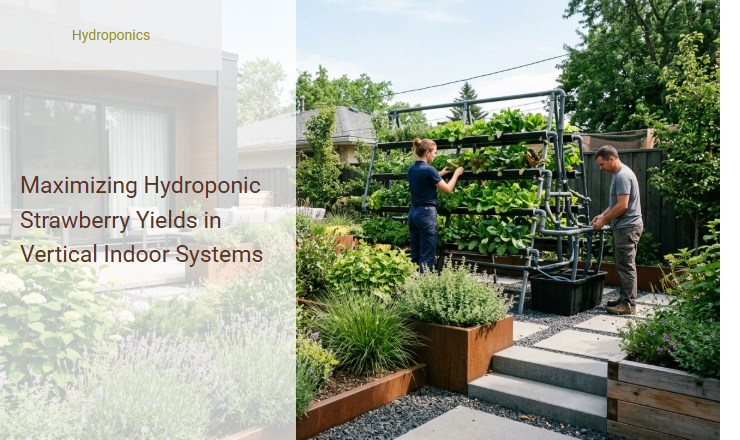
Indoor growers often struggle to transition from simple leafy greens to high-value fruiting crops, frequently facing disappointing strawberry yields and bland flavor profiles despite incurring high energy costs. To bridge this gap, one must first analyze the unique biological demands of the strawberry plant when confined to vertical structures, where microclimates easily develop. Mastering this environmental synergy grants commercial operators the ability to unlock consistent, premium, year-round harvests that command top-market pricing.
However, achieving these results requires a strict commitment to system calibration; success is contingent upon meticulous, automated data tracking. For instance, maintaining a precise electrical conductivity (EC) level between 1.2 and 1.4 mS/cm and deploying a targeted far-red light spectrum are critical to inducing heavy, continuous flowering. In this article, we will outline the advanced nutrient formulations, precise airflow configurations, and optimal photoperiod schedules required to maximize your vertical strawberry farm's output.
Read also: Warm White vs Cool White for Vegetative Growth
Introduction to Vertical Hydroponic Strawberry Cultivation
The agricultural landscape is undergoing a massive transformation, and vertical indoor hydroponic systems are at the forefront of this revolution. By shifting strawberry cultivation from traditional horizontal fields to stacked vertical planes, growers can maximize space efficiency to unprecedented levels. Operating in a controlled indoor environment eliminates the unpredictability of weather, pests, and seasons, unlocking the potential for consistent year-round yields of high-quality, flavorful berries.
Selecting High-Yielding Strawberry Cultivars
Choosing the correct strawberry variety is paramount for the success of a vertical hydroponic facility. Unlike outdoor farming, indoor growers must prioritize continuous production over single, massive seasonal harvests.
- Day-neutral cultivars: Varieties like Albion, San Andreas, and Monterey are highly recommended for indoor setups. They initiate flower buds regardless of day length, ensuring a steady, continuous yield of sweet fruit throughout the year.
- June-bearing cultivars: These produce one large crop over a short period of a few weeks. While they yield exceptionally large berries, their lack of yield continuity makes them less suitable for vertical indoor business models.
Vertical Hydroponic System Architectures
The choice of physical structure dictates operational efficiency, water distribution, and light interception in a vertical farm.
Vertical Towers (Aero-Hydroponic Columns)
These systems utilize central columns where water cascades down from the top, feeding the root systems of strawberries protruding from the sides. They offer exceptional space efficiency, though uneven light distribution between the top and bottom of the tower can sometimes occur.
A-Frame Hydroponic Systems
An A-frame structure supports horizontal gutters stacked diagonally. This configuration allows natural or overhead artificial light to hit the plants more evenly, though it requires a larger footprint compared to vertical columns.
ZipGrow-style Vertical Channels
These systems use vertical tracks with a specialized fiber growing medium. They provide highly efficient water usage and excellent crop support, though inserting and extracting plants during transplanting cycles requires more labor.
Optimizing the Nutrient Solution and pH Levels
Strawberries are highly sensitive to salt buildup and improper nutrient balance. Maintaining precise electrical conductivity (EC) and pH levels ensures optimal fruit sweetness and root health.
| Growth Stage | Target pH Range | Target EC (mS/cm) | Key Nutritional Focus |
|---|---|---|---|
| Vegetative Stage | 5.5 - 6.0 | 1.2 - 1.5 | Higher Nitrogen (N) for foliage development |
| Flowering Stage | 5.8 - 6.2 | 1.4 - 1.8 | Increased Potassium (K) and Phosphorus (P) |
| Fruiting Stage | 5.8 - 6.2 | 1.6 - 2.0 | High Potassium (K) and Calcium (Ca) for sweetness and firmness |
Perfecting LED Light Spectrums and Photoperiods
Indoor strawberries rely entirely on artificial lighting to drive photosynthesis and flower induction. Modern LED fixtures allow growers to tailor light recipes to specific growth phases.
Vegetative and Canopy Development
During the early vegetative phase, use a light spectrum richer in blue wavelengths to promote compact, sturdy growth. A target photoperiod of 18 hours with a daily light integral (DLI) of 15-18 mol/m²/day is ideal.
Flowering and Fruiting Stages
To induce heavy flowering and increase fruit sugar content, shift the spectrum to favor red and far-red wavelengths. Increase the PPFD (Photosynthetic Photon Flux Density) to 250-350 µmol/m²/s to achieve a DLI of 20-25 mol/m²/day under a 16-hour photoperiod.
Managing Indoor Climate, Humidity, and Vapor Pressure Deficit
Maintaining the perfect balance between temperature and humidity is critical to preventing physiological disorders like tipburn, which is caused by localized calcium deficiency during rapid growth. Airflow and Vapor Pressure Deficit (VPD) must be actively monitored.
Sufficient horizontal airflow using specialized fans ensures that boundary layers around the leaves are broken, facilitating proper transpiration and preventing moisture accumulation on the fruit.
Indoor Pollination Strategies for High Fruit Set
Without wind or wild insects, indoor growers must manually or mechanically facilitate pollination to prevent misshapen berries and ensure high yields.
- Manual Hand Pollination: In small-scale setups, growers can use a soft-bristled makeup brush or paint brush to gently transfer pollen from the outer anthers to the central pistils of each open flower.
- Mechanical Vibration: Using leaf blowers on a low setting or air-circulating fans to gently vibrate the plants can successfully shake pollen loose within self-pollinating strawberry blossoms.
- Commercial Bumblebees: For large-scale vertical farms, introducing managed hives of commercial bumblebees (such as Bombus impatiens) provides the most efficient and thorough pollination.
Pruning and Canopy Management in Vertical Columns
In dense vertical setups, managing the plant canopy is essential for keeping light distribution uniform and humidity levels low. Strawberries constantly produce runners (stolons), which must be promptly removed to prevent the plant from wasting energy on vegetative cloning instead of fruit production. Regularly thinning out old, yellowing leaves from the base of the crown improves airflow, limits microclimates where pathogens thrive, and ensures light reaches the developing green berries.
Integrated Pest and Disease Management
Controlled environments are not immune to pests; when a pathogen or insect enters a vertical farm, the dense, warm environment can cause rapid spreads.
Common Pathogens and Pests
Powdery mildew, grey mold (Botrytis cinerea), two-spotted spider mites, and thrips are the primary threats to indoor strawberry production.
Biological and Preventative Controls
- Introduce predatory mites, such as Phytoseiulus persimilis, to control spider mite populations without chemical intervention.
- Deploy beneficial wasps or lacewings to naturally target thrips and aphids.
- Maintain strict biosecurity protocols, including air showers and dedicated indoor footwear, to prevent introduction of pests.
Harvesting and Post-Harvest Optimization
Strawberries do not continue to ripen after harvest, so timing is critical. Berries should be harvested when they are at least 90% red to ensure maximum sugar content and optimal flavor profile. Hand-harvesting should be done carefully by pinching the stem above the calyx rather than pulling the fruit directly, which prevents bruising. To preserve shelf life and arrest decay, transfer the harvested berries to a rapid cooling chamber at post-harvest, reducing their temperature to 2°C (35°F) for transport.
Summary
This comprehensive article explores advanced strategies for maximizing crop yields in vertical indoor hydroponic strawberry systems. By leveraging vertical space, growers can exponentially increase plant density and overall output per square foot compared to traditional farming methods. The guide highlights the critical role of environmental control, emphasizing the precise management of LED light spectrums, photoperiods, temperature, and relative humidity to trigger robust flowering and fruiting.
Furthermore, it details essential nutrient delivery methods, such as the Nutrient Film Technique (NFT), stressing the importance of maintaining optimal electrical conductivity (EC) and pH levels tailored specifically for strawberry cultivars. By integrating automated climate monitoring, precise hand-pollination techniques, and high-yielding day-neutral varieties, indoor cultivators can achieve consistent, high-quality, year-round strawberry production while dramatically minimizing water use and eliminating the need for chemical pesticides.
Leave a comment