
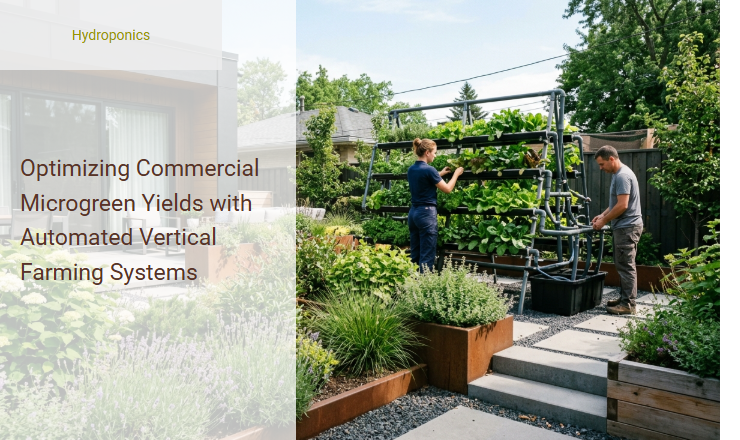
Commercial microgreen growers constantly battle razor-thin margins driven by erratic crop yields and soaring manual labor costs. While scaling operations traditionally meant acquiring more physical real estate, urban resource constraints and rising land costs now make horizontal expansion highly impractical. Transitioning to automated vertical farming systems bridges this gap, granting growers unprecedented year-round yield predictability and maximized profit margins.
However, automation is not a simple plug-and-play endeavor; maximizing output requires strict adherence to system calibration. Implementing automated ebb-and-flow irrigation and dynamic LED spectrum scheduling, for instance, is critical to preventing crop mold while accelerating harvest cycles. This article explores the core automation technologies, calibration strategies, and ROI considerations necessary to scale your commercial microgreen production successfully.
Read also: Flat Trays vs Channel Trays for Microgreen Propagation
The Rise of Automated Vertical Farming for Microgreens
Commercial microgreen production has evolved from a niche culinary trend into a high-value sector of modern agriculture. These nutrient-dense, fast-growing crops demand meticulous environmental management to transition from delicate sprouts to marketable greens. Traditional horizontal farming models struggle to remain profitable due to soaring labor costs and high spatial footprints. Automated vertical farming is the key to maximizing yields, quality, and year-round crop consistency. By stacking cultivation layers vertically and automating core processes, growers can produce massive volumes of high-quality microgreens in a fraction of the space, completely independent of external weather conditions.
Understanding Controlled Environment Agriculture (CEA)
Controlled Environment Agriculture (CEA) represents a technology-based approach to food production. In vertical microgreen farms, CEA transforms the cultivation room from a simple greenhouse into a highly sophisticated, closed-loop bioreactor. By enclosing the growing space, operators exercise total authority over all inputs and ambient variables. This level of manipulation ensures that optimal growing conditions are sustained twenty-four hours a day.
Eliminating environmental unpredictability allows vertical farms to bypass seasonal constraints. Rather than reacting to outdoor weather shifts, the system proactively maintains a perfect microclimate. This absolute stability accelerates vegetative growth phases, leading to shorter crop cycles, heavier harvest weights, and a level of product uniformity that outdoor or traditional greenhouse operations cannot match.
Precision LED Lighting Spectrums for Microgreen Growth
Microgreens respond dramatically to the composition of light they receive during their brief growth cycles. By utilizing narrow-band LED fixtures, commercial growers can tailor specific light recipes to manipulate plant morphology and maximize quality.
- Blue light (450 nm): Promotes robust chlorophyll absorption, stimulates stomatal opening, and triggers the production of secondary metabolites that enhance flavor profiles and nutritional density.
- Red light (660 nm): Drives photosynthesis efficiency, encourages biomass accumulation, and supports rapid leaf development.
- Far-red light (730 nm): Can be carefully introduced to initiate shade avoidance responses, helping control hypocotyl elongation for easier mechanical harvesting.
Applying these targeted wavebands at specific intervals ensures that crops develop strong stems, vibrant colors, and optimal nutritional potency without wasting electrical energy on unneeded spectrums.
Automated Irrigation: Hydroponics versus Aeroponics
Irrigation delivery systems form the lifeblood of vertical farming operations, ensuring uniform moisture delivery to dense canopies.
| System Type | Water-Use Efficiency | Root Oxygenation | Automation Compatibility |
|---|---|---|---|
| Ebb-and-Flow Hydroponics | High (Recirculating) | Moderate (Intermittent Drainage) | Excellent (Simple Valve Controls) |
| Aeroponic Misting | Ultra-High (Minimal Runoff) | Excellent (Suspended in Air) | High (Requires Precise Timer Calibration) |
Ebb-and-flow hydroponics remains the industry workhorse due to its mechanical simplicity and resistance to clogging. It floods growing trays at timed intervals, allowing the substrate to soak up nutrients before draining back to a central reservoir. Aeroponic misting offers even greater water savings and superior root oxygenation by spraying a fine nutrient mist directly onto exposed roots. However, aeroponics demands precise control mechanisms and carries a higher risk of system failure if nozzles clog, making automated monitoring critical for crop safety.
Dynamic Climate Control and Vapor Pressure Deficit (VPD)
In high-density vertical arrays, transpiration from millions of tiny leaves can quickly oversaturate the surrounding air, creating stagnant microclimates. Automated HVAC systems combined with variable-speed circulation fans are essential to continuously mix the air and keep temperature and relative humidity within strict parameters. These systems adjust dynamically to maintain a steady Vapor Pressure Deficit (VPD) across all tiers.
When the VPD is too low, plants cannot transpire, which halts the transport of calcium and leads to tip burn and structural weakness. Conversely, an excessively high VPD forces stomates to close to conserve water, stalling growth. Dynamic automated controls constantly measure ambient conditions and adjust cooling, heating, and dehumidification equipment in real time to keep the VPD at ideal levels.
Selecting Substrates for Automated Seeding Systems
The choice of growing media directly affects germination rates, root anchorage, and the overall compatibility of the crop with automated seeding systems.
For automated seed lines to distribute seeds uniformly and avoid issues during automated harvesting, the substrate must possess a consistent texture, optimal water retention, and structural integrity. Several materials are commonly evaluated for commercial operations:
- Coconut Coir: Provides exceptional moisture retention and outstanding root aeration, making it highly reliable for automated dispensers.
- Peat Moss: Highly absorbent and naturally acidic, though its fine particle size can sometimes clog automated handling machinery if not mixed correctly.
- Hemp Mats: Offer a clean, biodegradable option that fits neatly into standardized trays, facilitating rapid root penetration and hassle-free post-harvest cleanup.
- Reusable Meshes: Eliminate consumable substrate costs entirely, providing a sterile surface that aligns perfectly with automated washing and sanitizing equipment.
IoT Sensors and Real-Time Data Analytics
Modern vertical farming relies on a network of IoT sensors that constantly monitor environmental health. These digital instruments transmit data packages every few seconds to a central building management system, translating biological conditions into actionable digital assets.
To keep the nutrient solution in perfect balance, sensors continuously measure pH to verify acidity levels and electrical conductivity EC to calculate overall dissolved salt concentrations. Soil moisture sensors monitor substrate saturation, while ambient sensors log air temperature and carbon dioxide concentrations. When any reading moves outside the pre-programmed safety threshold, the central automation software immediately triggers corrective actions-such as activating dosing pumps, opening fresh air dampers, or adjusting LED intensities-without requiring human intervention.
Preventing Mold and Pathogens in High-Density Canopies
The high-density planting style required to make commercial microgreens profitable creates a humid boundary layer at the crop canopy. This environment is highly susceptible to fungal outbreaks, such as damping-off caused by Pythium or gray mold from Botrytis. Automated environmental control serves as the primary defense mechanism against these costly crop failures.
"Consistent vertical and horizontal airflow, coupled with continuous dehumidification, prevents the localized microclimates where mold spores thrive."
Advanced facilities integrate automated UV-C sterilization systems within their irrigation loops to destroy waterborne pathogens. High-rate airflow designs ensure air moves consistently through every level of the vertical racks, disrupting the humid boundary layer. Automated dehumidifiers respond instantly to spikes in humidity, keeping the canopy dry and disease-free.
Automated Harvesting and Post-Harvest Preservation
Harvesting microgreens manually is a labor-intensive bottleneck that can quickly erode a farm's profit margins. Automated harvesting machines solve this challenge by utilizing high-speed reciprocating blades that cut the delicate stems cleanly at a uniform height just above the substrate level.
Once cut, microgreens must be processed immediately to halt cellular degradation. Automated conveyor belts transfer the harvested greens directly into rapid cooling tunnels or vacuum-cooling chambers, lowering the product's core temperature to 36 degrees Fahrenheit within minutes of harvest.
Scaling Up: ROI and the Future of Automated Microgreen Yields
Transitioning from manual operations to an automated vertical system involves significant upfront capital expenditure. However, the return on investment (ROI) becomes clear when evaluating long-term operational efficiency. By automating seeding, irrigation, climate control, and harvesting, commercial growers reduce their direct labor costs by up to seventy percent.
Beyond labor savings, automation guarantees predictable yields and uniform quality that command premium pricing from distributors, restaurants, and retail chains. As sensor technology, machine learning, and robotics continue to advance, the cost of automated vertical equipment will decrease. Commercial growers who adopt and master these automated platforms are uniquely positioned to scale their operations quickly, secure market share, and deliver fresh, sustainable produce to urban centers throughout the entire year.
Summary
The article "Optimizing Commercial Microgreen Yields with Automated Vertical Farming Systems" explores how integrating advanced automation into vertical agriculture addresses the surging market demand for high-quality microgreens. By replacing manual labor with automated systems for climate control, spectrum-specific LED lighting, and precise hydroponic irrigation, commercial growers can meticulously regulate the cultivation environment.
This technological optimization leads to significantly higher crop yields, accelerated growth cycles, and superior nutritional profiles compared to traditional farming methods. Furthermore, the study highlights the resource efficiency of automated vertical setups, noting substantial reductions in water consumption, labor costs, and physical footprint. Ultimately, automated vertical farming emerges as a highly scalable, sustainable, and profitable solution for year-round urban agriculture, offering a viable blueprint for modern commercial growers to maximize productivity while minimizing operational overhead.
Leave a comment