
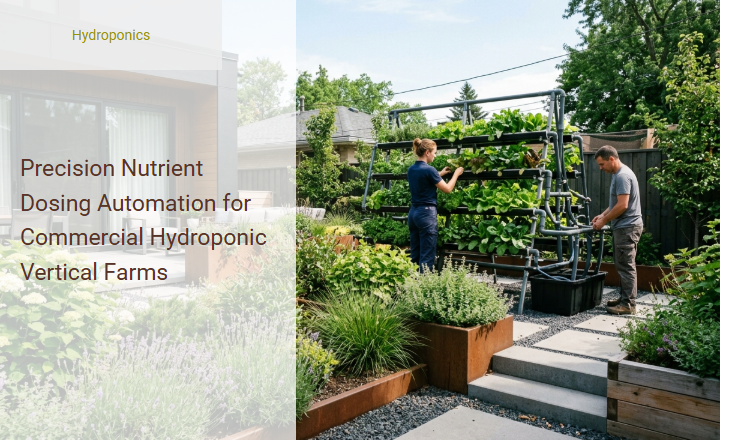
Commercial vertical farming operators constantly battle the costly volatility of crop inconsistency and labor-intensive reservoir management. As facilities scale to meet soaring market demands, relying on manual nutrient mixing becomes an operational bottleneck that threatens profit margins. Precision nutrient dosing automation bridges this gap, granting growers unprecedented control over crop recipes and unlocking ultimate yield predictability.
However, automation is not a plug-and-play cure-all; successful deployment stipulates a rigorous alignment between system calibration and dynamic crop chemistry. For instance, maintaining strict electrical conductivity (EC) and pH parameters for fast-growing leafy greens requires highly responsive peristaltic pumps integrated with real-time sensor loops. This article will examine the essential hardware components of dosing automation, sensor calibration best practices, and the strategic integration steps needed to optimize your commercial facility.
Read also: Organic vs Synthetic Nutrients for Leafy Greens
The Revolution of Precision Nutrient Dosing in Vertical Farming
The modern agricultural landscape is undergoing a massive paradigm shift, driven by the rapid expansion of commercial hydroponic vertical farms. To achieve maximum crop yields and establish long-term environmental sustainability, operators are abandoning manual processes in favor of precision nutrient dosing automation. This technological leap allows farms to deliver exact chemical ratios to plant root zones with unmatched accuracy.
By automating the delivery of liquid fertilizers, commercial growers can eliminate human error, optimize resource consumption, and dramatically accelerate crop growth cycles. As urban populations rise and arable land decreases, these automated systems are no longer just an operational advantage-they are a fundamental necessity for scalable food production.
Demystifying Hydroponic Crop Nutrition
Plants grown in soil-free vertical systems depend entirely on irrigation water to deliver essential elements directly to their root systems. These elements are divided into macronutrients, which plants consume in large quantities, and micronutrients, which are required in trace amounts to facilitate metabolic and developmental pathways.
- Macronutrients: Nitrogen (N) for vegetative growth, Phosphorus (P) for root and flower development, and Potassium (K) for overall cellular regulation, alongside secondary macronutrients like Calcium, Magnesium, and Sulfur.
- Micronutrients: Iron, Manganese, Zinc, Boron, Copper, and Molybdenum, which act as catalysts for enzymatic reactions and chlorophyll synthesis.
The nutritional requirements of crops change dynamically as they transition from seedling to vegetative and reproductive stages. For example, leafy greens require high nitrogen levels during vegetative expansion, while fruiting cultivars need shifted ratios of potassium and phosphorus during flowering. Failing to match these precise ratios leads to deficiency or toxicity, crippling yield potential.
Manual vs. Automated Dosing: The Cost of Inefficiency
Traditional manual nutrient dosing relies on human operators measuring concentrated fertilizers and mixing them directly into reservoirs. This approach is highly vulnerable to inaccuracies, creating a volatile growing environment that compromises crop quality and wastes expensive inputs.
| Operational Parameter | Manual Dosing Methods | Automated Dosing Systems |
|---|---|---|
| Labor Requirements | High; continuous manual labor and constant monitoring needed. | Low; system operates autonomously with scheduled maintenance. |
| Chemical Precision | Poor; subject to measurement errors and delayed adjustments. | Extremely High; precision injection based on real-time feedback. |
| Resource Waste | Significant; frequent reservoir dumps due to chemical imbalances. | Minimal; precise dosing conserves both water and fertilizer. |
| Response Time | Slow; corrections occur only during manual testing rounds. | Instantaneous; continuous monitoring triggers immediate adjustments. |
Anatomy of an Automated Dosing System
A commercial-grade automated dosing system is an assembly of specialized plumbing and electronic hardware engineered to work in perfect synchronization.
Peristaltic Pumps and Solenoid Valves
Peristaltic pumps are the workhorses of nutrient delivery, utilizing rotating rollers to compress flexible tubing and push precise micro-doses of concentrated liquid nutrients into the water stream. Solenoid valves act as electronically controlled gates, opening and closing rapidly to regulate water flow and prevent backflow between different chemical lines.
Stock Tanks and Concentrated Reservoirs
Commercial facilities utilize separate, highly concentrated stock tanks for incompatible elements-such as Calcium and Phosphate-which would otherwise precipitate into solid minerals if mixed directly in concentrated forms. Automated systems draw from these distinct reservoirs and dilute them on-demand.
Programmable Logic Controllers (PLCs)
The Programmable Logic Controller serves as the central brain of the dosing unit. It processes sensor signals, compares the inputs against pre-configured target recipes, and sends precise electrical commands to the pumps and valves to maintain the ideal nutritional balance.
Critical Water Chemistry Parameters to Monitor
For automated dosing to be effective, the system must continuously analyze the physical and chemical state of the irrigation water. Small deviations in water chemistry can quickly lock out nutrients, preventing root absorption and causing crop failure.
pH (Potential Hydrogen)
The pH value measures the acidity or alkalinity of the nutrient solution. Most hydroponic crops thrive in a slightly acidic range of 5.5 to 6.5. If the pH drifts outside this window, essential elements like iron and phosphorus become chemically unavailable, resulting in rapid nutrient deficiencies.
Electrical Conductivity (EC)
Electrical Conductivity indicates the total concentration of dissolved salts in the water. High EC values point to an overly concentrated solution that can burn roots and cause osmotic stress, while low EC values indicate starvation.
Dissolved Oxygen (DO) and Temperature
Water temperature directly impacts both root respiration rates and the solubility of oxygen. Maintaining high Dissolved Oxygen levels at optimal temperatures between 18°C and 21°C maximizes root nutrient uptake efficiency and suppresses harmful pathogens.
The Role of IoT and Smart Sensors in Data Acquisition
Modern vertical farms leverage Internet of Things (IoT) architectures to capture and stream environmental data at unprecedented resolutions. Smart sensor arrays placed within the reservoir and irrigation manifolds continuously capture chemical readings and transmit them wirelessly to central software dashboards.

AI-Driven Algorithmic Dosing and Predictive Modeling
Moving beyond simple reactive adjustments, advanced vertical farms integrate machine learning algorithms to anticipate crop needs. By training models on historical growth cycles, climate variables, and yield data, these systems construct predictive curves that proactively adjust nutrient recipes before deficiencies manifest.
"By applying machine learning models to real-time runoff data, our automated facility adjusts individual ionic ratios hour-by-hour, maximizing photosynthetic efficiency and cutting vegetative growth cycles by up to fifteen percent."
Maximizing Commercial ROI and Resource Efficiency
Investing in automated dosing infrastructure yields substantial economic dividends for commercial operators. By eliminating human error, farms experience a drastic reduction in crop loss and a massive boost in product consistency, which directly translates to premium wholesale pricing.
Resource conservation is another major driver of profitability. Automated systems use exact volumetric dosing to prevent over-fertilization, reducing fertilizer input costs by up to 30%. Furthermore, when coupled with closed-loop water reclamation systems, automated dosing allows farms to safely recirculate runoff water, achieving up to 95% water savings compared to traditional open-field farming.
Overcoming Operational Challenges and System Failures
While automated systems deliver incredible performance, they are not immune to wear and mechanical failures. Vertical farm operators must implement strict maintenance protocols to prevent system downtimes.
Sensor Drift and Calibration
Over time, pH and EC probes experience sensor drift due to biofouling and chemical scaling on their glass electrodes. Regular calibration is vital to maintain accuracy.
- Clean probe tips weekly using specialized cleaning solutions and soft brushes.
- Calibrate sensors bi-weekly using certified pH and EC reference buffer solutions.
- Implement redundant sensors to cross-verify readings and flag anomalous drift automatically.
Physical Blockages and Power Disruptions
Nutrient crystallization can clog the narrow orifices of peristaltic tubing and solenoid valves, leading to under-dosing. Regular system flushes with mild organic acids prevent salt buildup. Additionally, deploying uninterruptible power supplies (UPS) and automated backup generators ensures that PLC controllers and dosing pumps keep running during electrical grid failures.
The Future Horizon of Autonomous Vertical Agriculture
The evolution of indoor farming points toward completely closed-loop, fully autonomous agricultural facilities. The next generation of automated systems will move beyond broad reservoir-level dosing to target individual plant microclimates, customizing nutrient profiles dynamically using multispectral camera systems that detect plant stress invisible to the human eye.
As robotic manipulators and automated guided vehicles take over the physical planting, spacing, and harvesting steps, the integration of autonomous nutrient replenishing networks will solidify vertical farming as a highly efficient, climate-resilient solution for global food security. The marriage of hardware automation and deep learning algorithms will ensure that vertical farms operate at peak biological efficiency, delivering maximum yield with a minimal ecological footprint.
Summary
This article explores the critical role of precision nutrient dosing automation in modern commercial hydroponic vertical farming. As the demand for sustainable and high-yield agriculture grows, manual nutrient management proves inefficient and prone to human error. Automated dosing systems solve this challenge by utilizing advanced sensors, real-time data monitoring, and IoT-enabled feedback loops to deliver precise ratios of essential minerals while constantly maintaining optimal pH and EC (electrical conductivity) levels.
By dynamically adjusting nutrient solutions to meet specific crop needs at various growth stages, these automated technologies significantly enhance crop quality, maximize yields, and minimize water and fertilizer waste. Additionally, the integration of automation reduces labor costs and mitigates operational risks, making vertical farming more economically viable and scalable. Ultimately, precision dosing is presented as a cornerstone technology for the future of resource-efficient, resilient, and highly productive urban agriculture.
Leave a comment