
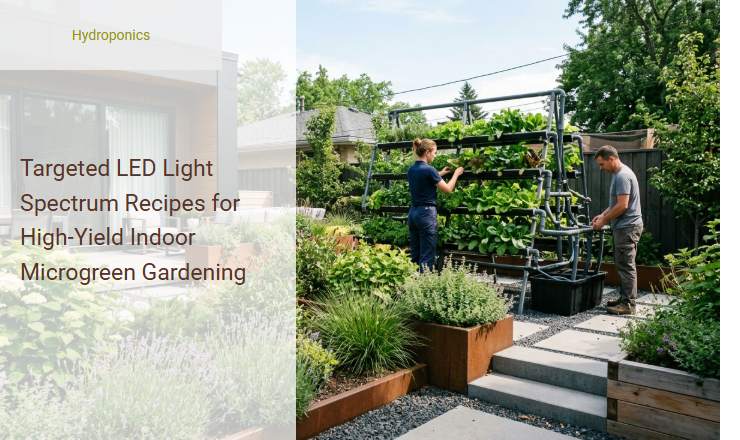
Many indoor growers share the frustration of harvesting leggy, pale microgreens that lack the robust flavor and weight expected of premium crops. While irrigation and substrate quality are critical, the root of this issue often lies in generic lighting systems that fail to target the specific photoreceptors of developing seedlings. Mastering targeted LED light spectrums bridges this gap, granting growers the ability to dramatically maximize yield, enhance phytochemical density, and intensify natural crop flavors.
It is important to stipulate, however, that spectral optimization is not a standalone remedy; it must operate alongside precise temperature and humidity controls to be effective. For example, applying a blue-heavy spectrum (around 450 nm) during the early post-blackout phase of broccoli microgreens prevents stretching, resulting in thick stems and expanded cotyledons. In this article, we will detail specific spectral recipes, analyze waveband ratios, and provide actionable setups to elevate your indoor microgreen yields.
Read also: Blue Spectrum vs Red Spectrum for Leaf Development
Introduction to Photomorphogenesis in Microgreens
In the controlled environment of indoor vertical farming, light is much more than a simple energy source; it is a powerful informational signal. Photomorphogenesis-the process by which plants alter their anatomy, growth rate, and physiological chemistry in response to different colors of light-allows growers to actively sculpt their crops. By utilizing targeted LED light spectrums, indoor farmers can manipulate the development of microgreens without changing the nutrient solution or ambient temperature. This customized spectral tuning directly influences how quickly the crop matures, how robustly the plants stand, and the concentration of volatile compounds that define their flavor profile. Precise control over light wavebands translates directly to enhanced yield, crisp texture, and intense culinary appeal.
The Blue Spectrum (450 nm) for Structural Integrity
Engineered Compactness
The blue wavelength, specifically centered around 450 nm, plays a foundational role in establishing the physical structure of microgreens. This wavelength is highly absorbed by cryptochromes and phototropins, photoreceptors responsible for regulating key developmental processes. When young seedlings receive adequate blue light, it suppresses cell elongation in the stem, effectively preventing hypocotyl elongation. Instead of stretching upward in search of light and becoming weak, the microgreens develop short, thick, and robust stems that can support heavy cotyledons.
Stomatal Regulation and Sturdiness
Beyond structural height, blue light at 450 nm acts as a primary trigger for stomatal opening, regulating transpiration and gas exchange. Strong stomatal activity encourages nutrient uptake, particularly calcium, which strengthens cell walls. This results in a crisp, sturdy texture. Delivering a consistent dose of blue light early in the photoperiod ensures that the crops develop structural integrity, preventing lodging (falling over) and making the final harvesting process significantly cleaner and more efficient.
The Red Spectrum (660 nm) for Biomass Accumulation
Fueling Photosynthetic Drivers
While blue light establishes structural discipline, the red spectrum centered at 660 nm is the primary engine of photosynthesis. Chlorophyll a and b exhibit high absorption peaks within this band, converting light energy into chemical energy with outstanding efficiency. Under dominant red light, microgreens prioritize leaf expansion and rapid cell division, resulting in broad, lush cotyledons that capture even more light.
Maximizing Commercial Yield
For commercial growers, utilizing 660 nm light is key to maximizing overall harvest weight. Fast-tracking biomass accumulation ensures that crops reach their target weight in fewer days, increasing cycles per year. However, relying solely on red light can cause plants to stretch unnaturally. Combining red with blue creates a balanced environment where the plant is both structurally sound and highly productive, ensuring a heavy, high-quality canopy at harvest.
Far-Red (730 nm) and the Shade Avoidance Response
Triggering the Stretching Reflex
Far-red light, occupying the 730 nm wavelength, sits on the edge of the visible spectrum and interacts with the phytochrome system. When plants detect a high ratio of far-red to red light, they perceive that they are being shaded by taller neighbors. This triggers the shade avoidance response, a physiological reflex where the plant rapidly elongates its stems and petioles to rise above the imaginary competition.
Strategic Application in Microgreens
In microgreen cultivation, this reaction can be strategically harnessed. Introducing controlled pulses of 730 nm light during the early growth phases can gently stretch the stems, making the crop easier to cut during harvest. However, this must be carefully managed. Excessive exposure to far-red light can lead to weak, leggy stems that collapse under their own weight. Balancing the ratio of red to far-red is essential to capture the benefits of height without compromising physical stability.
Green Light (500-550 nm) for Deep Canopy Penetration
Reaching the Lower Layers
Green light, spanning 500-550 nm, was historically dismissed as useless because chlorophyll reflects a portion of it, giving leaves their green color. Modern photobiology, however, highlights its crucial role in dense growing setups. While red and blue light are heavily absorbed in the uppermost layers of the microgreen canopy, green light penetrates much deeper. It passes through the top leaves to reach the lower, shaded foliage that would otherwise starve in darkness.
Optimizing Canopy Efficiency
By incorporating 500-550 nm wavelengths into the spectral mix, growers ensure that the entire vertical profile of the microgreen tray remains active. This deep penetration drives photosynthesis in the understory leaves, maintaining uniform growth across the tray. The result is a more even crop height, fewer yellowing lower leaves, and a boost in overall canopy health.
Recipe One: The Germination and Rooting Spectrum
Establishing a Strong Foundation
The first few days following the blackout phase are critical for root establishment and early stem organization. This recipe is designed to stimulate downward root growth while keeping the young stems compact and upright as they transition to light.
Spectral Composition and Strategy
- Blue Light (450 nm): 35% to prevent immediate stretching and lock in stem thickness.
- Red Light (660 nm): 55% to initiate photosynthesis and build cellular energy.
- Far-Red Light (730 nm): 10% to provide a gentle upward pull, encouraging upright posture without causing weakness.
Applying this ratio during the first 72 hours of illumination ensures that the seedlings establish a strong root system and a stable, upright frame before vegetative growth accelerates.
Recipe Two: Maximum Biomass and Yield
Accelerating Foliar Growth
Once the root system is established, the focus shifts to maximizing leaf surface area and overall crop weight. This recipe channels energy into photosynthesis, driving fast cell division and expanding the cotyledons to their maximum size.
Spectral Composition and Strategy
- Red Light (660 nm): 70% to serve as the primary energy source for rapid biomass accumulation.
- Blue Light (450 nm): 15% to maintain structural discipline and prevent the canopy from collapsing.
- Green Light (530 nm): 15% to penetrate the closing canopy and keep the lower stems and leaves active.
This formulation maximizes photosynthetic efficiency, allowing growers to produce heavy, lush trays of microgreens in the shortest possible time frame, maximizing commercial yield.
Recipe Three: Phytochemical and Flavor Enhancement
Triggering Defense Responses
In the final phase of growth, light can be used as a tool to stimulate the production of secondary metabolites. By subjecting the plants to a mild, controlled light stress, we trigger the synthesis of compounds that protect the plant and enhance its culinary value.
Spectral Composition and Strategy
- Blue Light (450 nm): 80% to maximize the activation of cryptochromes, driving the production of antioxidants and pigments.
- UV-A Light (385 nm): 5% to stimulate defense mechanisms, accumulating anthocyanins and phenolic compounds.
- Red Light (660 nm): 15% to maintain basic metabolic functions.
Applying this high-blue, UV-enhanced recipe during the final 48 hours before harvest dramatically boosts flavor intensity, sharpens the color of red and purple varieties, and extends post-harvest shelf life.
Managing PPFD, DLI, and Photoperiod
To successfully implement these spectral recipes, growers must manage the quantity of light delivered to the crop. Photosynthetic Photon Flux Density (PPFD) measures the intensity of light reaching the canopy per second, while the Daily Light Integral (DLI) measures the total amount of light delivered over a 24-hour period. Balancing PPFD and photoperiod ensures microgreens receive optimal energy without suffering from light burn or wasting electricity.
| Growth Phase | Target PPFD (µmol/m²/s) | Photoperiod (Hours) | Target DLI (mol/m²/day) |
|---|---|---|---|
| Rooting (Post-Blackout) | 100 - 150 | 18 | 6.5 - 9.7 |
| Vegetative (Bulk Growth) | 200 - 250 | 18 | 12.9 - 16.2 |
| Finishing (Pre-Harvest) | 150 - 200 | 16 | 8.6 - 11.5 |
Best Practices for Implementing Custom LED Spectra
When transitionining to spectrum-specific cultivation, selecting programmable multi-channel LED fixtures is paramount. These units allow you to fine-tune individual wavebands to match the specific growth phase of your crop, ensuring optimal resource use. Additionally, precise thermal management is required, as excessive heat from LEDs can stress the young plants and degrade their delicate flavor compounds.
Pro Tip: Always pair spectral adjustments with close visual observation. Every microgreen variety-from delicate amaranth to robust radish-responds uniquely to light recipes. Documenting crop height, color, and taste profiles under different spectrums is key to perfecting your farm's signature growing programs.
Summary
This article explores the optimization of indoor microgreen cultivation through targeted LED light spectrum recipes. By customizing light wavelengths, growers can significantly enhance both the yield and nutritional profile of various microgreen species. The research highlights the critical roles of red and blue light spectra; red light primarily drives biomass accumulation and elongation, while blue light stimulates chlorophyll production, compact growth, and the synthesis of health-promoting phytochemicals like antioxidants and vitamins.
Additionally, the strategic integration of far-red and green light is discussed as a method to improve photosynthetic efficiency and overall crop yield. Ultimately, the article provides actionable guidance on tailoring light recipes-specifically adjusting intensity, photoperiod, and spectral ratios-to maximize quality and energy efficiency, offering a sustainable blueprint for high-output indoor farming.
Leave a comment