
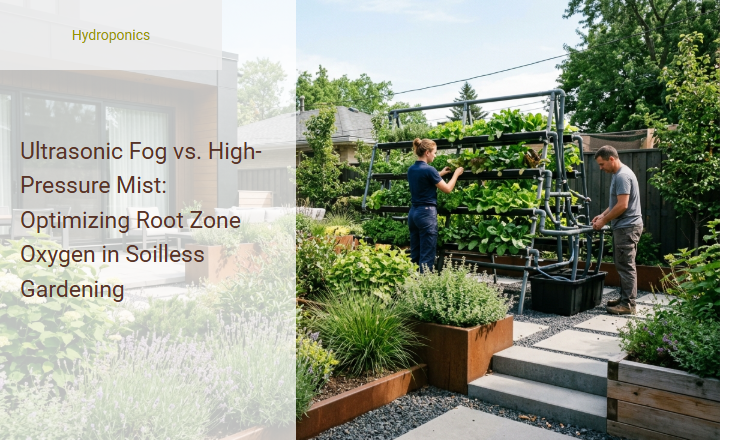
Many advanced soilless growers struggle with chronic root zone suffocation and pythium, watching their crops underperform despite meticulous nutrient management. Traditionally, cultivation focused strictly on liquid volume, yet root biology fundamentally requires a delicate balance of moisture and gaseous oxygen. Mastering droplet suspension grants growers the ability to maximize dissolved oxygen levels, unlocking explosive vegetative growth and nutrient uptake.
However, success with suspended delivery is stipulative; droplet size dictates whether roots breathe or drown. For instance, a system utilizing 50-micron droplets from high-pressure nozzles interacts with root hairs much differently than a dry, 5-micron ultrasonic fog. This article compares ultrasonic fog and high-pressure mist systems, analyzing their mechanical differences, oxygen-delivery efficiency, and hardware demands to help you optimize your root zone environment.
Read also: Fogponics vs Aeroponics for Root Development
The Critical Role of Root Zone Oxygenation in Soilless Systems
In soilless cultivation, the availability of Dissolved Oxygen (DO) within the root zone is a primary driver of nutrient uptake and overall plant vitality. Unlike soil-based systems where structure naturally harbors pocketed air, hydro-aeroponic environments require deliberate engineering to maintain high oxygen levels. Without sufficient gas exchange, root respiration stalls, leading to nutrient deficiencies, stunted growth, and opportunistic pathogens. To combat this, advanced growers utilize specialized delivery methods designed to maximize root exposure to oxygen. Among these methods, ultrasonic fog and high-pressure mist stand out as the two most sophisticated technologies capable of elevating dissolved oxygen delivery to its physical limits.
Droplet Dynamics: How Particle Size Affects Gas Exchange
The efficiency of gas exchange at the root interface is governed by the physical properties of the water droplets delivered to the root chamber. In droplet dynamics, the surface-area-to-volume ratio increases exponentially as droplet size, measured in microns, decreases. Smaller droplets expose a significantly larger surface area of water to the surrounding air for any given volume of liquid. This massive increase in exposed surface area accelerates the rate of oxygenation, allowing the water to absorb and carry maximum levels of dissolved gases directly to the root tissue. When these tiny droplets contact the root system, they facilitate rapid gas exchange, ensuring that aerobic respiration occurs at peak efficiency.
Deciphering Ultrasonic Fogponics: Sub-Micron Moisture Delivery
Ultrasonic fogponics represents a highly refined approach to moisture delivery, utilizing ceramic transducers submerged in a nutrient solution. These transducers vibrate at high ultrasonic frequencies-typically 1.6 to 2.4 MHz-to create rapid pressure waves that tear the surface of the liquid apart. This process, known as cavitation, produces an incredibly fine, dry fog with droplet sizes ranging from 1 to 10 microns. Because these sub-micron particles are so light, they behave more like a gas than a liquid, drifting effortlessly through the root chamber. This micro-fine distribution ensures that the root zone remains highly oxygenated, facilitating effortless root respiration without placing any physical weight or moisture stress on the delicate root system.
High-Pressure Aeroponics (HPA): The 50-Micron Standard
High-Pressure Aeroponics (HPA) is a highly precise method of root nourishment that relies on pressurized delivery systems. By utilizing specialized pumps operating at 80+ PSI alongside engineered, fine-mist nozzles, HPA systems atomize the nutrient solution into a consistent 20 to 80 micron mist, with 50 microns widely accepted as the industry standard. This precise droplet size is heavy enough to carry a reliable payload of essential macro and micronutrients, yet light enough to prevent the root system from becoming oversaturated or drowned. By preventing the pooling of excess water, HPA maintains an ideal air-to-water ratio in the root chamber, maximizing nutrient absorption while ensuring the roots have continuous access to fresh oxygen.
Head-to-Head: Micron Size and Root Surface Interaction
The physical interaction between the nutrient droplet and the root hair determines how effectively a plant can photosynthesize and grow. While dry fog remains suspended in the air to create a humid environment, high-pressure mist is designed to settle gently onto the root surfaces, creating a thin, highly oxygenated film of moisture.
| Parameter | Ultrasonic Dry Fog | High-Pressure Mist (HPA) |
|---|---|---|
| Average Droplet Size | 1 - 10 Microns | 20 - 80 Microns |
| Physical Behavior | Stays suspended, behaves like a gas | Settles gently, coats root structures |
| Root Coverage Type | Humid vapor envelope | Thin, high-oxygen liquid film |
| Runoff Potential | Extremely low (near zero) | Minimal (re-circulating runoff) |
Oxygen Dynamics and Temperature Control in Ultrasonic Systems
While ultrasonic foggers excel at creating microscopic droplets, they introduce a distinct thermal challenge to the root zone. The rapid mechanical vibration of ceramic transducers generates friction, which inevitably transfers heat to the surrounding nutrient solution. This temperature rise directly impacts the physical properties of the water, dramatically reducing its capacity to hold dissolved oxygen.
- Elevated water temperatures lower the saturation point of dissolved oxygen, starving roots of vital gas exchange.
- Warm, stagnant moisture zones create an ideal breeding ground for harmful anaerobic pathogens such as Pythium.
- Mitigation requires the integration of inline water chillers to keep the reservoir temperature below 68°F (20°C).
- Implementing duty cycles that pulse the ultrasonic transducers can minimize heat buildup without sacrificing humidity levels.
Maximizing Dissolved Oxygen with High-Pressure Mist Intervals
High-Pressure Aeroponics capitalizes on the power of intermittent delivery to optimize gas exchange. Instead of continuous spraying, HPA systems operate on strict, short-duration timers, often running for only 5 seconds on followed by 5 minutes off. This cycling creates a dynamic piston-like effect within the sealed root chamber. As the high-pressure mist is discharged, it displaces the stale air; as the mist settles and the chamber pressure normalizes, fresh, oxygen-rich ambient air is drawn back down into the root zone. This continuous exchange of gases ensures that the boundary layer surrounding the root hairs is constantly replenished with fresh oxygen, driving plant metabolic rates to their absolute maximum.
Operational Challenges: Clogging, Maintenance, and Reliability
Maintaining a reliable environment is essential for root survival, as even brief periods of system failure can lead to rapid crop desiccation. Both ultrasonic and high-pressure systems present unique mechanical vulnerabilities that require consistent maintenance and preventative protocols.
- Ultrasonic Transducers: The ceramic discs are highly sensitive to mineral scale and salt accumulation from nutrient solutions. This buildup dampens vibrations, reduces fog output, and shortens the operational lifespan of the components.
- High-Pressure Nozzles: Featuring micro-sized orifices, HPA nozzles are highly prone to clogging from particulate matter or salt precipitation. This necessitates multi-stage sediment filtration and the use of high-quality, fully soluble nutrients.
- System Downtime: Because aeroponic roots lack a supporting medium to retain moisture, any system failure can cause total crop loss within hours. High-pressure setups require reliable pressure relief valves and backup power sources to guarantee constant uptime.
Root Morphology: Fuzzy Root Hairs vs. Lateral Branching
The choice of delivery method leaves a distinct footprint on the physical architecture of the root system. Roots grown under the ultra-fine influence of ultrasonic fog adapt to capture suspended moisture by developing an abundance of "fuzzy" root hairs. These microscopic structures maximize surface area to pull water vapor from the air. Conversely, High-Pressure Aeroponics encourages a highly structured, robust lateral branching pattern. The periodic wetting and drying cycles of HPA force the main taproots to branch out aggressively in search of moisture, creating a thick, highly resilient root mass capable of supporting massive vegetative and reproductive growth above the surface.
Strategic Selection: Choosing the Best System for Your Crops
Selecting the ideal oxygenation system depends on the specific goals, scale, and resources of your cultivation facility. Ultrasonic fogponics is exceptionally well-suited for cloning, microgreens, and leafy greens, where delicate root systems benefit from a gentle, non-abrasive micro-climate. For commercial operations, high-value fruiting crops, or long-term cultivars, High-Pressure Aeroponics provides the mechanical reliability and heavy nutrient carrying capacity required for dense, high-yielding crops. By weighing the operational demands of nozzle maintenance against the thermal challenges of ultrasonic transducers, growers can design a highly optimized root zone that unleashes the full genetic potential of their crops.
Summary
This article evaluates the critical differences between ultrasonic fog and high-pressure mist systems in soilless cultivation, focusing on how each technology impacts root zone oxygenation. Ultrasonic foggers produce ultra-fine droplets (under 10 microns) that create a suspended cloud of moisture; however, this dense fog can restrict oxygen exchange and lead to root saturation.
In contrast, high-pressure aeroponic (HPA) mist systems deliver water droplets optimized between 30 and 80 microns. This specific droplet size strikes the perfect balance, ensuring that roots receive both essential nutrients and maximum access to atmospheric oxygen. By facilitating superior gas exchange, high-pressure mist prevents root suffocation, deters pathogens, and accelerates nutrient absorption. Ultimately, the analysis demonstrates why high-pressure mist remains the preferred choice for commercial cultivators seeking to maximize root vitality and crop yields in aeroponic environments.
Leave a comment