
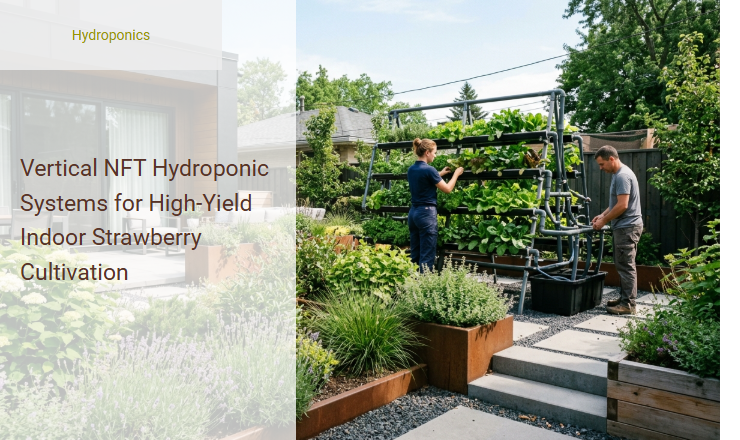
Indoor growers frequently struggle with low strawberry yields and high disease susceptibility, finding that traditional cultivation setups demand too much labor for too little return. While horizontal hydroponic systems offer some relief, they quickly exhaust valuable floor space, limiting commercial scalability. Shifting to vertical Nutrient Film Technique (NFT) systems solves this spatial bottleneck, granting growers a highly efficient footprint that can quadruple yield per square foot.
However, achieving these premium harvests requires a strict stipulation: precise control over nutrient EC, pH, and root-zone oxygenation. When these parameters are properly managed, specific day-neutral cultivars like 'Albion' and 'San Andreas' thrive, delivering consistent brix levels and rapid fruiting cycles. This article outlines the essential vertical NFT system configurations, tailored nutrient formulations, and environmental parameters required to maximize your indoor strawberry harvest.
Read also: Continuous Flow vs Intermittent Flow for NFT Channels
Introduction to Vertical NFT Strawberry Cultivation
The agricultural landscape is undergoing a massive shift, and vertical farming combined with the Nutrient Film Technique (NFT) stands at the forefront of this revolution. Traditional soil-based strawberry cultivation requires vast tracts of land and is highly vulnerable to seasonal weather fluctuations, pests, and soil-borne pathogens. By utilizing a vertical NFT framework indoors, growers can stack growing channels in multi-tiered arrays, dramatically maximizing space efficiency and achieving exponentially higher yields per square foot.
In a vertical NFT system, a continuous, highly controlled film of nutrient-rich water flows over the bare roots of strawberry plants. This method delivers an optimal balance of hydration, essential minerals, and dissolved oxygen directly to the root zone. Consequently, plants grow faster, use up to 90% less water than traditional farming, and produce clean, high-quality berries year-round, completely detached from outdoor climate constraints.
Anatomy of a Vertical NFT System for Strawberries
A high-yielding vertical NFT system requires precise structural planning to ensure uniform delivery of nutrients and oxygen to every plant tier. The architectural design must support rapid water transit while facilitating adequate drainage and preventing stagnation.
Nutrient Reservoirs and Delivery Pumps
The foundation of the system is the nutrient reservoir, located at the lowest level. Submersible pumps push the nutrient solution to the top tier, where gravity takes over, guiding the liquid downward through the stacked channels.
Drainage Channels and Structural Framework
The growing channels house the strawberry root systems. Unlike deep water systems, these channels must remain shallow to prevent root drowning. Key physical hardware includes:
- Food-grade PVC or UV-stabilized plastic channels: These inert conduits prevent chemical leaching into the root zone.
- Submersible delivery pumps: High-head pumps capable of lifting water to the topmost vertical tier.
- Aerated nutrient reservoirs: Large capacity tanks paired with air stones to maximize dissolved oxygen levels.
- Sloped mounting racks: Sturdy metallic structures engineered to hold the weight of water and mature plants.
- Bypass manifolds and control valves: Gateways to regulate water volume going into individual vertical lines.
Selecting the Best Strawberry Cultivars for Indoor NFT
Not all strawberry varieties adapt well to the rapid-flow dynamics of a hydroponic system. For indoor vertical NFT systems, day-neutral cultivars are highly preferred over June-bearing varieties because they continuously flower and set fruit regardless of day length, ensuring a steady, predictable harvest throughout the year.
| Cultivar | Type | Fruit Profile | Vigor & System Fit |
|---|---|---|---|
| Albion | Day-Neutral | Large, firm, sweet, deep red color | Moderate vigor; highly suited for vertical stacks |
| San Andreas | Day-Neutral | Slightly lighter color, exceptional firmness | High vigor; requires consistent runner management |
| Monterey | Day-Neutral | Very large, sweet, rich flavor profile | Highly vigorous; needs spacious channel layout |
While Albion is favored for its premium flavor profile and structural compactness, San Andreas offers excellent disease resistance, and Monterey provides exceptional yield volume if root space is managed diligently.
Mastering the Nutrient Solution: pH, EC, and Temperature
Strawberries are highly sensitive to mineral imbalances. Managing the chemical makeup of the hydroponic reservoir requires constant monitoring of Electrical Conductivity (EC), pH, and water temperature to prevent nutrient lockout and encourage vigorous cell division.
Vegetative Growth Phase
During the early leafy growth stage, strawberries require a lower mineral concentration to prevent root burn. Aim for a target EC of 1.2 mS/cm to 1.4 mS/cm. Keep the pH level strictly between 5.5 and 6.0 to maximize the bioavailability of elements like iron (Fe) and manganese (Mn). Keep the root zone water temperature consistently around 18°C (64°F) to ensure maximum dissolved oxygen availability.
Fruiting and Flowering Phase
As the plants transition to flower production, potassium (K), calcium (Ca), and phosphorus (P) demands spike. Elevate the EC to a range of 1.6 mS/cm to 1.8 mS/cm. Maintain the pH between 5.8 and 6.2. During this period, keep close watch on nitrogen levels, as excess ammonium (NH4+) can lead to soft, flavorless fruit and poor shelf life.
Hydraulic Dynamics: Channel Slope and Flow Rates
The success of a vertical NFT setup depends heavily on gravity-driven water flow. If the water flows too quickly, the roots cannot absorb nutrients efficiently. If it flows too slowly or pools, the roots will quickly suffocate, leading to pythium outbreak (root rot) and crop failure.
The standard slope angle for NFT channels is 1:30 to 1:40, which translates to a 2.5% to 3% incline. This specific gradient ensures that the water moves swiftly enough to form a thin, highly oxygenated film over the root tips rather than submerging the entire root mass.
"For vertical strawberry NFT channels, maintain a flow rate of 1.0 to 1.5 liters per minute (0.26 to 0.40 gallons per minute) per channel. Exceeding this limit causes deep water pooling, while falling below it risks drying out the upper root zones."
Photoperiod and LED Light Spectrum Optimization
Since indoor vertical farms lack access to natural sunlight, customized LED grow lights must supply the exact spectrum and photon intensity needed to drive photosynthesis and stimulate heavy flowering.
Light Spectrum Components
Strawberries respond dynamically to specific light wavelengths. Deep blue light (450 nm) keeps the plants compact and prevents excessive stretching, which is crucial in tight vertical tiers. Red light (660 nm) triggers heavy flowering and increases sugar synthesis within the berries. Far-red light (730 nm), when applied strategically, can accelerate flower initiation and overall biomass accumulation.
For optimal results, provide a Daily Light Integral (DLI) of 20 to 25 mol/m²/day, and maintain a photoperiod of 16 hours of light paired with 8 hours of darkness.
Managing Indoor Microclimate and Vapor Pressure Deficit (VPD)
A closed vertical farming environment requires active climate control to maintain steady transpiration. If the air is too humid, the plants cannot transpire, which limits calcium transport and causes tipburn on developing leaves. If the air is too dry, stomata close, halting photosynthesis.
Vapor Pressure Deficit (VPD) is the most accurate metric for measuring this transpiration potential. It combines temperature and relative humidity into a single reading of drying pressure.
- Daytime Target VPD: Keep between 0.8 kPa and 1.1 kPa to encourage steady, stress-free nutrient uptake.
- Nighttime Target VPD: Keep between 1.2 kPa and 1.4 kPa to limit excessive humidity spikes when the lights are off.
- Air Temperature: Maintain a daytime temperature of 20°C to 22°C (68°F to 72°F) and a night temperature of 14°C to 16°C (57°F to 61°F).
Pollination and Runner Management in Vertical Layers
Without wind, bees, or wild insects inside an indoor farm, growers must manually facilitate pollination and actively manage vegetative runners to ensure consistent yields.
Manual Pollination Techniques
Each strawberry blossom contains both male and female reproductive organs. To trigger fruit development, pollen must travel from the outer anthers to the central pistils. Growers can achieve this by using gentle paintbrushes, specialized air blowers, or installing mechanical vibrating wands to gently shake the flower clusters daily during peak bloom cycles.
Pruning Runners to Maximize Energy Allocation
Strawberry plants naturally produce runners (stolons) to reproduce. In a production-focused vertical NFT system, these runners sap valuable photosynthetic energy away from fruit development.
- Inspect the vertical tiers twice a week for any emerging horizontal stolons extending from the crown.
- Using sanitized pruning shears, snip the runner as close to the crown base as possible.
- Remove any yellowing or senescing lower leaves to improve airflow around the crown.
- Discard the pruned tissue immediately to prevent organic rot in the growing room.
Biosecurity, Pest Control, and Pathogen Prevention
In closed indoor environments, the absence of natural predators means that once a pest or disease enters the facility, it can spread rapidly across vertical tiers. Preventing introduction is the most effective defense strategy.
Implement strict biosecurity protocols, including mandatory sticky traps at entryways, positive-pressure air filtration (HEPA), and protective clothing for all staff. Use organic Integrated Pest Management (IPM) practices, such as introducing predatory mites (Phytoseiulus persimilis) to combat two-spotted spider mites, and applying biological inoculants like Bacillus subtilis to prevent root pathogens.
Harvesting, Grading, and Post-Harvest Cooling
Strawberries do not continue to ripen after they are harvested. Gathering them at peak color, sugar concentration, and firmness is essential to delivering a high-quality product to market.
Identify ripe berries by checking for full color development up to the calyx. Carefully harvest the fruit by pinching the stem about one centimeter above the berry to avoid bruising the delicate skin. Place the berries directly into ventilated clamshells to minimize physical handling.
To preserve shelf life and stop cellular decay, transfer the harvested berries to a rapid cooling room within one hour. Bring the fruit temperature down quickly and store at 2°C (35.6°F) with a relative humidity of 90% to 95%. Proper post-harvest cooling can extend the shelf life of indoor-grown strawberries to over two weeks.
Summary
Vertical Nutrient Film Technique (NFT) hydroponic systems represent a revolutionary advancement in indoor agriculture, specifically optimized for high-yield strawberry cultivation. By utilizing vertical space, this innovative method drastically increases plant density per square foot, making it highly efficient for urban farming. The system operates by continuously circulating a shallow stream of nutrient-rich water directly over the exposed root systems, ensuring optimal uptake of water, oxygen, and essential minerals.
This precise control over the growing environment eliminates soil-borne diseases, reduces water consumption by up to 90% compared to traditional soil farming, and accelerates crop growth cycles. Additionally, the automated nature of these systems reduces labor costs and simplifies harvesting processes. Ultimately, vertical NFT systems empower growers to produce premium-quality, flavorful strawberries year-round, offering a highly sustainable, space-saving, and profitable solution for modern commercial food production.
Leave a comment