
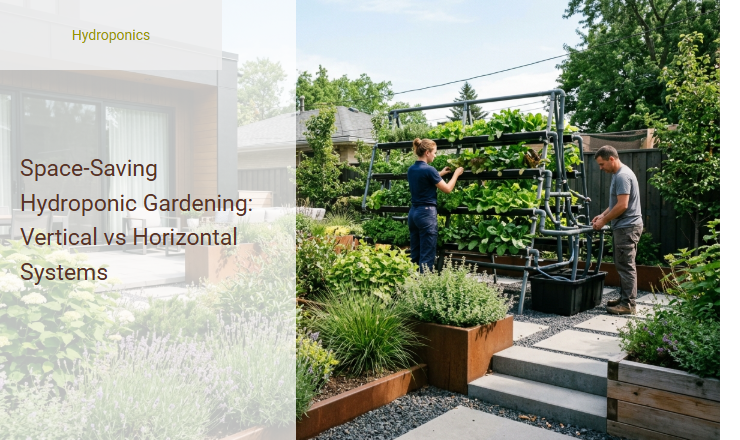
Urban growers frequently struggle with limited square footage, often watching their dreams of home food production get squeezed out by tight apartments or small balconies. Historically, traditional cultivation demanded expansive backyard plots, but the rise of indoor soilless technology has fundamentally redefined how we utilize domestic space.
Transitioning to controlled-environment hydroponics grants growers the power to maximize yields year-round, regardless of external weather. However, achieving peak efficiency requires a crucial stipulation: success depends on matching your specific botanical goals to the correct system architecture. For instance, compact leafy greens like spinach and sweet basil thrive in stacked vertical towers, whereas heavier fruiting plants require different spatial layouts.
This guide will analyze the key differences between vertical and horizontal hydroponic systems. By comparing their physical footprints, initial equipment costs, and ongoing maintenance needs, we will help you select the ideal framework for your indoor garden.
The Rise of Space-Saving Hydroponics
Urbanization has drastically reduced the available soil footprint for traditional farming, prompting modern gardeners to look toward innovative, soil-free cultivation techniques. By replacing dirt with nutrient-rich water solutions, urban agriculturalists can grow pristine crops indoors, on balconies, or in small basements. This agricultural shift relies heavily on design configuration. Vertical and horizontal hydroponic systems represent the two primary physical layouts used to tackle spatial limitations. While one stretches toward the ceiling to maximize overhead volume, the other spreads out across flat surfaces to offer stability and ease of access.
Understanding Vertical Hydroponic Systems
Vertical hydroponic systems are engineered to maximize plant density by stacking growing spots upward rather than outward. In these setups, plants grow along vertical columns, multi-tiered racks, or angled walls, with water and nutrients delivered from the top down or pumped upwards from a bottom reservoir.
Common types of vertical setups include:
- Tower Gardens: Aeroponic or hydroponic columns where plants protrude from the sides of a central vertical pipe.
- A-Frame Systems: Slanted, ladder-like structures that allow crops to sit on angled shelves, optimizing light exposure.
- Stacked Trays: Multiple horizontal shelving layers placed directly above one another, utilizing LED grow lights for each tier.
Demystifying Horizontal Hydroponic Systems
Horizontal hydroponic systems represent the classic approach to soil-free farming, utilizing a single-level layout where plants grow side-by-side. These systems lay flat across benches, tables, or ground surfaces, relying on gravity to spread nutrient solutions evenly across a shallow, wide horizontal plane.
Key variations of horizontal systems include:
- Nutrient Film Technique (NFT): Shallow channels where a continuous stream of nutrient water flows over the bare roots.
- Deep Water Culture (DWC): Large, flat reservoirs where plants float on polystyrene rafts with roots submerged in water.
- Ebb and Flow Beds: Large flat trays that are periodically flooded with nutrient solution and drained back into a reservoir.
Spatial Footprint: Comparing the Two Layouts
The physical footprint of a hydroponic system is often the deciding factor for urban growers with limited real estate. Horizontal systems spread out wide, requiring a substantial amount of floor space to achieve significant yields. This means a single horizontal table can quickly monopolize an entire room, limiting the grower to a single plane of production.
In contrast, vertical setups utilize vertical volume, allowing growers to produce multiple times the amount of crops within the exact same square footage. By building upward, a grower can squeeze dozens of plants into a corner that would otherwise only accommodate a few horizontal specimens.
Growing vertically transforms two-dimensional floor space into three-dimensional volume, allowing urban farmers to multiply their harvest capacity without expanding their physical footprint.
Crop Suitability and Yield Potential
Selecting the right layout depends heavily on the specific types of crops you plan to cultivate. Lightweight, fast-growing plants with compact root structures thrive in the space-saving slots of vertical systems. Conversely, top-heavy, vining, or deep-rooting fruiting crops require the physical support and spacious reservoirs of horizontal systems.
| System Type | Ideal Crops | Yield Potential | Physical Support Needs |
|---|---|---|---|
| Vertical Systems | Leafy greens, herbs, strawberries, dwarf varieties | High volume per square foot of floor space | Low (crops are lightweight and self-supporting) |
| Horizontal Systems | Tomatoes, peppers, cucumbers, melons, root vegetables | High yield per plant, lower density per square foot | High (requires trellises, stakes, or heavy cages) |
Setup Complexity and Initial Investment
Building a vertical hydroponic setup requires careful planning and a higher initial budget. The structural engineering must account for the heavy weight of water elevated off the ground, along with complex plumbing manifolds to ensure even distribution to the top levels. High-pressure pumps and sturdy support frames add to the upfront cost.
Horizontal systems are far simpler to assemble and maintain. Because they sit close to the ground, they do not require heavy-duty load-bearing frames or highly pressurized plumbing systems. For beginners, horizontal configurations offer a much lower barrier to entry and a more forgiving learning curve.
Lighting and Resource Consumption
Resource consumption varies significantly between these two layouts, particularly regarding electricity and water distribution. Vertical systems rely heavily on powerful water pumps to push water against gravity to the top of the columns. Additionally, distributing light evenly in a vertical space is challenging, often requiring specialized vertical LED bars or rotating systems to prevent lower tiers from being shaded out by the upper leaves.
Horizontal systems benefit from uniform overhead lighting, making them highly efficient when using natural sunlight in greenhouses or standard hanging grow lights indoors. Because water flows on a flat plane, low-wattage pumps are sufficient to circulate the nutrient solution, reducing energy bills and pump wear over time.
Advantages and Drawbacks of Vertical Growing
Vertical growing offers unique advantages for high-density food production, but it also comes with notable structural compromises that growers must manage.
Key benefits and drawbacks include:
- Pro: Maximizes crop yield per square foot of floor space, making it perfect for tiny apartments.
- Pro: Water recycling is highly efficient as it drips down through multiple plant tiers.
- Con: Gravity-defying plumbing is prone to clogging, which can rapidly starve upper plants of water.
- Con: Uneven light distribution can lead to slower growth on lower shelves or shadowed sides.
Advantages and Drawbacks of Horizontal Growing
Horizontal configurations provide a highly stable and accessible growing environment, though they demand a larger spatial commitment.
Key benefits and drawbacks include:
- Pro: Extremely easy to clean, inspect, and maintain due to simple plumbing and hip-height access.
- Pro: Delivers uniform light exposure to every plant, ensuring consistent growth rates across the crop.
- Con: Demands a large physical footprint, which limits its viability in tight indoor spaces.
- Con: Inefficient use of vertical room height, leaving overhead space entirely unused.
Making the Right Choice for Your Space
Choosing between vertical and horizontal setups requires balancing your available space, budget, and agricultural goals. If you have limited floor space but want to maximize your output of fresh herbs and greens, a vertical system is your best choice. It turns unused walls and corners into productive green spaces, provided you are willing to invest in the necessary plumbing and lighting hardware.
If you prefer a simpler, lower-cost entry point or wish to grow heavy fruiting plants like tomatoes and peppers, a horizontal system is the superior option. Your decision should align with your daily capacity for maintenance and the specific plants you wish to harvest. By matching your system design to your spatial and financial realities, you can establish a thriving soil-free garden that meets your exact needs.
| Key Metric | Vertical Systems (e.g., VLM, Carousels) | Horizontal Systems (e.g., Traditional, Lateral) |
|---|---|---|
| Footprint & Height | Minimal floor footprint; maximizes unused overhead airspace (up to 30m+). | Large floor footprint; constrained by ceiling height and aisle access. |
| Storage Density | Ultra-high density; eliminates aisles; compresses storage up to 85%. | Moderate density; requires dedicated aisle space for retrieval access. |
| Retrieval & Throughput | Goods-to-Person delivery; slower cycle times per individual line item. | Person-to-Goods retrieval; high throughput for simultaneous multi-user picking. |
| Capital Investment | High initial cost; requires structural engineering, software, and motors. | Low to moderate cost; simple mechanical installation and maintenance. |
| Optimal Facility Type | High-ceiling warehouses, clean rooms, and tight urban fulfillment centers. | Low-ceiling facilities, cross-docks, and heavy/bulky inventory storage. |
Leave a comment