
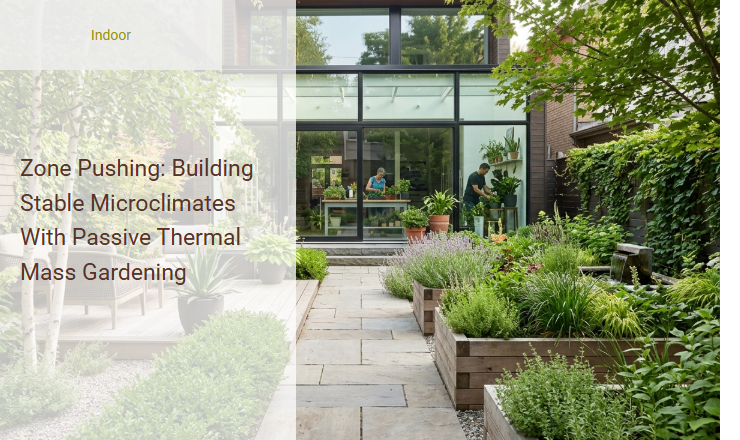
For ambitious growers, regional hardiness zones often feel like an inescapable ceiling, where late spring frosts or short growing seasons routinely cut short the lifespan of prized crops. While these broad geographic classifications offer a reliable baseline, they fail to account for the hyper-local temperature fluctuations within an individual landscape. By mastering passive thermal mass, however, you can strategically "push" your agricultural zone, granting your garden the resilience to sustain sensitive, high-yield varieties otherwise unsuited to your climate.
Success in zone pushing is not a matter of luck, but of applied thermodynamics. By integrating high-density materials-such as dark stone retaining walls, gravel beds, and water-filled drums-you can capture solar radiation during the day and slowly radiate that stored heat during freezing nights. In this guide, we will examine the physics of thermal retention, evaluate the best materials for microclimatic design, and outline actionable strategies to stabilize your garden's ambient footprint.
Read also: Greenhouses vs Open Shelves for High-Humidity Plants
Introduction to Zone Pushing and Microclimates
For ambitious gardeners, the USDA hardiness zones are not rigid boundaries, but rather starting points for experimentation. Through the practice of Zone Pushing, growers intentionally cultivate plants that are technically rated for warmer climates. By understanding and manipulating local conditions, you can successfully nurture tender perennials, exotic fruits, and delicate ornamental species that would otherwise perish in a standard regional winter.
The secret to successful Zone Pushing lies in the creation and exploitation of localized growing environments. By utilizing thermal storage, strategic positioning, and physical barriers, gardeners can trick sensitive plants into believing they are growing hundreds of miles further south.
The Science of Microclimates
Every property is a complex tapestry of distinct environmental zones. While your region shares a general macroclimate, your specific yard contains microclimates-small, localized areas where the temperature, humidity, wind exposure, and sunlight differ significantly from the surrounding environment. Factors such as elevation, slope, and proximity to structures dictate how energy moves through your landscape.
For instance, cold air behaves like water: it is dense and heavy, flowing down slopes and pooling in low spots, creating frost pockets. Conversely, south-facing slopes receive intense, angled solar radiation, keeping the soil warmer throughout the year. Wind patterns also play a critical role; structural obstacles or dense vegetation can deflect chilling drafts, preserving pockets of stagnant, warm air that protect sensitive foliage from desiccation.
Mechanics of Passive Thermal Mass
Passive thermal mass is the cornerstone of microclimate manipulation. It relies on the physical property of thermal inertia, which is the ability of a material to absorb, store, and slowly release heat energy over time. During the day, dense materials absorb incoming shortwave solar radiation. This process prevents the immediate air temperature from rising too rapidly, buffer-shielding plants from heat stress.
As the sun sets and ambient temperatures drop, these materials begin a steady process of thermal radiation. They emit longwave infrared heat back into the surrounding environment, warming the immediate boundary layer of air. This slow release of stored energy prevents sudden, catastrophic drops in temperature during cold nights, keeping sensitive root zones and lower branches safely above freezing thresholds.
Essential Thermal Mass Materials
Different materials possess varying capacities to absorb and retain heat, a characteristic known as specific heat capacity. Choosing the right material depends on your space, budget, and aesthetic preferences.
- Water: The absolute champion of thermal storage, holding exceptional amounts of heat per unit volume.
- Stone and Boulder fields: Excellent natural-looking elements that absorb intense heat during midday.
- Concrete and Masonry: Ideal structural materials that double as heavy-duty heat sinks when positioned correctly.
- Clay and Brick: Highly accessible options for lining beds or creating small thermal backing walls.
| Material Type | Specific Heat Capacity (J/g·°C) | Density (kg/m³) | Thermal Retention Rating |
|---|---|---|---|
| Water | 4.184 | 1,000 | Exceptional |
| Concrete | 0.880 | 2,400 | High |
| Stone (Granite) | 0.790 | 2,600 | High |
| Clay Brick | 0.840 | 1,800 | Moderate-High |
Positioning and Solar Orientation
To maximize the efficiency of your thermal mass, elements must be aligned precisely with the sun's seasonal path. In the Northern Hemisphere, the southern aspect receives the highest concentration of solar radiation throughout the year. Positioning dense stone backdrops, concrete retaining walls, or large containers along a south or southwest-facing axis ensures they capture the maximum amount of direct sunlight during the peak hours of the day.
To capture winter sun when the solar angle is low, thermal masses should be positioned vertically or at steep angles directly behind your target plants. This setup allows the low-slung winter sun to hit the mass directly, creating a warm, radiative backdrop right where tender branches are located.
Utilizing Water as a High-Capacity Heat Sink
Because water has an incredibly high specific heat capacity, it serves as the ultimate passive heat sink in the garden. When strategically placed, bodies of water stabilize temperatures by absorbing vast amounts of solar energy during the day without rapidly increasing in temperature. During cold snaps, this stored energy is slowly liberated back into the air, preventing frost from settling on nearby leaves.
Gardeners can implement this by placing large, dark-colored rain barrels filled with water directly behind tender plants, or by constructing deep ponds on the northern side of a planting zone so the water reflects light and radiates heat southward onto the vegetation.
"Water's unique thermal properties make it the single most valuable tool for microclimatic modification. A body of water acts as a thermal buffer, smoothing out the extreme temperature peaks and valleys that typically threaten non-native plant species."
Shielding with Windbreaks and Shelterbelts
Even the best thermal mass can lose its heat quickly if freezing winds are allowed to sweep across the landscape. Wind accelerates convective cooling, stripping away the thin envelope of warm air generated by your thermal elements. To counter this, thermal mass must be paired with effective windbreaks.
By erecting physical barriers or planting dense, cold-hardy vegetative screens, you can create a calm eddy where warmth is preserved.
- Identify the direction of the prevailing cold winter winds (typically north or northwest).
- Install a structural barrier, such as a solid wooden fence, a cob wall, or a dense evergreen hedge, on the windward side of your target zone.
- Ensure the height of the windbreak is sufficient; a well-designed shelterbelt provides wind protection for a horizontal distance downstream equal to several times its height.
- Position your thermal mass and tender plants within this protected, low-velocity pocket on the leeward side of the barrier.
Soil Health and Sub-Surface Warmth
Root protection is just as vital as canopy protection. Soil composition, structure, and coverage determine how deeply frost penetrates the earth. Unprotected, compacted soils freeze rapidly, destroying the root systems of marginal plants. To prevent this, gardeners can use organic materials to trap sub-surface warmth.
Thick layers of dark organic mulch, such as leaf mold or wood chips, act as an insulating blanket, slowing the escape of ground heat. Incorporating Hugelkultur beds-mounds built over decaying logs and organic debris-provides internal thermal benefits. As the buried wood slowly decomposes, the biological activity generates modest amounts of heat, keeping root zones above the critical 32°F (0°C) freezing threshold even when ambient air temperatures plummet.
Plant Placement and Microclimate Mapping
Before planting expensive or delicate specimens, you must map the unique environmental variations across your property. This process ensures that highly sensitive plants are paired with the exact microclimatic niches capable of supporting them.
Microclimate Mapping Exercise
To map your yard, observe your property during different seasons and times of day. Note where snow melts first in the spring, where frost lingers longest in the autumn, and which areas remain sheltered during heavy winds.
Once you have identified your warmest zones-typically south-facing walls protected from northern winds-you can confidently place tender plants like figs, cold-hardy citrus, or tender rosemary. These plants will thrive in these specialized pockets, despite being technically unsuited for your general regional hardiness zone.
Year-Round Maintenance and Monitoring
Microclimates are dynamic systems that require ongoing monitoring and seasonal adjustments. Using modern technology allows you to track the exact performance of your thermal niches, providing hard data to refine your zone-pushing strategies.
During the spring and summer, thermal masses may absorb too much heat, requiring temporary shading. In contrast, late autumn requires preparing these elements for the cold months ahead. This includes cleaning debris off masonry walls to maximize solar exposure and verifying that water-based heat sinks are insulated from freezing completely solid.
By monitoring sensor arrays, you can track variables such as sensorTemp_SouthWall and ambient_AirTemp to calculate your thermal buffer differential:
thermal_buffer_differential = sensorTemp_SouthWall - ambient_AirTemp
This data indicates whether you need to deploy temporary protective covers or add more thermal mass to keep your plants safe.
Summary
The article "Zone Pushing: Building Stable Microclimates With Passive Thermal Mass Gardening" explores innovative techniques for cultivating plants outside their traditional agricultural hardiness zones. By strategically incorporating passive thermal mass-such as water storage, stone features, and dense masonry-gardeners can absorb daytime solar radiation and slowly release it as radiant heat during cooler nights.
This thermal buffering minimizes extreme temperature fluctuations, effectively creating resilient localized microclimates that shield frost-sensitive crops. The piece details practical design strategies, including the positioning of windbreaks, optimizing southern exposure, and utilizing topography to trap warm air. Ultimately, zone pushing empowers growers to extend their seasons, diversify harvests, and successfully cultivate sensitive species by working in harmony with natural thermodynamic principles to maximize energy efficiency.
Leave a comment