
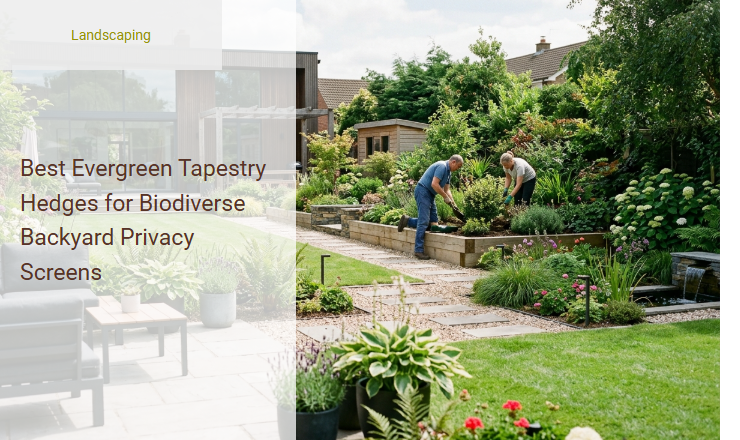
Many homeowners seeking backyard privacy struggle with sterile, monotonous green walls that feel more like artificial barriers than living sanctuaries. While traditional single-species conifers offer quick screening, these monocultures are highly vulnerable to pests and fail to support local wildlife. Transitioning to a biodiverse evergreen "tapestry hedge" solves this, granting you complete year-round seclusion while transforming your yard into a thriving ecological refuge.
However, success depends on one key stipulation: you must pair compatible species-such as shade-tolerant Taxus x media (Yew) and robust Ilex aquifolium (Holly)-that share similar growth rates to prevent dominant plants from outcompeting their neighbors. In this guide, we will analyze the best evergreen varieties for tapestry weaving, discuss optimal spacing, and provide a professional framework to establish your resilient, multi-textured privacy screen.
Read also: Hedges vs Fences for Property Borders
The Concept of the Evergreen Tapestry Hedge
An evergreen tapestry hedge is a living, breathing boundary composed of a curated mix of different evergreen species rather than a single, uniform plant. Unlike traditional monoculture hedges-which are highly vulnerable to pests, diseases, and environmental stressors-this mixed-species approach establishes a resilient, textured, and highly biodiverse privacy screen. By blending various foliage shapes, colors, and growth habits, a tapestry hedge creates a dynamic visual canvas that outperforms single-species barriers in both ecological function and year-round aesthetic appeal. Choosing this tapestry method ensures that if one species suffers from a localized pest or disease, the overall structural integrity and beauty of your living screen remain completely uninterrupted.
Key Benefits of a Biodiverse Privacy Screen
Transitioning from a traditional single-species hedge to a biodiverse tapestry barrier introduces multiple functional advantages to your garden landscape:
- Pest and Disease Resilience: A diverse mix of plants prevents pathogens and insects from sweeping through the entire hedge line, isolating potential outbreaks to individual specimens.
- Year-Round Visual Interest: The combination of varying shades of green, gold, and blue-grey foliage ensures the barrier remains vibrant and visually engaging through every season.
- Superior Windbreak Efficiency: The multi-layered texture of different leaf types diffuses strong winds more effectively than a solid, uniform wall of foliage.
- Microclimate Creation: The dense, varied canopy traps heat, retains moisture, and provides a stable, sheltered microclimate for delicate understory plants nearby.
Selecting the Structural Backbone: Top Conifers
To establish a reliable, year-round frame for your hedge, you need reliable, structural conifers that provide density and height. Taxus baccata (English Yew) is an exceptional choice, prized for its deep green, needle-like foliage and superb tolerance to hard shearing. Complementing this is Thuja occidentalis (American Arborvitae), which offers a narrower, columnar growth habit and bright, fan-like sprays of foliage. Together, these conifers form the reliable structural anchor of your living wall, tolerating regular maintenance while providing unmatched privacy and wind resistance throughout the coldest months of the year.
Adding Texture with Broadleaf Evergreens
Once your coniferous foundation is set, introducing broadleaf evergreens breaks up the fine-textured needles with bold, reflective surfaces. Ilex aquifolium (English Holly) brings iconic, spiny leaves and a glossy sheen that catches winter light beautifully. To soften the composition, integrate Prunus lusitanica (Portuguese Laurel), which features elegant, deep-green ovate leaves held on striking red stems. Mixing these diverse leaf geometries generates striking light-and-shadow play, transforming a flat green wall into a rich, multi-dimensional garden feature that remains attractive even in low winter light.
Introducing Seasonal Color and Wildlife Forage
A tapestry hedge should do more than block views; it should actively sustain the local ecosystem. Integrating berrying and flowering evergreens introduces seasonal color transitions while feeding local wildlife.
- Pyracantha (Firethorn): Features brilliant white spring blooms followed by masses of bright orange, red, or yellow autumn berries, while its thorny branches offer secure nesting sites for songbirds.
- Cotoneaster lacteus (Late Cotoneaster): Offers elegant arching branches, milky-white flower clusters for pollinators, and persistent red winter berries that sustain birds during cold spells.
Using these dynamic plants guarantees that your hedge remains a vibrant hub of ecological activity throughout the entire calendar year.
Integrating Native Evergreen Species
To ground your tapestry hedge in its geographical context, it is vital to incorporate native evergreens specific to your region. Native plants have co-evolved with local insect populations, providing the exact pollen, nectar, and foliage resources required by beneficial native insects and specialists. Furthermore, native selections possess exceptional climate adaptation, demonstrating superior resistance to regional weather extremes, local soil conditions, and endemic diseases without requiring excessive supplemental watering or chemical fertilizers.
Designing the Layout and Spacing
Achieving a dense, healthy tapestry hedge requires a thoughtful, calculated planting plan rather than a simple straight line.
- Mark out a staggered, double-row planting pattern to allow each species sufficient physical space to expand.
- Space the parallel rows roughly 2 to 3 feet apart to facilitate air movement and ease of maintenance access.
- Stagger individual plants within the rows, placing them 3 feet apart from center to center to ensure light penetrates deep into the lower branches.
- Position slower-growing species on the sunnier side of the layout to prevent them from being shaded out by faster, dominant neighbors.
Planting for Success: Soil and Establishment
The longevity of your mixed hedge depends heavily on the preparation of the planting trench. Dig a continuous trench twice as wide as the root balls and incorporate generous amounts of well-rotted organic matter to improve drainage and soil structure. Installing a dedicated drip irrigation line along the base ensures consistent, targeted moisture deep into the root zones during the critical first two years. Finish by applying a 3-inch layer of organic wood chip mulch, keeping it a few inches away from the main stems, to conserve moisture, suppress weeds, and regulate soil temperatures as the diverse roots establish themselves.
Maintenance and Pruning for a Cohesive Look
Pruning a tapestry hedge requires an individualistic approach rather than running a hedge trimmer blindly down the line. Fast-growing species must be pruned selectively to prevent them from overstepping their bounds and crowding out slower-growing companions. Always time your pruning based on the individual species; conifers are best trimmed in late summer, while flowering evergreens should be pruned immediately after blooming to preserve next year's flower buds. Using hand pruners to selectively thin branches allows light to reach the inner canopy, maintaining dense foliage from the ground up across all mixed species.
A Living Legacy for Your Backyard Ecosystem
Investing time in a biodiverse evergreen tapestry hedge yields a mature, living boundary that far surpasses any standard wooden fence or single-species screen. Over time, the interwoven branches, contrasting foliage textures, and seasonal bursts of berries form a deeply satisfying visual anchor for the landscape. This thoughtful combination of conifers, broadleaf evergreens, and berry-producing species nurtures a thriving wildlife community, creating a resilient, functional, and visually spectacular sanctuary that protects your privacy while regenerating your local environment for decades to come.
Summary
Transform your backyard into a private, ecological sanctuary with a biodiverse evergreen tapestry hedge. Unlike traditional, single-species hedges, a tapestry hedge weaves together a diverse mix of compatible evergreen shrubs and trees. This dynamic combination provides reliable, year-round privacy and wind protection while creating a vital habitat and food source for local birds, pollinators, and beneficial insects.
By blending various textures, foliage colors, and growth habits-utilizing resilient plants such as yew, holly, laurel, and juniper-you can design a visually stunning, multi-dimensional living wall. Beyond its aesthetic appeal, a biodiverse hedge is naturally more resilient against pests, diseases, and harsh weather than a monoculture. This article explores the best plant selections, design layouts, and maintenance tips to help you establish a thriving, low-maintenance privacy screen that supports local biodiversity.
Leave a comment