
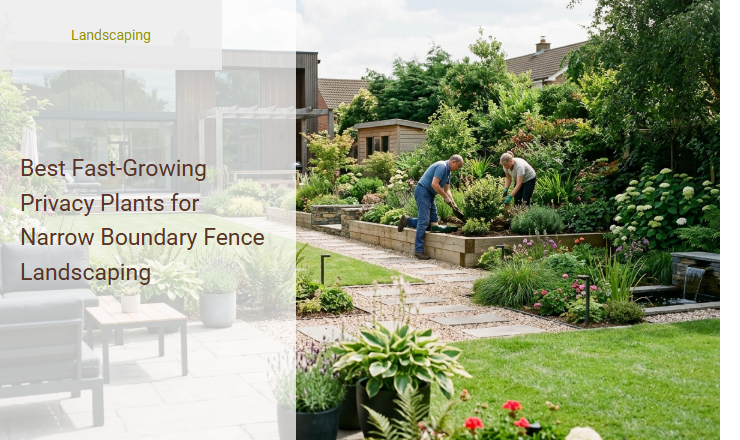
Establishing true backyard privacy in tight residential lots is a notoriously difficult design challenge. Homeowners with narrow boundary lines often struggle to block out neighboring views without sacrificing valuable outdoor living space to bulky, overgrown hedges.
While standard timber fences offer immediate containment, they often feel stark and sterile without a natural buffer. Integrating living screens provides the ultimate design solution, instantly softening harsh boundaries while significantly boosting your home's aesthetic appeal and property value.
However, planting in confined corridors requires a strategic approach. To prevent future damage to hardscaping, you must select specimens that offer rapid vertical growth without aggressive, invasive root systems. Slender cultivars such as the 'Skyrocket' Juniper, clumping 'Alphonse Karr' Bamboo, and 'Emerald Green' Arborvitae are proven performers for tight footprints.
Below, we outline the best fast-growing privacy plants tailored specifically for narrow boundary fences, detailing their growth habits, soil requirements, and essential maintenance needs.
Read also: Wood vs Vinyl for Garden Fences
The Challenge of Narrow Boundary Privacy
Establishing a private sanctuary in modern suburban properties often presents a difficult landscaping dilemma. With homes built closer together, the gap between your living space and the boundary fence is frequently restricted to a narrow strip of land. Traditional hedging plants tend to spread too wide, encroaching on pathways or spilling over into neighboring yards. Homeowners need fast-growing, slender upright plants that deliver maximum screening while occupying a minimal footprint, ensuring outdoor spaces remain private without feeling cramped.
Key Features of the Ideal Narrow Screening Plant
To successfully screen a tight boundary line, chosen plants must possess specific growth characteristics that allow them to thrive in confined soil volumes while reaching a functional height.
- Strictly Vertical Growth: Naturally fastigiate or columnar habits that grow upward rather than outward.
- Non-Invasive Root Systems: Roots that grow downward rather than spreading laterally to prevent damage to fences, pipes, and paved paths.
- Wind Resistance: Strong, flexible stems that can withstand wind tunnels often created between close buildings.
- Low-Maintenance Pruning: Varieties that naturally hold their tight form without requiring constant shearing.
Fast-Growing Columnar Evergreens for Year-Round Cover
Thuja occidentalis 'Smaragd' (Emerald Green Arborvitae)
For consistent, year-round density, Thuja occidentalis 'Smaragd' is a premier choice. This slow-to-medium growing evergreen reaches a mature height of 12 to 15 feet while maintaining a slender width of just 3 to 4 feet. Its dense, emerald-green foliage retains its vibrant color throughout the coldest winters, providing an impenetrable visual barrier along boundary fences.
Italian Cypress (Cupressus sempervirens)
The classic Mediterranean choice for tight spaces is the Cupressus sempervirens. Growing at a rapid pace of up to three feet per year, this striking tree can reach heights of 30 feet or more while staying incredibly narrow, often measuring less than three feet wide. Its dark green, scale-like foliage offers architectural structure and dependable privacy on minimal soil ground space.
Deciduous Trees with Sleek, Vertical Profiles
Columnar Hornbeam (Carpinus betulus 'Fastigiata')
The Columnar Hornbeam is highly valued for its dense, tight canopy that starts low to the ground. In summer, its rich green leaves provide absolute privacy along a fence line. As winter approaches, the foliage turns a warm yellow before dropping, exposing a clean, architectural branch structure that still diffuses harsh winter light beautifully.
Slender Silhouette Sweetgum (Liquidambar styraciflua 'Slender Silhouette')
With an extremely narrow growth habit, this deciduous tree typically grows up to 30 feet tall but remains only 5 to 6 feet wide. It provides spectacular vertical height for blocking views from two-story neighboring windows, followed by a brilliant autumn display of yellow, orange, and deep red foliage.
Utilizing Climbers and Vines on Trellised Fences
When the planting strip along a boundary fence is virtually non-existent, utilizing the vertical plane of the fence itself is the smartest solution. By installing a robust trellis system, you can grow fast-growing evergreen climbers such as Star Jasmine (Trachelospermum jasminoides) or Evergreen Clematis (Clematis armandii). These climbers quickly weave through the support structure, creating a lush, fragrant living green wall that is only a few inches deep, preserving every square inch of your yard.
Clumping Bamboo for Rapid, Sleek Privacy
Fargesia robusta (Campbell Bamboo)
For those requiring rapid privacy, non-invasive clumping bamboos are highly effective. Unlike running varieties, Fargesia robusta grows in tight, dense clumps that expand slowly from the base. This species maintains a slender profile, reaching up to 12 to 15 feet tall while the base remains compact, making it safe to plant near boundaries without the fear of invading neighboring lawns.
Tall Ornamental Grasses for Fast Seasonal Screens
Karl Foerster Feather Reed Grass
For a dynamic, moving privacy screen, tall ornamental grasses offer unmatched speed of growth. Karl Foerster Feather Reed Grass grows rapidly each spring, reaching up to six feet tall by mid-summer. Its stiff, vertical wheat-like stalks remain upright through winter, providing a sleek, modern screen that sways gently in the breeze.
Zebra Grass (Miscanthus sinensis 'Zebrinus')
Zebra Grass features horizontal yellow bands across arching green fronds, reaching heights of up to eight feet. It forms a dense, bushy screen by mid-summer, providing seasonal privacy and soft texture along boundaries where permanent solid foliage is not required year-round.
Soil Preparation and Planting Secrets in Tight Spaces
- Dig a Continuous Trench: Instead of digging individual holes, excavate a continuous trench along the fence line to encourage root systems to grow laterally along the boundary rather than outward into the lawn.
- Install Root Barriers: Place a physical root barrier on the fence side of the trench to protect neighboring property and direct root growth downward.
- Improve Drainage: Mix organic compost and coarse sand into the backfill soil, as tight spaces near concrete footings often suffer from poor drainage and compaction.
- Secure the Plant: Stake young trees firmly to protect them from wind tunnel effects common along narrow property passages.
Irrigation and Pruning for Ultra-Narrow Borders
Maintaining a narrow boundary screen requires consistent care tailored to tight spaces. Soil along fences dries out rapidly, making a dedicated drip irrigation system essential. Drip lines deliver water directly to the root zone, preventing waste and ensuring deep root development. Annual pruning is equally critical; fastigiate trees should be lightly trimmed along their vertical sides in early spring to encourage dense inner foliage and prevent the branches from spreading outward under the weight of rain or snow.
Choosing the Perfect Plant for Your Fence Line
Selecting the right plant for your narrow boundary depends on a careful assessment of your specific environment. Consider the daily hours of sunlight the narrow strip receives, as high fences can cast deep shade for half the day. Evergreens are best for constant, year-round screening, while deciduous trees or ornamental grasses offer beautiful seasonal variations. Match your climate zone and willingness to prune with the growth habits of these selected species to create a beautiful, space-saving green screen.
Summary
Creating a private backyard oasis in tight outdoor areas requires the strategic selection of narrow, fast-growing privacy plants. This guide highlights the best botanical solutions for tight boundary fences, where traditional wide-spreading trees and shrubs are impractical.
Columnar evergreens, such as 'Emerald Green' Arborvitae, 'Sky Pencil' Holly, and Italian Cypress, offer excellent vertical coverage and dense year-round foliage without encroaching on precious yard space. For a modern aesthetic, non-invasive clumping bamboo provides rapid height within a slender footprint. Additionally, training climbing evergreen vines like star jasmine on trellises offers a fragrant, ultra-slim screening alternative.
By choosing plants with naturally upright habits and vigorous growth rates, homeowners can quickly establish a lush, living green wall that blocks unsightly views, dampens noise, and enhances property aesthetics in even the most restricted garden spaces.
Leave a comment