
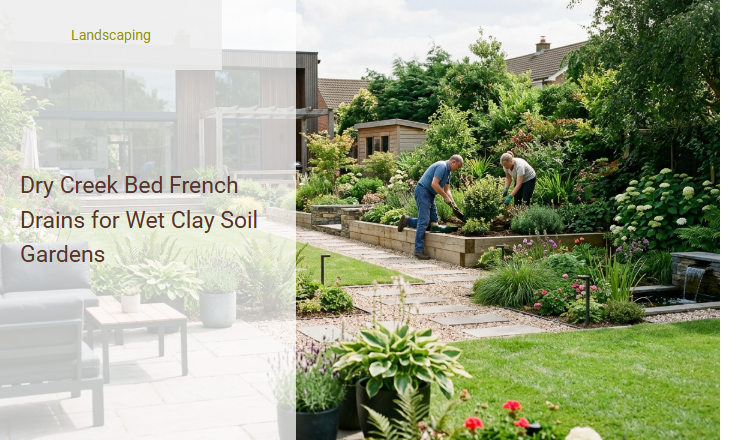
Gardening in heavy clay soil often feels like a losing battle against standing water, soggy lawns, and drowned plant roots. While standard subsurface drainage systems can resolve these pooling issues, they often leave behind unsightly scars on your landscape. By merging civil engineering with natural aesthetics, the dry creek bed French drain grants homeowners the ultimate dual benefit: an efficient runoff diversion system that doubles as a stunning, rustic stone feature.
However, successful installation in dense clay requires strict adherence to specific design stipulations. Unlike loose soils, clay demands precise trench sloping, heavy-duty non-woven geotextile fabric, and a calculated combination of perforated PVC pipes and smooth river rocks to prevent clogging and soil intrusion. In this guide, we will outline the essential engineering principles, material specifications, and step-by-step construction methods needed to transform your waterlogged yard into a beautifully drained, thriving garden sanctuary.
Read also: French Drains vs Dry Wells for Yard Drainage
Understanding Clay Soil Water Retention Challenges
Clay soil is notorious for its microscopic, tightly packed particles that leave virtually no space for water to drain. When heavy rains arrive, this dense structure acts like a sponge, holding onto moisture and creating unsightly, stagnant pooling across your garden. To combat this persistent issue, a hybrid dry creek bed French drain offers the most robust drainage solution, seamlessly combining surface water redirection with deep subsurface drainage.
The Anatomy of a Hybrid Dry Creek French Drain
A hybrid drainage system is a dual-action marvel designed to tackle two distinct water problems simultaneously. By combining subsurface and surface management, it ensures your yard remains dry even during torrential downpours.
- The French drain component works underground, using a perforated pipe surrounded by gravel to collect and channel away subsurface water saturating the clay soil.
- The dry creek bed sits directly above, utilizing a shallow, rock-lined channel to capture, slow down, and redirect rushing surface runoff.
Mapping and Planning the Drainage Route
Before breaking ground, you must carefully plan your drainage path to work with the natural topography of your yard.
- Assess the natural slope of your garden to determine where gravity naturally wants to pull the water.
- Locate the lowest pooling points where standing water accumulates most heavily during storms.
- Identify a safe, legal runoff exit point, such as a storm drain, rain garden, or the edge of your property.
- Sketch a winding, meandering path for the dry creek bed to mimic a natural waterway rather than a sterile straight trench.
Essential Tools and Materials Checklist
Gathering the right equipment beforehand is essential when dealing with tough clay excavation. Below is a comprehensive checklist of the materials and tools required for this project.
| Item Type | Description and Use |
|---|---|
| Non-woven Geotextile Fabric | Prevents fine clay particles from entering and clogging the gravel system. |
| Perforated PVC Pipes | Rigid, durable pipe with pre-drilled holes to carry subsurface water away. |
| River Rocks and Gravel | Washed round stone for the core and varying sizes of river rock for the surface. |
| Shovels and Wheelbarrows | Heavy-duty digging tools and transportation for dense, heavy clay soil. |
Trench Excavation Techniques for Heavy Clay
Digging in heavy clay can be physically exhausting, especially when the soil is wet and sticky. Following proper techniques ensures your hard work results in a perfectly functioning drain.
- Excavate a trench that is at least 12 to 18 inches wide and 18 inches deep, using a sharp, flat-nosed spade to slice through the dense clay layers.
- Maintain a continuous downward slope gradient of at least 1 percent (a 1-inch drop for every 8 feet of run) toward your exit point.
- Keep a scrape tool handy to clear sticky, wet clay clods from your shovel, and deposit the excavated soil directly into your wheelbarrow to prevent a messy cleanup.
Lining the Trench with Geotextile Fabric
One of the most common causes of French drain failure is the migration of fine clay particles into the gravel bed. Over time, these tiny particles wash into the gaps, cementing the gravel and completely blocking water flow. To prevent this, you must line the entire trench with a high-quality non-woven geotextile fabric. This specialized fabric acts as a high-performance filter, allowing water to pass through effortlessly while holding back the sticky clay. Ensure you leave enough fabric draping over the sides of the trench, as this extra material will eventually be folded over the top of the gravel core to create a fully enclosed, protected drainage envelope.
Laying the Perforated Pipe and Gravel Base
With the trench securely lined, you can now construct the subsurface drainage core that handles the bulk of the underground water flow.
- Pour a 2-inch to 3-inch bedding layer of clean, washed round gravel along the bottom of the fabric-lined trench.
- Lay your perforated PVC pipe directly on top of this gravel bed, ensuring the perforation holes are facing downward toward the soil.
- Fill the remaining core space around and over the pipe with washed round stone, leaving about 3 to 4 inches of space at the top of the trench.
Artistically Styling the Dry Creek Bed Surface
After wrapping the fabric over the gravel core, it is time to transition your utility drain into a beautiful landscape feature. To mimic a natural, flowing waterway, avoid placing rocks in a uniform, sterile pattern. Instead, arrange varied sizes of smooth river rock along the channel bed, scattering small cobbles in the center where water flows fastest. Frame the edges with larger boulders and irregular stones to anchor the structure and naturally mask the drainage system underneath.
Selecting Moisture-Tolerant Plants for Clay Margins
Integrating living elements along the margins of your dry creek bed enhances water absorption and stabilizes the clay soil against erosion.
- Plant deep-rooted native grasses like Switchgrass to soak up excess moisture and anchor the soil.
- Introduce beautiful flowering perennials like Blue Flag Iris that thrive in wet clay conditions.
- Incorporate hardy native shrubs to soften the rock borders and provide year-round structure.
Long-Term Maintenance for Peak Performance
Even the best-designed drainage systems require occasional upkeep to prevent blockages and maintain peak efficiency.
- Clear fallen leaves, twigs, and organic debris from the stone surface of the creek bed every autumn.
- Inspect the pipe outlet after heavy storms to ensure water is discharging freely without obstruction.
- Check for silt buildup along the rocks and gently hose down clogged areas to wash away fine particles before they settle.
Summary
Managing soggy gardens with heavy clay soil can be a persistent challenge for homeowners. Integrating a dry creek bed with an underlying French drain offers an elegant and highly effective solution to this common landscaping issue. While clay soil naturally retains water and drains poorly, this dual-action system tackles excess moisture both above and below the surface.
The visible dry creek bed uses graded stones and river rocks to mimic a natural waterway, beautifully redirecting surface runoff during heavy rains. Beneath this aesthetic feature lies a French drain-a perforated pipe enveloped in gravel-which actively collects and channels subsurface water away from vulnerable plant roots. By combining these two techniques, gardeners can eliminate standing water, prevent soil erosion, and transform a waterlogged yard into a thriving, picturesque landscape that offers year-round visual interest.
Leave a comment