
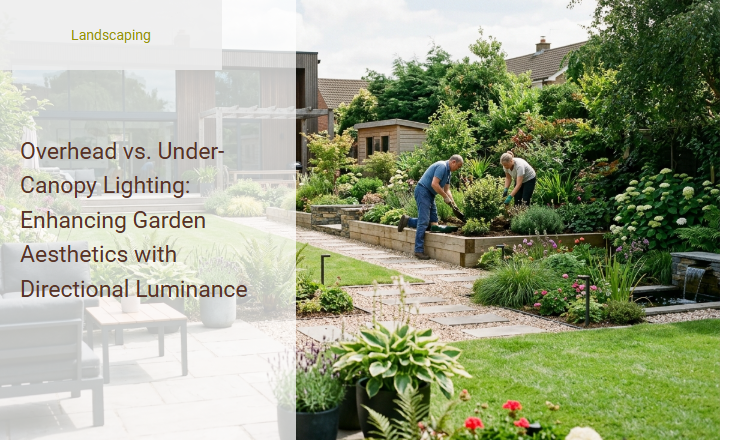
Many landscape designers and homeowners struggle to capture the true depth of their gardens after dark, often resulting in flat, washed-out foliage or harsh, unflattering shadows. Historically, basic high-altitude floodlighting was the standard solution, yet relying solely on static, top-down fixtures fails to respect the intricate architectural layers of modern garden design.
Mastering directional luminance, however, grants you the power to sculpt outdoor spaces, transforming a dark yard into a dramatic, multi-dimensional masterpiece. To achieve this, one must recognize that proper illumination is not merely about purchasing brighter fixtures; it requires a calculated approach to beam angles and foliage density. For instance, while under-canopy uplighting beautifully accentuates the delicate, skeletal structure of a Japanese Maple, overhead downlighting is required to mimic natural moonlight filtering through a dense oak canopy.
This article evaluates the distinct advantages of overhead versus under-canopy lighting, outlining the technical principles and placement strategies needed to elevate your garden's nocturnal aesthetic.
Introduction: The Power of Directional Luminance
As the sun dips below the horizon, the familiar contours of a garden fade into obscurity, waiting for a second debut. Landscape lighting is not merely about preventing missteps in the dark; it is an artistic medium that uses darkness as its canvas. By manipulating the angle and vector of light, you can completely redefine the spatial perception of your outdoor environment. The magic lies in the deliberate direction of the beam, transforming flat patches of grass into rich, sculptural landscapes.
Achieving this transformation requires a thoughtful interplay between two opposing forces: overhead illumination and under-canopy lighting. While one mimics the soft, comforting glow of celestial bodies, the other coaxes dramatic, hidden characters from the foliage below. Together, they create a balanced nocturnal ecosystem where shadow and light perform a captivating dance.
Overhead Lighting: Mimicking the Night Sky
Overhead lighting draws its inspiration from the heavens, seeking to recreate the gentle dispersion of light we experience during the day or under a full moon. By casting light downward from elevated vantage points, this method establishes a familiar sense of security and clarity. It taps into our primal comfort with top-down illumination, reassuring the eye by revealing pathways, lawns, and seating areas in a soft, uniform manner.
This approach is highly effective at establishing spatial openness. Instead of feeling confined by the surrounding darkness, the human mind perceives a wider boundary when the ground plane is gently bathed in light. It evokes the tranquil feeling of walking under a clear, starlit sky, making large outdoor areas feel both expansive and welcoming.
Master Techniques in Overhead Illumination
To achieve a natural look with overhead fixtures, designers rely on sophisticated placement methods rather than simple, stark floodlights. The goal is to make the source of light look as organic as possible, hiding the hardware within the environment.
- Moonlighting: This technique involves placing soft, cool-toned fixtures high up in the branches of mature trees to project organic, moving shadows onto the ground below.
- Downlighting: Focused more on function and safety, downlighting places fixtures on architectural structures or sturdy branches to illuminate specific features like patios.
- Tree Integration: Mount fixtures at least 20 to 30 feet high in mature trees, using adjustable straps to allow for tree growth and aiming beams slightly off-vertical.
Under-Canopy Lighting: Unveiling Drama and Depth
In contrast to the gentle wash of overhead light, under-canopy lighting works from the ground up to challenge our daytime perceptions of nature. By placing light sources beneath the leafy structures of trees and shrubs, we reveal a hidden world of skeletal branches and translucent leaves. This upward projection creates a high-contrast environment, turning ordinary plants into living sculptures.
This method excels at accentuating gnarled trunk structures and casting dramatic silhouettes against garden walls or the night sky. By leaving the outer edges of the canopy in shadow while illuminating the core, it infuses the garden floor with a sense of depth and architectural mystery.
Sculpting Textures with Uplighting
Uplighting serves as a magnifying glass for the physical textures of your garden. When light grazes the deeply furrowed bark of an oak tree or the peeling paper-like layers of a birch, it emphasizes the three-dimensional quality of these surfaces. The angle of the beam creates micro-shadows within the crevices, making the bark look incredibly tactile and rugged.
Leaf characteristics also dictate how this light is received. Delicate, translucent leaves like those of Japanese Maples glow like stained glass when illuminated from beneath, radiating a vibrant, warm color. Conversely, thick, glossy leaves like Magnolia foliage reflect the light sharply, creating a sparkling, energetic focal point that commands attention against dark stone walls or wooden garden structures.
Direct Comparison: Atmosphere, Shadow, and Scale
| Lighting Style | Atmosphere Created | Shadow Behavior | Spatial Scale |
|---|---|---|---|
| Overhead Lighting | Serene, calming, and natural | Soft, downward-projected, mimicking moonlight | Expansive, open, and grounding |
| Under-Canopy Lighting | Dramatic, theatrical, and mysterious | Sharp, upward-projected, high-contrast | Focused, intimate, and vertical |
Designing with Both: The Layered Approach
Relying on just one directional technique can leave a landscape feeling incomplete. Relying solely on overhead downlighting can result in a flat, clinical environment, while using only under-canopy uplighting can create a spooky, floating effect where trees appear disconnected from the ground. True design mastery lies in a layered approach that blends both directions into a seamless visual narrative.
By combining these methods, you fill the intermediate voids, eliminating awkward dark patches while preventing blinding glare. The overhead light provides a safe, ambient wash that anchors the scene, while the under-canopy light introduces spectacular focal points. This balance ensures the eye can move comfortably through the space, appreciating both the grand scale of the garden and its intricate, glowing details.
Technical and Practical Installation Guide
Bringing a directional lighting design to life requires careful physical execution. Proper planning ensures that the fixtures perform optimally and remain protected from the elements over time.
- Select narrow beam angles of 15 to 30 degrees for tall, slender trees, and wider 60-degree floods for broad, spreading canopies.
- Place fixtures away from direct lines of sight, utilizing natural barriers like rocks or low foliage to shield the light source.
- Run heavy-duty low-voltage cables along garden borders, burying them at least six inches deep to avoid damage from future digging.
Essential Tips for Precision Placement
Fine-tuning the angles and aiming of your lights makes the difference between an amateur setup and a professional-grade installation.
- Position uplights slightly forward of the trunk and tilt them upward to highlight the structural bark without creating upward glare into the sky.
- Install hex-cell louvers or shroud extensions on fixtures positioned near walkways to protect the eyes of passing guests from direct bulb glare.
- Test your light placement at night using temporary stakes before finalizing cable connections and burying the lines permanently.
Ecological Responsibility and Dark-Sky Compliance
While illuminating our gardens enhances our enjoyment of them, we must remain mindful of our impact on the surrounding ecosystem. Excess light pollution disrupts the natural rhythms of nocturnal birds, insects, and mammals that rely on darkness to forage, migrate, and reproduce.
Artificial light at night is a major threat to biodiversity, altering animal behaviors and disrupting delicate ecological networks. The International Dark-Sky Association
Preserving Nocturnal Ecosystems
To mitigate these effects, we must employ responsible lighting practices. This involves using fully shielded fixtures that direct light strictly downward or directly onto the intended target, preventing spill light from escaping into the upper atmosphere. Furthermore, choosing warm color temperatures, specifically under 2700 Kelvin, reduces blue light emissions which are most disruptive to wildlife.
By using warm, shielded illumination, we can balance human safety and aesthetic beauty with the preservation of natural night environments. Ecological Lighting Standards Bureau
Conclusion: Crafting Your Midnight Masterpiece
The interplay of overhead and under-canopy lighting offers an exceptional opportunity to reshape your outdoor world. By understanding how light behaves when projected from different directions, you can transform your garden into a dynamic, living gallery that thrives long after the sun goes down. Balancing the soft, natural wash of downlighting with the theatrical mystery of uplighting creates a rich, sensory experience for anyone who steps outside.
Every landscape is unique, meaning there is no single formula for perfection. Do not hesitate to experiment with different angles, shadows, and light intensities to discover the hidden drama in your own backyard. Embrace the creative power of directional luminance and craft a personalized midnight sanctuary that reflects your unique vision.
| Feature | Overhead Lighting (Downlighting) | Under-Canopy Lighting (Uplighting) |
|---|---|---|
| Light Direction | Downward (from branches/structures) | Upward (from ground/base) |
| Visual Effect | Natural "moonlight" effect, soft shadows | Dramatic, high-contrast silhouette and texture |
| Fixture Placement | High in tree canopy or adjacent structures | Ground-mounted or well-lights at root flare |
| Primary Purpose | Safety, pathway illumination, functional areas | Aesthetic focal point, highlighting architecture |
| Maintenance Access | Difficult (requires ladders/climbing gear) | Easy (accessible at ground level) |
Leave a comment