
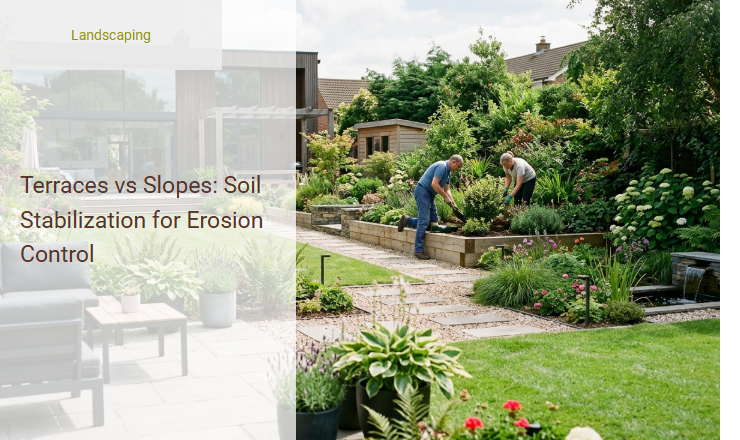
Managing sloped terrain often presents a frustrating battle against nature, as property owners watch heavy rains wash away valuable topsoil and compromise structural foundations. Before implementing a solution, it is vital to analyze how gravity and water velocity interact on inclined landscapes. Mastering these physical dynamics grants land managers permanent control over runoff, ultimately protecting property value and reducing long-term maintenance costs.
However, it is critical to stipulate that mitigation strategies must be tailored; soil composition and slope gradient dictate which methods are viable, as no single approach fits every site. For example, steeper inclines may demand engineered retaining walls and terracing, whereas gentler grades might only require biodegradable geotextile mats and deep-rooting vegetation.
This article provides a comprehensive comparison of terracing versus slope stabilization, examining the costs, structural integrity, and ecological impacts of each to guide your land management decisions.
Introduction to Soil Erosion on Slopes
Soil erosion on hilly terrains represents one of the most pressing challenges in land management and environmental conservation. When sloping landscapes are left bare or unmanaged, the natural protective layers of the earth are easily stripped away by natural forces. This continuous degradation poses a massive threat to landscapes, leading to the loss of fertile topsoil, devastating landslides, siltation of nearby waterways, and the destruction of local infrastructure. To combat this destructive process, land planners and property owners must choose between structural intervention and natural preservation. Terracing and natural slope stabilization stand as the two primary, yet fundamentally different, methodologies used to control water movement, anchor the soil, and secure the long-term integrity of the land.
The Mechanics of Slope Degradation
To effectively manage a hillside, one must first comprehend the physical forces driving its decline. Gravity is the constant, underlying force pulling soil particles downward, waiting for any destabilizing event to trigger movement. When rainfall occurs, its impact velocity acts as a mechanical hammer, detaching vulnerable soil aggregates upon contact. If the rainfall intensity exceeds the ground's natural infiltration rate, water begins to collect on the surface and flow downhill. As this runoff travels down an untreated incline, it gathers velocity and mass, rapidly transforming from minor sheet erosion into deeper, highly destructive rills and gullies. The combination of high runoff velocity, accelerated gravity vectors, and increased volume strips away the nutrient-rich organic layers, leaving behind a barren, unstable subsoil layer incapable of supporting life or resisting further collapse.
What is Terracing? Engineering the Landscape
Terracing is an ancient yet highly effective civil engineering technique that radically reshapes the topography of a hillside. By transforming a continuous, steep incline into a series of level, stair-step platforms, terracing completely alters how gravity and water interact with the land.
This structural modification controls erosion through several key mechanisms:
- Topographical Alteration: Replacing a continuous slope with flat benches stops the natural downhill acceleration of surface runoff.
- Reduction of Slope Length: Breaking a long, singular hill into shorter, managed segments limits the volume of water that can accumulate on any single surface.
- Runoff Interception: The flat step design captures rainwater directly where it falls, forcing it to pool and sink into the earth rather than washing away down the hillside.
Natural Slope Stabilization: Preserving the Gradient
In contrast to structural engineering, natural slope stabilization aims to preserve the original gradient of the terrain. This methodology focuses on reinforcing the natural incline rather than reshaping it, relying on bioengineering principles to establish a self-sustaining defense system against the elements.
This approach utilizes a combination of living and synthetic materials to secure the earth:
- Vegetative Anchoring: Utilizing the extensive root networks of specialized plants to bind soil particles together and increase shear strength.
- Geotextiles and Erosion Blankets: Laying down biodegradable coconut coir or synthetic blankets to shield the soil surface from the direct impact of heavy raindrops.
- Three-Dimensional Soil Nets: Installing subterranean netting systems that mechanically lock soil in place while vegetation establishes its root systems.
Structural and Economic Comparison
Choosing between terracing and natural stabilization requires a careful examination of structural requirements, initial investment, manual labor, and long-term durability. While terracing creates a highly controlled landscape, it demands a significant allocation of resources compared to biological alternatives.
| Parameter | Terracing (Structural) | Natural Stabilization (Bioengineered) |
|---|---|---|
| Initial Financial Cost | High (requires heavy machinery and masonry) | Low to Moderate (primarily seeds, plants, and blankets) |
| Labor Requirements | Intensive skilled labor for wall construction | Moderate labor for planting and blanket installation |
| Material Demands | Stone, concrete blocks, timber, gravel backfill | Geotextiles, native plants, seeds, organic compost |
| Longevity & Lifespan | Extremely long, though walls can eventually crack | Increases over time as plant root systems mature |
Hydrology and Water Management
The movement of water is the single most critical factor in slope stability, and both methods handle hydrology in completely different ways. Terracing relies on localized water retention and infiltration. By creating flat benches, terraces slow water down to a crawl, allowing it to percolate deeply into the subterranean aquifers. However, because water is held in place, terraces require engineered sub-surface drainage systems, such as French drains and weep holes, to prevent hydrostatic pressure from building up behind retaining walls and causing a catastrophic structural failure.
Natural slope stabilization, on the other hand, does not attempt to stop water from traveling down the incline; instead, it manages high-velocity runoff by increasing surface friction. The rough texture of grasses, shrubs, and geotextile mats disrupts sheet flow, turning destructive torrents into slower, harmless trickles. While infiltration occurs naturally, the primary hydrological goal of a stabilized slope is to shed excess water safely without allowing it to detach the underlying soil. Properly designed bioswales and check dams are often integrated into these slopes to guide high-volume runoff away from vulnerable zones.
Planting and Vegetation Strategies
Vegetation is highly critical to both erosion control methods, but the plant selection criteria differ drastically based on the structural style of the landscape.
For terraced systems, the emphasis is placed on soil productivity, crop production, and aesthetic curation:
- Agricultural Crops: Flat terraces are ideal for growing heavy feeders like vegetables, berries, and grains.
- Ornamental Flowers: Shallow-rooted perennials perform exceptionally well in the loose, highly aerated soil of terrace beds.
- Shallow-Rooted Species: Utilizing plants that do not possess aggressive taproots prevents structural damage to retaining walls.
For stabilized slopes, the botanical requirements focus entirely on structural holding capacity and resilience:
- Deep-Rooted Native Grasses: Species with fibrous root systems that penetrate deep into the subsoil, acting as living anchors.
- Native Shrubs: Tough woody plants that can withstand wind, sun exposure, and variable moisture levels.
- Dense Groundcovers: Fast-spreading plants that quickly carpet the surface, protecting the soil from rain impact.
Environmental and Ecological Impact
Both methods offer distinct ecological benefits, yet they also introduce unique environmental trade-offs that land managers must evaluate.
"While terracing radically alters local ecosystems to maximize land usability and water retention, natural slope stabilization harmonizes with existing ecological patterns to foster biodiversity and restore natural habitat networks."
Terracing creates localized microclimates and increases water infiltration, which can dramatically boost the health of the immediate soil microbiome. However, the heavy earth-moving equipment required for its construction destroys the original soil stratification and can disrupt local wildlife pathways. Natural stabilization, on the other hand, preserves the natural contours of the land. By avoiding major excavation, it minimizes initial soil disturbance, promotes carbon sequestration through native plant establishment, and provides immediate forage and nesting habitats for local birds, pollinators, and beneficial insects.
Decision Matrix: Terraces vs. Slopes
To determine the most appropriate strategy for a specific project, land managers must analyze a variety of physical, financial, and practical parameters.
The following criteria can guide the selection process:
- Slope Gradient: Slopes steeper than 30 to 40 degrees generally require the structural support of retaining walls and terraces, while gentler inclines are perfectly suited for bioengineered stabilization.
- Soil Type: Highly cohesive clay soils can often be stabilized naturally, whereas loose, sandy, or highly unstable soils may need the physical containment of structural terracing.
- Local Rainfall Patterns: Regions subject to sudden, torrential downpours benefit from the high-capacity holding benches of terraces, while areas with steady, moderate rain can rely on vegetative absorption.
- Project Budget: High-budget commercial or residential developments can absorb the cost of terracing, while large-scale acreage and low-budget restoration projects must prioritize cost-efficient natural covers.
Implementing Long-Term Erosion Control
Securing a hillside against the forces of nature is not a single, static event, but an ongoing process of stewardship. Whether one chooses the structural precision of terracing or the ecological harmony of natural stabilization, the long-term success of the project relies on vigilant maintenance and continuous monitoring. Over time, retaining walls can shift, drainage pipes can become clogged with debris, and heavy rains can wash out newly planted seedlings before their root networks have fully anchored. Regular inspections, prompt replanting of bare patches, and the immediate clearing of drainage pathways are vital steps to prevent localized failures from expanding into major slope collapses. For complex terrains, securing a professional engineering and geological assessment prior to breaking ground remains the single most important action to ensure the safety, longevity, and permanent stability of the landscape.
| Feature | Terraces | Slopes (Untreated/Natural) |
|---|---|---|
| Runoff Velocity | Low (broken into short, flat steps) | High (uninterrupted downward acceleration) |
| Water Infiltration | High (water ponds and sinks into soil) | Low (water sheds rapidly off surface) |
| Soil Retention | Maximum (retaining walls block sediment transport) | Minimum (gravity and water wash topsoil away) |
| Cost & Installation | High (requires grading, labor, and materials) | Low (natural state, requires only vegetative cover) |
| Suitable Gradients | Very steep terrain (prevents severe erosion) | Gentle to moderate gradients only |
Leave a comment