
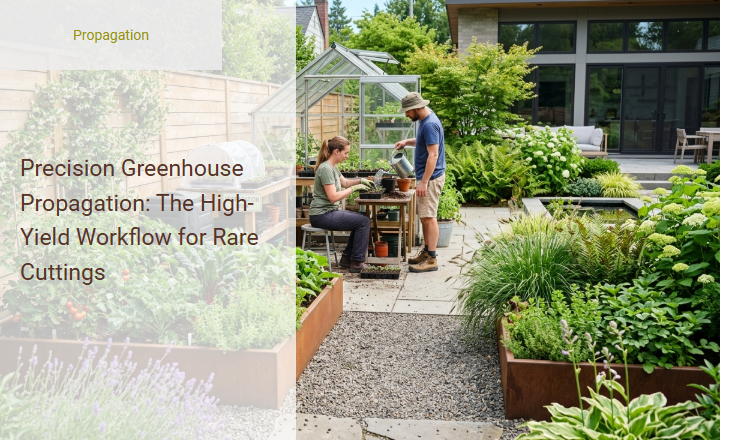
For commercial cultivators, propagating high-value botanical specimens often feels like a high-stakes gamble, where a minor environmental fluctuation can lead to devastating crop loss and wasted capital. Before optimizing complex hormone treatments, growers must first master microclimate stability, as understanding the relationship between vapor pressure deficit (VPD) and cellular stress is the essential prerequisite to any successful rooting protocol.
Establishing this precise level of environmental control grants cultivators a predictable 95% rooting success rate, transforming volatile botanical investments into highly reliable revenue streams. Note, however, that this methodology requires strict adherence to sterile sanitation protocols; even the most advanced precision propagation cannot compensate for latent pathogen contamination.
When applied to challenging cultivars like Monstera deliciosa 'Albo' or delicate hardwood grafts, this structured workflow ensures rapid, uniform adventitious root initiation. Below, we break down the critical stages of this high-yield system, detailing substrate formulation, hormonal integration, and automated moisture delivery.
Read also: Mist System vs Manual Spraying for Greenhouse Cuttings
Introduction to Precision Propagation
Propagating rare and sensitive botanical species requires more than standard gardening techniques. Standard propagation methods often fail because they rely on variable environments and imprecise cuts, which lead to desiccation, fungal infection, or metabolic arrest. By implementing a strict, scientific workflow, growers can optimize cellular regeneration and achieve a 95%+ success rate even with the most challenging cultivars.
Sterile Protocols and Tool Preparation
Maintaining an aseptic environment is the first line of defense against systemic pathogens. Fungal spores and bacterial colonies can easily enter fresh open wounds on a cutting, causing tissue rot before root initials can develop.
- Sanitize all cutting tools using
70% isopropyl alcoholor a10% bleach solution. - Wipe down the entire workstation surface with a broad-spectrum disinfectant.
- Ensure gloves are worn and frequently sterilized with
ethanol spraybetween handling different mother plants.
Formulating the Perfect Propagation Medium
A high-porosity propagation substrate balances capillary action with oxygen diffusion, ensuring that the developing root initials have access to both hydration and aeration.
| Substrate Ingredient | Volume Percentage | Primary Physical Property |
|---|---|---|
| Coarse Perlite | 50% | High air porosity and drainage |
| Fine Sphagnum Peat Moss | 30% | Moisture retention and low pH buffering |
| Vermiculite | 20% | Cation exchange capacity and water holding |
Selecting and Executing the Perfect Cut
The physical act of harvesting a cutting determines how quickly the plant can seal its wound and redirect its energy toward root initiation.
- Identify a healthy, non-flowering shoot on the mother plant with at least two active nodes.
- Position a sterilized, razor-sharp blade at a 45-degree angle directly beneath the lowest node.
- Make a swift, clean slice to minimize cell crushing and maximize the surface area available for hormone absorption.
Rooting Hormone and Wound Therapy
To stimulate rapid cell differentiation, exogenous auxins are applied directly to the freshly cut basal tissue. Using a precise blend of Indole-3-butyric acid (IBA) and 1-Naphthaleneacetic acid (NAA) triggers the cambium layer to produce root cells rather than vegetative shoots.
Softwood cuttings require lower concentrations of liquid or gel auxins, whereas hardwood cuttings benefit from higher-concentration powders. Allowing the wound to undergo a brief, controlled callusing process prior to insertion into the media protects the stem from systemic pathogens.
Mastering VPD and Microclimate Dynamics
Vapor Pressure Deficit (VPD) dictates the rate of transpiration. For unrooted cuttings, managing this microclimate is critical because they lack a root system to replace lost water.
Lighting Spectrum and Intensity Configuration
Unrooted cuttings do not require intense light; high light levels drive excessive transpiration and stress the plant tissue before roots can support it.
- Maintain a low Daily Light Integral (DLI) of 4 to 6 mol/m²/day.
- Utilize a spectrum rich in blue wavelengths (450 nm) to promote compact growth and sturdy cellular walls.
- Keep the photoperiod to a steady 18 hours on, 6 hours off cycle to stabilize metabolic rhythms.
Automated Mist Cycles and Irrigation
Rooting substrates must remain consistently damp without becoming saturated, as excess water depletes oxygen and invites disease.
- Program the automated system to deliver short, 5-second mist bursts every 15 to 30 minutes during light hours.
- Reduce frequency during the dark period to prevent prolonged water pooling on leaf surfaces.
- Monitor the substrate to ensure it maintains a high air-to-water ratio, avoiding anaerobic root rot.
Biosecurity and Pathogen Monitoring
Warm and humid propagation chambers are ideal breeding grounds for destructive mold and water molds.
- Inspect the stems daily for early signs of Pythium (root rot) or Botrytis (grey mold).
- Introduce beneficial microbes like Trichoderma harzianum to colonize the root zone.
- Apply organic, systemic inoculants to establish a protective biological barrier around vulnerable tissues.
Hardening Off and Transplanting Success
Acclimatizing newly rooted clones to ambient greenhouse conditions requires a slow, deliberate reduction in humidity.
- Crack open the propagation dome vents gradually over a three-day period to reduce relative humidity.
- Expose the plants to ambient air for longer intervals to encourage the development of a waxy leaf cuticle.
- Transplant the rooted plug into the final growing medium once vigorous secondary roots emerge from the substrate.
Summary
"Precision Greenhouse Propagation: The High-Yield Workflow for Rare Cuttings" outlines a highly engineered system designed to maximize the survival and growth rates of high-value, delicate botanical specimens. The article details a rigorous step-by-step methodology, transitioning from mother plant cultivation to the final hardening-off phase. Key steps include strict sanitation protocols to eliminate pathogens, optimal cutting techniques to maximize rooting surface area, and the strategic application of rooting hormones.
Furthermore, it emphasizes the critical role of environmental controls, detailing how to manage microclimates through automated misting, bottom-heat propagation mats, and custom LED lighting spectrums. By shifting from traditional gardening methods to a data-driven, systematic workflow, growers can significantly reduce mortality rates and accelerate root development. This guide serves as an essential technical blueprint for commercial nurseries and advanced collectors aiming to scale up the production of rare plants with near-perfect success rates.
Leave a comment