
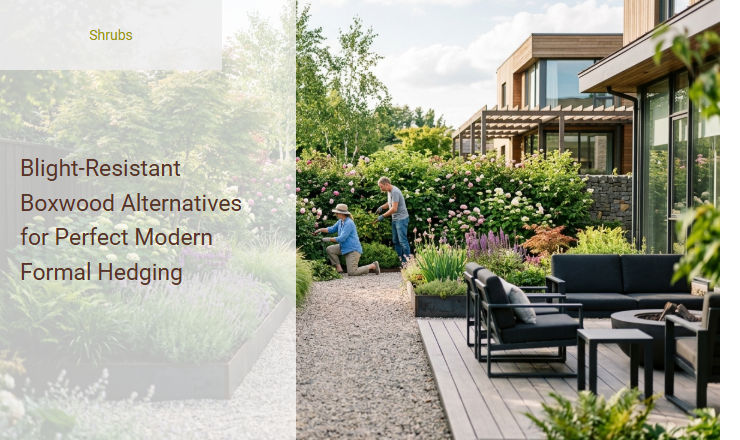
For years, estate managers and landscape designers have watched their meticulously manicured hedges fall victim to the devastating, rapid spread of boxwood blight. Historically, Buxus sempervirens has been the undisputed gold standard for defining formal garden geometry, making its loss highly disruptive to classic designs.
Fortunately, transitioning to modern, resilient cultivars grants you the peace of mind of disease immunity while fully preserving the crisp, architectural lines essential to high-end landscaping. It is important to stipulate, however, that successful substitution requires adapting to the slightly different soil chemistry and shearing schedules these alternative species demand.
Integrating proven, blight-resistant specimens like Japanese Holly (Ilex crenata 'Green Lustre') or dwarf Yew (Taxus baccata) provides the same dense, small-leaved texture and excellent response to shaping. This guide examines the premier alternatives on the market, comparing their growth rates, hardiness zones, and maintenance profiles to help you secure a pristine, lasting formal boundary.
Read also: Yew vs Boxwood for Formal Hedges
Introduction: The Boxwood Blight Dilemma and the Rise of Modern Alternatives
For centuries, the structured elegance of estates and urban courtyards relied on the crisp, clean lines of traditional boxwood hedges. However, the rapid spread of Boxwood Blight, a devastating fungal disease caused by the pathogen Cylindrocladium buxicola, has severely disrupted this horticultural tradition. The disease causes rapid defoliation, unsightly brown lesions, and eventual dieback, leaving historic and modern gardens alike vulnerable to sudden ruin.
Faced with this persistent threat, landscape architects and home gardeners are transitioning toward resilient, modern hedging alternatives. These carefully selected species offer the same tight, architectural form as traditional boxwood but come with natural resistance to blight, signaling a new era of sustainable and durable formal garden design.
What Makes a Perfect Formal Hedge Alternative?
To successfully replicate the iconic look of a classic boxwood hedge, a plant must possess specific structural characteristics. Standard shrubs often lack the density or texture required to maintain sharp, geometric edges over time.
- Dense growth habit: The plant must produce closely spaced branching to prevent hollow spots and maintain a solid architectural barrier.
- Small evergreen leaves: Tiny, ovate, or glossy leaves are essential for mimicking the fine-textured aesthetic of traditional boxwood.
- High tolerance for shearing: The species must respond well to frequent trimming, pushing out tight new growth rather than dying back when cut.
- Multi-season resilience: It must retain its vibrant color and foliage density throughout winter without significant bronzing or leaf drop.
Japanese Holly (Ilex crenata): The Ultimate Lookalike
For those seeking an identical visual replacement for traditional boxwood, Ilex crenata, commonly known as Japanese Holly, stands out as the premier candidate. Boasting small, obovate, lustrous green leaves and a naturally dense structure, this species is virtually indistinguishable from boxwood to the untrained eye, while remaining completely immune to the devastating effects of boxwood blight.
Cultivar Spotlight: 'Green Luster'
The Ilex crenata 'Green Luster' cultivar is a low-growing, rounded shrub that excels in horizontal borders. It features highly polished, dark green foliage and maintains a compact shape with minimal shearing, making it excellent for low-maintenance formal knot gardens.
Cultivar Spotlight: 'Sky Pointer'
For vertical elements and tight spaces, the columnar Ilex crenata 'Sky Pointer' offers a striking upright form. Its narrow growth habit is ideal for adding height to formal designs or creating narrow, space-saving geometric hedges along pathways.
English Yew (Taxus baccata): The Regal, Long-Lived Option
Known as the king of hedging plants, Taxus baccata has been utilized in grand European estate gardens for centuries. This exceptionally long-lived conifer features dark, needle-like foliage that creates a rich, velvety backdrop, showcasing other garden colors and hardscapes with regal sophistication.
Dwarf and Standard Yew Cultivars
Whether utilizing dwarf selections for low parterres or standard upright cultivars for tall boundary walls, English Yew provides unmatched flexibility. It thrives in conditions ranging from full sun to deep, dry shade, adapting beautifully to various urban and rural microclimates.
One of the primary maintenance advantages of English Yew is its unique ability to regenerate from old wood. Unlike most conifers, if a yew hedge becomes overgrown or misshapen, it can be hard-pruned back to the main trunk and will fully regenerate with lush, new green growth over subsequent seasons.
Sweet Box (Sarcococca confusa): Fragrance and Shade Tolerance
For challenging, light-deprived areas of the garden, Sarcococca confusa offers an elegant and functional solution. This tough, evergreen shrub features highly glossy, deep green leaves that reflect ambient light, brightening dark corners where traditional boxwood would struggle and succumb to disease.
Beyond its structural utility, Sweet Box adds sensory delight to the winter landscape. In the coldest months, typically from January to March, the plant produces inconspicuous white flowers that emit a remarkably intense, sweet fragrance, followed by glossy black berries that attract local bird life.
Privet Honeysuckle (Lonicera pileata): Low-Growing and Fast-Spreading
If you need to establish clean borders quickly, Lonicera pileata is an exceptional choice. This low-growing, semi-evergreen to evergreen shrub features tiny, glossy leaves arranged in neat, flat pairs along horizontal branches, closely mimicking the texture of fine-leaved boxwood.
Its natural prostrate growth habit makes it exceptionally well-suited for low parterres, modern minimalist borders, and bank stabilization. A standout benefit of Privet Honeysuckle is its rapid growth rate, allowing gardeners to achieve a fully established, manicured formal look in a fraction of the time required by slower-growing species.
Dwarf Myrtle (Myrtus communis 'Compacta'): Best for Warm, Sunny Climates
In hot, arid regions where traditional boxwood suffers from heat stress and drought, Myrtus communis 'Compacta' shines. This dwarf evergreen shrub features tiny, teardrop-shaped leaves that release a pleasant, spicy aroma when brushed against or pruned.
Aromatic Structure for Mediterranean Designs
Perfect for USDA zones 8 through 11, Dwarf Myrtle is highly drought-tolerant once established and thrives in poor, well-drained soils. Its tight branching habit allows it to be sheared into crisp, geometric shapes, making it the perfect choice for creating neat, aromatic borders in Mediterranean-style formal gardens.
Designing Modern Formal Hedges: Spacing and Geometry
Achieving a seamless, architectural look with alternative plants requires precise planning and planting techniques. Unlike informal mixed borders, formal hedging relies on mathematical symmetry and dense planting to form a single, cohesive unit.
- Optimal spacing: Space smaller cultivars (such as Japanese Holly) 10 to 12 inches apart, and larger species (such as Yew) 18 to 24 inches apart from center to center to ensure rapid closure.
- Perfect alignment: Always use a taught builder's string line and a spacing template during planting to guarantee perfectly straight lines.
- Tapered profiles: Prune your hedges so they are slightly wider at the base than at the top. This "A-shape" or trapezoidal profile ensures sunlight reaches the lower branches, preventing bottom balding.
- Consistent height: Use a laser level or highly accurate spirit levels on stakes to guide your shears along the top plane of the hedge.
Pruning and Maintenance Secrets for Pristine Hedges
Maintaining the crisp lines of a formal hedge requires a disciplined pruning schedule and proactive plant health care. While these modern alternatives are highly resistant to boxwood blight, they still require proper husbandry to look their absolute best.
For most boxwood alternatives, the optimal times to shear are mid-spring and late summer. Avoid pruning in late autumn, as this stimulates tender new growth that can easily be damaged by winter frosts. To prevent the spread of opportunistic secondary pests and pathogens, always use razor-sharp shears and sanitize your blades with a 10% bleach solution or isopropyl alcohol between different sections of the garden.
Choosing Your Perfect Path: A Comparative Summary
Selecting the right plant for your landscape depends on a careful evaluation of your garden's unique environmental conditions. While Japanese Holly offers the most precise visual match, its performance relies on slightly acidic, moist, well-drained soils. For dry shade, English Yew or Sweet Box remains unmatched, whereas Dwarf Myrtle is the logical selection for sun-drenched, drought-prone environments.
By matching your specific soil condition, light requirements, and climate suitability to these modern, blight-resistant cultivars, you can confidently construct a beautiful, long-lasting formal garden that will stand resilient against disease for decades to come.
Summary
Traditional boxwood (Buxus) has long been the gold standard for creating structured, elegant formal hedges. However, the devastating spread of boxwood blight and destructive box tree moth infestations have forced gardeners to seek resilient alternatives. This guide highlights excellent blight-resistant evergreen substitutes that perfectly replicate the dense, neat aesthetic of classic boxwood without the high risk of disease.
Key alternatives include Ilex crenata (Japanese Holly), which features small, glossy leaves ideal for tight shearing, and Taxus baccata (Yew) for creating a dark, sophisticated, and long-lived structured border. Additionally, fast-growing options like Lonicera nitida (Box Honeysuckle) offer versatile, easily maintained solutions for modern garden designs. By transitioning to these hardy, disease-resistant species, homeowners can achieve the pristine, architectural look of formal hedging while ensuring long-term landscape health and sustainability.
Leave a comment