
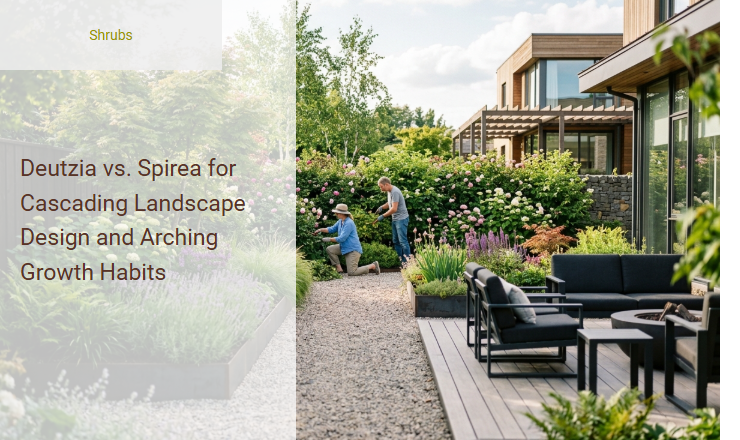
Achieving a seamless cascading effect in home gardens often frustrates designers, who struggle to find weeping shrubs that deliver elegant draping without devolving into unruly, overgrown tangles. Before selecting your plants, it is crucial to first consider how structural plant architecture defines the transitions between multi-tiered garden beds. Selecting the correct genus grants your landscape effortless, low-maintenance movement and reliable seasonal focal points. However, an essential design stipulation remains: success depends on matching each shrub's unique growth rate and site preferences to your local microclimate. For instance, the delicate, star-laden branches of Deutzia gracilis 'Nikko' require sheltered, moist soils to thrive, whereas the robust, fountain-like habit of Bridalwreath Spirea (Spiraea x vanhouttei) tolerates harsher, drought-prone environments.
In this guide, we will analyze the key distinctions between Deutzia and Spirea, comparing their growth habits, bloom timelines, and maintenance requirements to help you choose the perfect specimen for your cascading landscape design.
Introduction to Arching Shrubs in Landscape Design
Landscape design is not merely about choosing colors; it is about orchestrating movement and form within a space. Among the most dramatic elements in a well-planned garden are cascading and arching shrubs. These plants break the monotony of rigid structures and upright conifers, introducing a sense of fluidity and softness. By gracefully sweeping toward the earth, they guide the eye and create natural transitions between different layers of the garden landscape.
To achieve this weeping effect, two plant genera stand out as prime contenders: Deutzia and Spirea. Both offer exceptional structural elegance, converting static garden beds into dynamic, living sculptures that dance with the breeze.
Botanical Profiles: Deutzia vs. Spirea
The Genus Deutzia
Deutzia is a genus of about 60 species of flowering plants in the Hydrangeaceae family. Primarily native to eastern and central Asia, particularly China and Japan, these deciduous shrubs are highly valued for their delicate growth habits and neat, compact structure.
The Genus Spirea
Spirea, belonging to the Rosaceae family, comprises around 80 to 100 species of deciduous woody shrubs. Native throughout the temperate Northern Hemisphere, with a rich concentration in eastern Asia, Spirea species are known for their remarkable toughness and dense, fountain-like growth profiles.
General Growth Characteristics
- Deutzia typically features opposite leaves, hollow stems, and fibrous bark that peels attractively as the plant ages.
- Spirea features alternate leaves, solid stems, and a dense branching network that produces masses of tiny flowers in clustered corymbs or panicles.
Analyzing the Cascading Aesthetics and Textures
In professional landscape architecture, texture and visual weight determine how a plant is perceived from a distance. The choice between these two genera hinges on the specific mood a designer wishes to cultivate within the garden canvas.
The fine, layered branches of Deutzia sweep downward with a light, airy grace, making it an excellent choice for intimate spaces where its delicate details can be appreciated up close.
Conversely, the Spirea genus offers a much more dramatic, fountain-like spray of foliage. Its branches are packed with dense, small leaves, creating solid mounds of green that spill over boundaries like rushing water. This dense texture makes Spirea highly effective for grand gestures, where a powerful focal point is needed to anchor a large garden bed and draw the eye from afar.
Growth Habit, Mature Size, and Structural Differences
Understanding the spatial footprints of these shrubs is critical for proper garden planning. While both offer arching forms, their mature dimensions and structural qualities differ significantly.
| Feature | Deutzia (Cascading Types) | Spirea (Arching Types) |
|---|---|---|
| Mature Height | 1 to 3 feet (dwarf) to 5 feet | 3 to 8 feet depending on species |
| Mature Spread | 2 to 5 feet | 4 to 10 feet |
| Branch Flexibility | Highly flexible, slender, creeping stems | Stiffly arching, woody, self-supporting sprays |
Seasonal Interest: From Spring Blooms to Autumn Foliage
Springtime Flowering Patterns
Deutzia bursts into a cloud of blossoms in mid to late spring. The flowers are typically star-shaped or bell-shaped, dangling gracefully from the undersides of the weeping branches in shades of white or soft pink. Spirea, depending on the species, can bloom in early spring or mid-summer. The classic arching spring-bloomers, such as Spiraea x vanhouttei, produce tight, button-like white flowers clustered along the entire length of the stems, mimicking a heavy dusting of fresh snow.
Summer and Autumn Transitions
After the spring bloom, Deutzia transitions to a quiet, deep green backdrop, with some cultivars developing a rich burgundy or bronze tint in autumn. Spirea, however, often steals the show in the fall. Many Spirea varieties exhibit dramatic foliage shifts, changing from bright chartreuse or blue-green in summer to brilliant oranges, fiery reds, and deep purples as the temperatures drop, ensuring year-round garden interest.
Environmental Needs: Soil, Sun, and Climate Tolerances
Both Deutzia and Spirea are remarkably adaptable, yet understanding their optimal environmental niches ensures peak performance and structural integrity. Deutzia thrives in moist, well-drained loamy soil and prefers full sun to light, dappled shade. It is generally hardy in USDA zones 5 through 8, though extreme winter winds can sometimes damage the flower buds of early-blooming varieties.
Spirea is legendary for its rugged durability. It tolerates a wider range of soil types, including heavy clay and poor soils, and possesses superior drought tolerance once established. Spirea performs best in full sun, which maximizes its bloom density and autumn coloration across USDA zones 3 through 8.
Pruning Strategies for Maintaining Cascading Forms
Improper pruning can easily ruin the natural arching habits of these shrubs, turning a graceful cascade into a blocky, unnatural hedge. Follow these targeted steps to maintain their weeping structures:
- Prune immediately after flowering: Because spring-blooming varieties of both Deutzia and Spirea set their flower buds on the previous year's wood, pruning in late summer or winter will cut off next spring's show.
- Use the renewal method: Instead of shearing the top, cut the oldest, thickest woody stems down to the ground level. Remove about one-third of the oldest canes each year to encourage fresh, flexible shoots from the base.
- Remove dead or crossing wood: Clean up the inner framework of the shrub to allow light penetration and air circulation, preserving the healthy outer cascading branches.
Top Cultivars for Maximum Arching and Weeping Effects
Deutzia gracilis 'Nikko'
This dwarf cultivar is a masterpiece of cascading form. Reaching only 1 to 2 feet in height but spreading up to 5 feet wide, it creates a dense carpet of bright green leaves that are completely covered in pure white, star-like flowers in spring. Its low-growing, weeping habit makes it perfect for spilling over walls.
Spiraea x vanhouttei (Vanhoutte Spirea)
Often called the bridal wreath spirea, this classic cultivar is the gold standard for arching shrubs. It grows 5 to 8 feet tall and features fountain-like, blue-green foliage that arches dramatically to the ground under the weight of countless snow-white flower clusters in late spring.
Practical Landscape Applications: Slopes, Walls, and Borders
The cascading forms of Deutzia and Spirea are not just beautiful; they are highly functional tools for solving landscape challenges.
- Erosion Control on Slopes: The spreading root systems and low-draping foliage of ground-cover Deutzias make them ideal for stabilizing soil on steep banks, softening harsh inclines while suppressing weeds.
- Draping Over Retaining Walls: Planting 'Nikko' Deutzia or compact Spirea varieties at the edge of stone walls allows their branches to cascade down, breaking up harsh masonry lines with organic softness.
- Anchoring Mixed Borders: The taller, fountain-like Spirea varieties serve as magnificent structural anchors in the middle or back of mixed shrub borders, providing a lush backdrop for perennials.
Selection Guide: Choosing the Perfect Shrub for Your Garden
Selecting the right shrub depends on your specific microclimate, space constraints, and design goals. While both options offer beautiful, weeping forms, they serve different landscape roles.
Choose Deutzia if you have a smaller, protected garden area, enjoy delicate close-up floral details, or need a low-growing ground cover for moist soil.
Choose Spirea if you need a tough, low-maintenance plant that can handle poor soil, cold winter winds, or hot summer sun while offering dramatic multi-season foliage shifts.
| Feature | Deutzia (e.g., 'Nikko') | Spirea (e.g., 'Bridal Wreath') |
|---|---|---|
| Growth Habit | Low-growing, compact, ground-hugging drapes. Slender, delicate arching stems. | Tall, vigorous, fountain-like sweeping arches. Broad, dramatic weeping branches. |
| Bloom Distribution | Star-shaped individual flowers lining the upper side of stems in neat rows. | Dense, heavy clusters (corymbs) that weigh down branches into deep curves. |
| Peak Cascade Season | Late spring (brief, concentrated 2–3 week display). | Early spring to mid-summer (dependent on species; longer-lasting impact). |
| Landscape Application | Draping over low retaining walls, rock gardens, and steep bank covers. | Large scale specimen planting, dramatic property borders, and tall backdrops. |
| Cascade Maintenance | Minimal pruning required; naturally holds neat, weeping shape. | Requires annual renewal pruning to prevent stiff, woody centers. |
| Folliage Texture | Fine, neat green leaves; creates a dense, uniform cascading carpet. | Feathery, airy leaves; offers dynamic movement and vibrant fall color. |
Leave a comment