
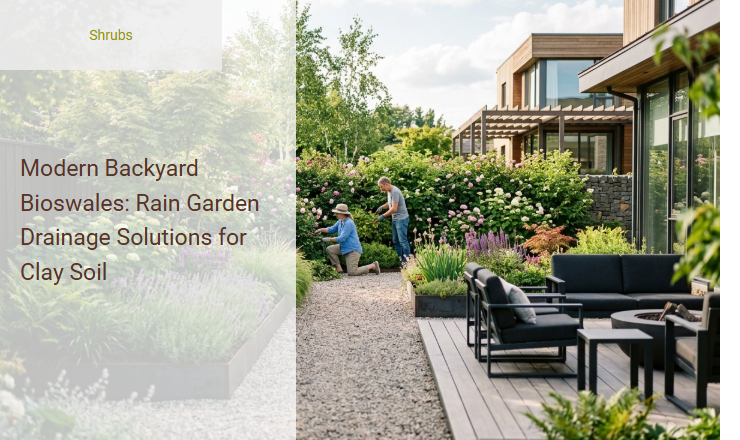
For homeowners with heavy clay soil, a single downpour can transform a manicured backyard into a frustrating, waterlogged marsh that refuses to drain. While traditional solutions often rely on unsightly pipes that merely export the problem, modern landscape design offers a more ecological approach. Integrating a backyard bioswale provides a highly effective remedy, transforming a soggy eyesore into a striking, self-sustaining feature that naturally filters storm runoff and enhances property value.
Success with clay, however, requires careful planning; without precise slope grading and specific soil modification, standing water will persist. By incorporating structured elements such as deep-rooted native sedges, permeable gravel aquifers, and decorative river rocks, you can slow and sink water efficiently. In this guide, we will examine the essential engineering principles, plant profiles, and step-by-step installation techniques required to build a functional, clay-optimized rain garden.
Read also: Buttonbush vs Summersweet for Rain Gardens
The Clay Soil Conundrum: Why Standard Drainage Fails
For many homeowners, the dream of a lush, functional backyard quickly washes away with the first heavy rainfall. Properties built on heavy clay suffer from severe soil compaction, a condition where tiny, tightly packed soil particles leave virtually no pore space for water to travel. When storm events occur, these dense subterranean layers act like a sheets of concrete, preventing water infiltration and leading to persistent surface ponding, soggy lawns, and drowned turf grass.
Traditional lawn care practices and standard flat yard designs are ill-equipped to handle this excess runoff. Standard turfgrass possesses shallow root systems that cannot penetrate compacted clay, causing water to pool on the surface for days. This standing water creates breeding grounds for mosquitoes and risks damaging home foundations. To solve this persistent headache, modern landscape design has turned to nature-inspired engineering: the modern bioswale. This system actively redirects, absorbs, and filters stormwater rather than letting it stagnate.
Bioswales vs. Rain Gardens: Understanding the Flow
While often used interchangeably in casual gardening conversations, bioswales and rain gardens serve distinct functions in managing residential stormwater. Understanding these differences is crucial for selecting the right intervention for clay-heavy yards.
Rain gardens are designed as static, shallow depressions that collect water from a specific source, like a downspout, allowing it to slowly seep into the ground over a day or two. In contrast, bioswales are dynamic, gently sloped channels designed to convey, filter, and direct water safely from one area of a property to another.
- Water Movement: Rain gardens hold water in a single ponding area until it infiltrates. Bioswales actively channel water along a engineered path, reducing water velocity and preventing erosion.
- Structural Footprint: Rain gardens are typically bowl-shaped and localized. Bioswales are linear, meandering paths that blend seamlessly into broader landscaping borders.
- Filtration Method: While rain gardens rely solely on vertical filtration through the soil, bioswales combine horizontal flow-through vegetation with engineered subsurface layers to scrub pollutants and sediment on the move.
- Clay Adaptation: In heavy clay, a simple rain garden can quickly become a permanent puddle. A bioswale uses its sloped design to move excess water to a safe outlet while filtering as much as possible along the way.
Mapping and Site Assessment for Your Backyard Bioswale
A successful bioswale requires careful planning to ensure water flows efficiently without causing damage to your property or neighboring yards. Proper site assessment ensures your system handles peak runoff volumes safely.
Before putting a shovel to the dirt, you must study the unique topography of your yard during a rain event to see exactly where water naturally collects and travels. Follow these steps to map and assess your site:
- Identify Runoff Sources and Paths: Observe your yard during a heavy storm. Note where water runs off the roof downspouts, patios, and driveways, and map the natural low-gradient pathways across your lawn.
- Establish Safe Setbacks: Ensure the proposed path of your bioswale keeps water at least 10 feet away from your home's foundation to prevent water from seeping into basements or crawlspaces.
- Conduct a Soil Percolation Test: Dig a hole 12 inches deep and 12 inches wide in your project zone. Fill it with water and let it drain completely to saturate the soil. Fill it again and measure how many inches it drains per hour. Clay soils often drain at a rate of less than 0.1 inches per hour, confirming the need for an engineered soil replacement.
- Locate a Safe Outlet: Determine where the water will exit the bioswale once it reaches capacity. This could be a rain garden, a dry well, or a designated drainage easement. Never direct runoff toward a neighbor's property.
Anatomy of a Modern Bioswale: Designing for Function and Beauty
A modern residential bioswale is far more than a simple ditch; it is a carefully layered, multi-functional landscape feature that balances engineering with contemporary aesthetics. By utilizing gentle curves and varied depths, a bioswale mimics natural creek beds, turning a functional utility into a stunning design asset.
The system is constructed with distinct zones, starting with a shallow, wide channel with gently sloping sides to prevent soil collapse. Beneath the surface, layers of engineered soil and gravel work together to filter and store water, while native plantings anchor the soil and absorb moisture.
   \  Zone C: Dry Rim (Turf/Grasses)  /
    \_______________________________/
     \  Zone B: Slope (Transition) /
      \                           /
       \   Zone A: Wet Channel   /
   ~~~~~\~~~~~~~~~~~~~~~~~~~~~~~/~~~~~ <-- Water Level (Flow Line)
   =================================== <-- Rock Armor / River Stone (2"-4")
   ----------------------------------- <-- Engineered Soil Mix (60% Sand / 20% Compost / 20% Topsoil)
   ::::::::::::::::::::::::::::::::::: <-- Geotextile Fabric (Optional)
   ooooooooooooooooooooooooooooooooooo <-- Pea Gravel / Perforated Pipe (Subdrain)
Excavation and Slope Grading: Setting the Foundation
The physical construction of your bioswale begins with excavation and grading. Establishing the correct slope is critical; too steep, and the rushing water will cause erosion; too flat, and the bioswale will turn into a stagnant pond rather than a slow-flowing drainage channel.
Aim for a gentle slope of 1% to 2% along the length of the channel. This means for every 10 feet of length, the channel bed should drop between 1.2 and 2.4 inches. Dig the main channel to a depth of 18 to 24 inches to accommodate the engineered soil mix and stone layers, keeping the side slopes gentle with a 3:1 ratio (three feet of width for every one foot of depth) to ensure stability.
The Engineered Soil Mix: Overcoming Clay's Deficiencies
Because native clay soil drains too slowly to be effective in a high-flow drainage system, the excavated clay must be removed and replaced with an engineered soil matrix. This custom mixture is designed to maximize water infiltration while retaining enough nutrients and organic matter to support robust plant life.
Replacing the heavy clay with this porous, structured mix allows water to sink rapidly into the bioswale bed. This process filters out suspended sediments and excess nutrients before the water either drains into the lower subsoil or flows safely out the end of the channel.
| Soil Component | Percentage by Volume | Primary Functional Role |
|---|---|---|
| Coarse Sand | 50% - 60% | Provides structural integrity, prevents compaction, and ensures rapid hydraulic conductivity. |
| Organic Compost | 20% - 30% | Retains essential moisture for plants, filters chemical pollutants, and provides vital nutrients. |
| Loamy Topsoil | 20% | Introduces beneficial microbes, supplies trace minerals, and helps anchor plant root systems. |
Plant Selection: Thriving in Wet and Dry Cycles
Plants chosen for a clay-bound bioswale must be resilient. These species need to survive "two worlds": temporary inundation during heavy storms, and periods of prolonged dryness during hot summer spells. Native plants are ideal because of their deep root systems, which can reach up to ten feet into the ground, punching channels through compacted clay and improving soil drainage over time.
To ensure plant survival, organize your selections into distinct zones based on moisture levels:
- Zone A: The Channel Bottom (Frequent Inundation)
- This zone experiences the highest volume of water and remains damp for the longest periods. Optimal plants include deep-rooted sedges (such as Carex stricta), rushes (Juncus effusus), Blue Flag Iris, and moisture-loving native shrubs like Red Osier Dogwood.
- Zone B: The Slope Banks (Transition Zone)
- The sides of the channel experience fluctuating moisture levels, catching runoff but draining quickly. Plant these areas with resilient perennials such as Swamp Milkweed, Joe-Pye Weed, Cardinal Flower, and Switchgrass.
- Zone C: The Upper Rim (Drier Margins)
- The highest outer edges of the bioswale rarely hold water and remain dry most of the year. Use drought-tolerant native species like Purple Coneflower, Black-Eyed Susan, Little Bluestem, and aromatic Aster to transition the bioswale naturally into the rest of your home landscape.
Hardscaping and Armoring: Preventing Erosion with Stone
In addition to plants, stone elements play a critical dual role in a bioswale. They provide necessary structural armoring against erosion and elevate the feature into a striking, naturalistic dry creek bed when the weather is dry.
Placing smooth, rounded river rocks along the bottom of the channel slows down fast-moving water, giving it more time to soak into the engineered soil. Large, strategically placed boulders can be used at curves and inlet points to deflect high-velocity flows, protecting the banks from washouts and keeping soil and mulch from drifting downstream.
"When placing stones in a bioswale, avoid uniform, grid-like layouts. For a professional, natural appearance, mix sizes from tiny pea gravel to medium-sized river rocks and heavy anchor boulders. Arrange them in clusters to replicate the organic sorting found in wild mountain streams."
Maintenance and Seasonal Care for Peak Performance
While a well-designed bioswale is self-sustaining in many ways, regular seasonal upkeep ensures it functions at peak efficiency and remains an attractive addition to your yard. Clay soils can easily wash back into the bioswale if nearby gardens are left bare, making routine checks important.
Caring for your bioswale changes throughout the year. Keep your system running smoothly with this seasonal checklist:
- Spring Startup Tasks:
- Remove accumulated winter leaves and organic debris from the channel bottom to prevent clogging.
- Inspect the rock armor for shifting or erosion and replace displaced stones.
- Prune dead foliage from native perennials to allow new green shoots room to grow.
- Summer Maintenance:
- Weed the channel and side slopes regularly to prevent invasive species from outcompeting your native plants.
- Water new plants deeply during their first growing season if dry spells last more than a week.
- Monitor the bioswale after major summer storms to ensure water drains completely within 24 to 48 hours.
- Fall and Winter Preparation:
- Divide overgrown plants and sedges to keep them from choking out the flow channel.
- Spread a fresh, thin layer of shredded hardwood mulch on bare spots along the slope transitions.
- Clear fallen leaves and debris from the inlet and outlet zones to prevent winter ice dams from forming.
The Working Landscape: Ecological Rewards of Modern Drainage
Replacing a waterlogged, compacted lawn with an engineered backyard bioswale is a powerful way to transform a landscaping challenge into a biological triumph. Rather than fighting against clay soil, this approach works with natural systems to direct water safely, filter out urban pollutants, and recharge local aquifers.
Over time, the deep roots of native plants continue to break up the surrounding clay, improving your yard's natural drainage capacity year after year. Beyond resolving drainage issues, a bioswale introduces vital biodiversity to your property, inviting birds, butterflies, and beneficial insects to a thriving pocket habitat. By choosing a bioswale, homeowners can trade a soggy, frustrating lawn for an active, living landscape that proves drainage solutions can be both highly functional and breathtakingly beautiful.
Summary
Modern backyard bioswales offer an innovative and eco-friendly solution to the persistent drainage challenges posed by heavy clay soil. Traditional clay landscapes often suffer from waterlogging, but bioswales are engineered channels designed to capture, filter, and slowly absorb stormwater runoff. By combining strategic grading with deeply rooted native plants, gravel layers, and amended soil mixtures, these systems effectively manage excess water while preventing erosion.
Integrating a bioswale into a modern outdoor space not only resolves standing water issues but also enhances local biodiversity and elevates a property's aesthetic appeal. This sustainable approach transforms a practical drainage necessity into an attractive, low-maintenance rain garden. Ultimately, bioswales prove that functional water management can seamlessly blend with contemporary landscape design, offering a beautiful, green solution for challenging clay terrains.
Leave a comment