
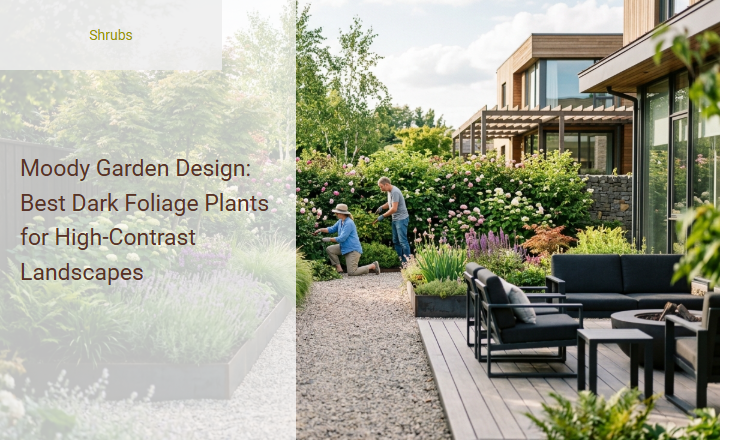
Many gardeners struggle to design outdoor spaces that maintain visual interest after summer blooms fade, often resulting in a flat, washed-out green expanse. While traditional garden design relies heavily on temporary floral color to create focal points, sustainable depth is actually achieved through deliberate foliage contrast.
Integrating ultra-dark foliage grants your landscape a sophisticated, architectural structure that endures throughout the growing season. However, successfully designing with near-black hues requires a baseline understanding of light physics: without strategic positioning and bright companion plants, these moody tones can easily recede into the shadows and become lost to the eye.
When positioned correctly-such as contrasting the deeply incised, dark purple leaves of 'Black Lace' Elderberry (Sambucus nigra) or the obsidian ruffles of 'Obsidian' Coral Bells (Heuchera) against vibrant chartreuse neighbors-the visual payoff is extraordinary. In this guide, we will explore the premier dark-foliage cultivars available today and outline professional placement strategies to master high-contrast garden design.
Read also: Smoke Bush vs Ninebark for Dark Foliage
Embracing the Shadows: Introduction to Moody Garden Design
For decades, traditional landscape design has focused on bright, sun-drenched blooms and uniform green lawns. However, a modern design revolution is taking root in the shade. Moody garden design embraces the deep, saturated tones of dark foliage to create environments filled with drama, mystery, and high-contrast beauty. By stepping away from conventional palettes, gardeners can cultivate intimate, atmospheric sanctuaries that captivate the senses.
Incorporating deep plums, charcoals, and near-blacks into your landscape does not make a space feel gloomy; instead, it introduces an unexpected layer of sophistication. These rich tones act as a visual anchor, making the surrounding greenery look more vibrant and alive. This design approach transforms ordinary yards into living works of art, where every leaf tells a story of shadows and light.
The Science of Contrast: Why Dark Foliage Works
Understanding the visual mechanics of dark foliage requires looking at how light interacts with different pigments. Deep purple, charcoal, and near-black leaves contain high concentrations of anthocyanins. These pigments absorb a massive portion of the visible light spectrum, reflecting very little back to our eyes. Because these dark surfaces absorb light rather than bounce it away, they naturally recede into the background, creating an illusion of endless depth and space.
When dark foliage absorbs light, it creates a powerful negative space. This visual vacuum forces the human eye to focus on the brighter, lighter elements placed immediately adjacent to it, magnifying their brilliance.
This optical phenomenon is why a pale pink flower or a chartreuse leaf appears infinitely brighter when set against a dark backdrop. Instead of competing for attention, the dark foliage acts as a velvety stage, elevating nearby colors. Contrast is not just about color differences; it is about manipulating light and shadow to guide the viewer's gaze. By utilizing these deeply pigmented plants, you can control where the eye travels and create stunning focal points in otherwise flat areas of the garden.
Tall Statements: Dark Trees and Large Shrubs
To establish a successful moody garden, you must start with structure. Large-scale dark trees and shrubs serve as the backbone of your design, providing essential height, defining boundaries, and casting dramatic shadows. These woody giants create an architectural frame that encloses the garden space, instantly making it feel more private and secretive.
- Black Lace Elderberry (Sambucus nigra 'Eva'): This striking shrub features finely cut, lacy foliage in a deep purple-black shade. In late spring, it produces massive clusters of pinkish-white flowers that stand out beautifully against the dark, feathery leaves.
- Forest Pansy Redbud (Cercis canadensis 'Forest Pansy'): Renowned for its heart-shaped leaves, this small tree emerges in spring with brilliant scarlet-purple foliage that matures to a rich, deep maroon. Its elegant branching structure adds architectural interest throughout the year.
- Diabolo Ninebark (Physocarpus opulifolius 'Monlo'): A tough, adaptable shrub with deep purple foliage and peeling bark that adds winter interest. Its creamy-white summer blooms offer a stark, stunning contrast to its dark background.
Mid-Border Anchors: Bold Medium-Sized Foliage
The middle layer of your garden border is where different plant heights meet and blend. Without strong mid-sized plants, a garden can feel disconnected, leaving a noticeable gap between the ground level and the overhead canopy. Selecting bold, medium-sized plants with deep hues bridges this gap, creating a seamless visual flow and anchoring your design compositions.
- 'Britt Marie Crawford' Ligularia (Ligularia dentata): This plant boasts massive, glossy, leathery leaves of a dark chocolate-purple. In late summer, bright golden-orange daisy-like flowers emerge, creating a spectacular contrast directly above the dark mound of foliage.
- Dark-Leaved Cannas (Canna indica): Varieties like 'Australia' or 'Tropicanna Black' bring a tropical flair to the moody landscape. Their broad, paddle-like leaves in deep bronze and black tones catch the eye and provide strong architectural contrast to finer-textured plants.
- Black Barlow Columbine (Aquilegia vulgaris): This perennial features upward-facing, double-petal flowers of such a deep violet-purple they appear completely black, nestled among attractive blue-green and dark-flushed foliage.
Ground-Level Drama: Dark Groundcovers and Grasses
A truly immersive moody garden pays attention to every dimension, including the very ground you walk on. Utilizing dark groundcovers and grasses helps to build a rich, textured, and mysterious garden floor. Instead of a standard green turf, these low-growing options lay down a dark carpet that grounds the entire landscape, making the space feel deeply rooted and cohesive.
- Black Mondo Grass (Ophiopogon planiscapus 'Nigrescens'): This extraordinary grass-like plant features tufts of arching, strap-like leaves that are nearly pure black. It spreads slowly to form a striking, velvet-like ground cover that contrasts beautifully with light-colored gravel or stone paths.
- 'Chocolate Chip' Ajuga (Ajuga reptans): A fast-spreading groundcover with tiny, chocolate-brown and bronze leaves that hug the earth. In spring, it erupts with spikes of bright blue flowers, offering a breathtaking color combination.
- 'Hillside Black Beauty' Bugbane (Actaea simplex): Though it eventually sends up tall, fragrant white flower spikes, its low-growing foliage mounds remain a dense, deep purple-black for most of the season, creating a solid dark base in shady borders.
High-Contrast Pairings: Partnering Dark and Light
To keep a moody garden from looking flat or overly sombre, you must master the art of pairing. The magic of dark foliage is unlocked when it is juxtaposed with highly reflective, bright colors. This contrast creates dynamic energy in the garden, making colors seem purer and shapes more defined. By intentionally grouping these opposites, you can craft high-impact focal points that immediately draw the eye.
- Chartreuse and Plum: Pair the golden-green foliage of 'Aureola' Hakone Grass or 'Lemon Lace' Elderberry with the deep purple leaves of a smokebush. The bright chartreuse glows like a neon light against the dark, absorbing backdrop.
- Silver and Charcoal: Place dusty miller, Artemisia, or lamb's ear next to black mondo grass. The metallic sheen of the silver leaves bounces light directly off the absorbing charcoal surface, highlighting the unique textures of both plants.
- White Blooms and Black Foliage: Plant white-flowered perennials like 'Honorine Jobert' Anemones in front of a dark-leaved ninebark. The pure white petals will seem to float in mid-air against the dark backdrop, especially during the twilight hours.
Painting with Light: Positioning for Dramatic Shadow Play
The secret to a dynamic moody garden lies in how you use sunlight. Unlike bright, pastel gardens that look best under clear midday sun, a dark foliage garden relies on strategic light positioning to reveal its subtle textures and rich undertones. How light filters through or bounces off dark leaves can completely transform the mood of the garden from dawn to dusk.
To capture the most dramatic effects, position your dark-leaved plants where they can receive morning sun or late afternoon backlighting. When low-angled sunlight passes through translucent dark leaves, like those of a redbud or maple, the foliage glows with a rich, ruby-red luminosity. Placing dark plants in areas of dappled shade under a light canopy also allows pockets of sunlight to dance across the deep foliage, creating a moving tapestry of shadows. Always remember that dark plants placed in deep, unlit corners will disappear visually; they require at least a touch of light to showcase their deep colors and intricate details.
Moody Containers: High-Contrast Pots and Planters
If you have limited space or want to test the moody aesthetic before transforming your entire landscape, containers are the perfect medium. Designing small-scale moody displays allows you to experiment with intense color contrasts and bold textures in a highly controlled, easily movable format. By using a dark focal plant as your centerpiece, you can build a dramatic, high-contrast arrangement in any container.
- Purple Fountain Grass (Pennisetum setaceum 'Rubrum'): This stunning ornamental grass serves as an excellent central thriller for pots. Its arching burgundy-purple leaves and soft, feathery seed heads provide height, movement, and rich color.
- Sweet Potato Vine (Ipomoea batatas 'Blackie'): A classic spiller plant with deeply lobed, near-black foliage that cascades over the edges of containers, drawing the eye downward and grounding the display.
- Vibrant Companion Plants: Surround your dark focal elements with bright companions like lime-green sweet potato vine, hot pink petunias, or silver dichondra to make the dark colors pop and keep the arrangement visually exciting.
Year-Round Mystery: Seasonal Transitions of Dark Foliage
A moody garden is not a static display; it is a living entity that evolves beautifully throughout the year. Dark foliage plants offer distinct visual contributions in every season, shifting their tones and textures as the weather changes. Understanding these seasonal transitions allows you to design a landscape that maintains its mystery and allure from spring through winter.
In spring, many dark-leaved plants emerge with intense, vibrant tones of bronze, copper, and bright red before deepening into their signature summer charcoals and dark purples. During the summer heat, these plants provide a cool, soothing visual anchor against the bright sun. As autumn arrives, dark foliage undergoes a spectacular shift, often turning to fiery shades of orange, amber, and deep crimson. Even in winter, when the leaves have fallen, the dark wood and architectural silhouettes of trees like the redbud stand out sharply against pale winter skies and white snow, keeping the dramatic spirit of the garden alive.
Designing Your Shadow Garden: Key Takeaways
Creating a moody, shadow-filled garden is a rewarding design journey that rewards creativity and attention to detail. By shifting your focus from bright blooms to deep, textured foliage, you can design a space that feels sophisticated, calming, and deeply mysterious. Keeping a few core principles in mind will help you successfully balance these dramatic elements in your own yard.
- Maintain a Balanced Ratio: Aim for a ratio of roughly one-third dark foliage to two-thirds light or green foliage. This prevents the garden from feeling too dark or cramped.
- Focus on Foliage Texture: Use a mix of fine, lacy leaves and broad, bold foliage to create depth and visual interest without relying solely on color.
- Utilize Strategic Lighting: Position dark plants where they can be backlit by the sun or paired with light-reflecting hardscapes and paths.
- Commit to High-Contrast Pairings: Always partner your dark foliage with bright chartreuse, silver, or white companions to make both elements stand out.
Summary
This article explores the sophisticated trend of moody garden design, demonstrating how to utilize dark foliage plants to create striking, high-contrast landscapes. Incorporating plants with deep purple, burgundy, and near-black leaves offers a dramatic alternative to traditional green backdrops. By strategically pairing these shadowy varieties with bright blooms, chartreuse foliage, or light-colored hardscaping, gardeners can achieve an extraordinary visual depth that shifts beautifully with the daily light.
The guide highlights top plant recommendations for achieving this aesthetic, including 'Black Lace' Elderberry, dark-leaved Heuchera, black mondo grass, and deep-hued canna lilies. It also offers practical tips on placement, texture contrast, and light management to ensure these deep tones stand out rather than get lost in the shadows. Ultimately, embracing a moody palette allows gardeners to craft a mysterious, romantic, and modern outdoor sanctuary that commands attention year-round.
Leave a comment