
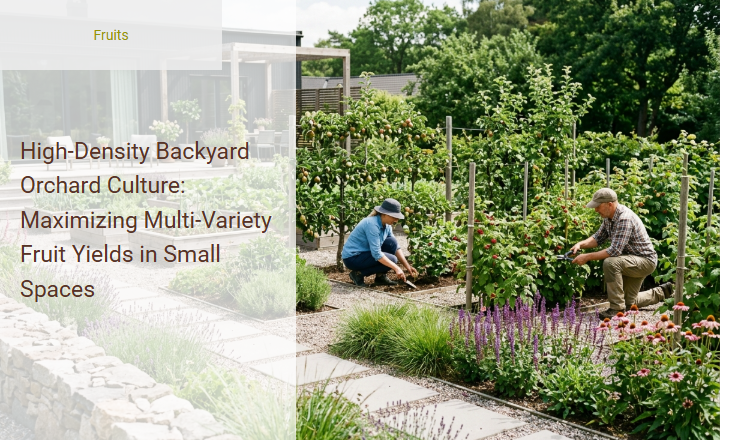
Many aspiring home orchardists struggle with the frustrating limitation of suburban yard space, often believing they must choose between growing just one massive fruit tree or none at all. Traditionally, agricultural standards have dictated spacing trees fifteen to twenty feet apart-a layout design that is highly impractical for the modern backyard.
High-Density Backyard Orchard Culture (BYOC) bridges this spatial gap, offering growers the invaluable benefit of a staggered, multi-month harvest of diverse fruits from a minimal footprint. However, this system stipulates a strict commitment to hands-on management; success relies entirely on diligent, size-controlling summer pruning rather than letting the trees reach their genetically programmed sizes.
By implementing close-association plantings-such as grouping three or four distinct peach or plum varieties in a single planting hole-you can enjoy successive ripening windows in a space no larger than a garden shed. Below, we will examine the essential pruning techniques, spatial configurations, and cultivar selection strategies required to successfully establish your own high-yielding micro-orchard.
Read also: Apple vs Pear for Backyard Orchards
Introduction to High-Density Backyard Orchard Culture
Backyard Orchard Culture (BYOC) is a revolutionary approach to home fruit growing that prioritizes a continuous harvest of diverse varieties over maximum individual tree yields. Traditional commercial orchard design spaces trees far apart to allow heavy machinery access and maximize the production of a single crop. For home gardeners, this model is highly inefficient, often leading to an overwhelming surplus of one fruit variety all at once.
By challenging these conventional commercial standards, BYOC proves that high-density planting can thrive in modest residential spaces. This methodology enables backyard growers to plant multiple fruit varieties close together, turning a standard yard into a highly productive food forest. The focus shifts from the quantity of fruit per tree to the duration and variety of the harvest, making it possible to enjoy fresh, tree-ripened fruit for many months of the year.
Selecting the Perfect Rootstocks and Dwarf Varieties
The foundation of any successful high-density orchard lies below the soil line. Selecting the correct rootstock is the primary method for controlling tree vigor and ultimate size. While genetic dwarf varieties exist, grafting standard varieties onto specific dwarfing or semi-dwarfing rootstocks provides growers with predictable growth habits and enhanced resilience.
Choosing the right combination requires understanding how rootstocks interact with your local environment. A well-chosen rootstock offers several critical benefits:
- Size Control: Dwarfing rootstocks naturally limit the height and spread of the canopy, making close spacing manageable.
- Cross-Pollination: Planting compatible varieties close together ensures reliable pollination, which is essential for fruit set in many species.
- Environmental Adaptability: Selected rootstocks offer resistance to soil-borne pathogens, tolerate poor drainage, or survive extreme winter temperatures.
- Precocity: Trees grafted onto dwarfing rootstocks often produce fruit much earlier in their lifecycle than standard trees.
Careful pairing of variety and rootstock ensures that your closely spaced trees remain healthy, manageable, and highly productive within their microclimate.
Innovative Layouts: Multi-Planting and Hedgerows
To maximize space efficiency, backyard growers can utilize creative planting configurations that depart from the traditional single-tree grid.
Multi-Planting in a Single Hole
This technique involves planting two, three, or four trees of the same fruit type in a single planting hole. The trees are spaced mere inches apart, effectively growing together as a single multi-trunked tree.
- Select varieties grafted on the same rootstock to ensure uniform growth rates.
- Arrange the trees in a triangle for a three-in-one system, or a square for a four-in-one system.
- Prune inward-facing branches to open up the center of the combined canopy, allowing sunlight to reach all parts of the cluster.
Linear Hedgerow Configurations
Another highly effective spatial strategy is the close-spaced hedgerow, where trees are planted in a single line along a fence, pathway, or property boundary.
- Space individual trees eighteen to thirty-six inches apart along a continuous trench.
- Train the branches along a horizontal plane to create a narrow, productive living wall.
- Keep the width of the hedge thin to make harvesting, monitoring, and maintenance exceptionally easy.
Soil Preparation and Nutritional Foundations
Because high-density planting packs multiple root systems into a concentrated area, soil preparation must be meticulous. Before planting, the soil must be prepared to support intense competition for water and nutrients. Incorporating abundant organic matter, such as compost or well-rotted manure, improves soil structure, enhances aeration, and establishes a sponge-like reservoir for moisture.
Excellent drainage is non-negotiable for closely spaced trees. Heavy clay soils can be amended or shaped into raised mounds to prevent waterlogged roots, which leads to devastating root rot. Inoculating the planting site with mycorrhizal fungi establishes a symbiotic relationship with the tree roots, dramatically expanding their surface area and capacity to absorb essential nutrients.
Establishing a robust nutritional baseline ensures that the young trees have immediate access to the fuel they need. Laying down a thick layer of organic mulch keeps the rootzones cool, suppresses weeds, and continuously feeds the soil biology as it decomposes over time.
Step-by-Step Planting Process for Multi-Tree Systems
Planting multiple trees in a single hole requires precision to ensure the root systems integrate smoothly and the canopies develop in balance.
- Dig a wide, shallow hole: Create a basin that is roughly twice as wide as the combined root systems, keeping the depth shallow enough so the graft unions remain well above the final soil line.
- Arrange the root systems: Position the trees inside the hole, gently intertwining the root systems if using bare-root stock, or placing the root balls as close together as possible.
- Angle the trunks outward: Tilt each trunk slightly outward at a fifteen-degree angle away from the center to encourage the canopies to grow outward rather than tangled together.
- Backfill and settle: Fill the hole with native soil, firming it gently to eliminate air pockets, and water thoroughly to settle the soil around the roots.
- Perform the initial head-back cut: Immediately prune each tree back to eighteen to twenty-four inches above the ground to stimulate low branch development and balance the top growth with the disturbed root system.
Following these steps establishes a structurally sound, multi-grafted appearance that keeps fruit easily accessible for years to come.
The Art of Summer Pruning for Size Control
While rootstock selection provides a physical limit, the true secret to maintaining a high-density orchard is strategic pruning timing. Managing the canopy during the active growing season is the primary way to control the overall scale of your trees.
Summer Pruning vs. Winter Pruning
Understanding the physiological response of the tree to pruning during different seasons is crucial for successful size management.
- Summer Pruning (Dwarfing): Pruning in mid-to-late summer removes active leaf surface, which reduces the tree's ability to manufacture food through photosynthesis. This slows down root growth and stunts overall vigor, making it the most effective tool for keeping trees at a manageable height.
- Winter Pruning (Vigor-inducing): Pruning when the tree is dormant triggers a massive flush of vegetative growth in the spring. This is because the undisturbed root system pumps stored energy into a reduced number of buds, causing rapid, tall shoots.
Focusing your heavy shaping and height-reduction cuts in the summer ensures your high-density plantings remain within arm's reach without triggering aggressive vegetative regrowth.
Efficient Irrigation Strategies for Dense Rootzones
When multiple trees are planted closely together, their root systems overlap and compete intensely for moisture. Proper irrigation design is critical to ensure that every tree receives uniform, deep watering without encouraging disease or water stress.
Using drip irrigation or micro-sprinklers is the most efficient way to deliver targeted moisture directly to the root zones. Drip lines with multiple emitters per tree allow water to slowly seep into the soil, minimizing runoff and evaporation. This targeted delivery keeps the foliage dry, which significantly reduces the risk of fungal leaf diseases.
Monitoring soil moisture at the root level is essential to prevent root rot. Because high-density plantings require frequent watering, over-saturation can occur quickly in poorly draining soils. Utilizing automated irrigation timers with soil moisture sensors ensures the rootzone stays consistently damp but never soggy, supporting healthy root respiration and robust fruit development.
Integrated Pest and Disease Management in Close Quarters
High-density orchards face an elevated risk of pest and disease transmission due to the physical proximity of the host plants. Fungal spores and insect pests can travel easily from branch to branch when canopies are close together. Implementing a proactive pest management strategy is vital to maintaining a healthy growing environment.
To mitigate these challenges, backyard growers should focus on cultural practices and organic interventions:
- Maintain an open canopy structure through targeted pruning to maximize air circulation and sunlight penetration, which dries damp foliage quickly.
- Cultivate a highly biodiverse understory by planting companion flowers and herbs that attract beneficial predatory insects.
- Apply organic horticultural oils or insecticidal soaps during the dormant season to smother overwintering pest eggs and scale insects.
- Promptly clean up fallen leaves and mummified fruit from the orchard floor to disrupt the life cycles of pathogens and pests.
Prioritizing prevention and biodiversity allows growers to maintain a balanced ecosystem that naturally keeps pest populations below damaging thresholds.
Designing for Successive Ripening and Continuous Harvest
One of the greatest advantages of high-density backyard orchard culture is the ability to design for a successive ripening window. Instead of planting a single large tree that yields hundreds of fruits all at once, growers can select several varieties that ripen sequentially.
Staggering the Harvest
By choosing a mix of early-season, mid-season, and late-season varieties within the same fruit family, you can extend your harvest from a single week to several months. For example, planting an early-ripening peach alongside mid- and late-season peach varieties in a multi-planting layout ensures a steady supply of fresh fruit without any overwhelming surpluses.
This deliberate design strategy ensures that your family has a manageable amount of fresh fruit to consume, preserve, or share throughout the entire growing season. It maximizes the utility of your garden footprint and provides a diverse sensory experience as different flavors and textures peak at different times of the year.
Long-Term Maintenance and Orchard Longevity
A high-density backyard orchard can remain productive for decades when supported by consistent, thoughtful maintenance. Because these closely spaced systems rely on artificial restriction of tree size, skipping even a single year of pruning can result in vigorous branches overshadowing weaker neighbors. Annual pruning consistency is the cornerstone of keeping the delicate balance of light and air in multi-tree setups.
Over the years, the intensive demands on the soil require active soil rejuvenation. Top-dressing the orchard floor annually with rich compost, organic fertilizers, and fresh woodchip mulch keeps the biological food web thriving and replenishes trace minerals. Monitoring tree health through regular visual inspections allows you to address localized nutrient deficiencies or pest pressures before they impact the entire system.
By committing to this routine care, you ensure that your backyard orchard remains a beautiful, highly productive sanctuary that feeds your household year after year.
Summary
The article "High-Density Backyard Orchard Culture: Maximizing Multi-Variety Fruit Yields in Small Spaces" explores innovative gardening techniques designed to maximize fruit production in limited residential areas. Instead of traditional, widely-spaced orchard layouts, this method advocates for planting multiple fruit tree varieties in close proximity, such as grouping two to four trees in a single planting hole or spacing them just feet apart.
Through strategic summer pruning, growers can strictly control tree size, keeping the canopy manageable and fruits within easy reach without sacrificing overall yields. This high-density approach allows suburban homeowners to enjoy a prolonged, staggered harvest season by selecting diverse varieties that ripen successively from spring through autumn. Ultimately, backyard orchard culture transforms small yards into highly productive, diverse ecosystems, proving that space constraints are no barrier to achieving a bountiful and continuous home fruit harvest.
Leave a comment