
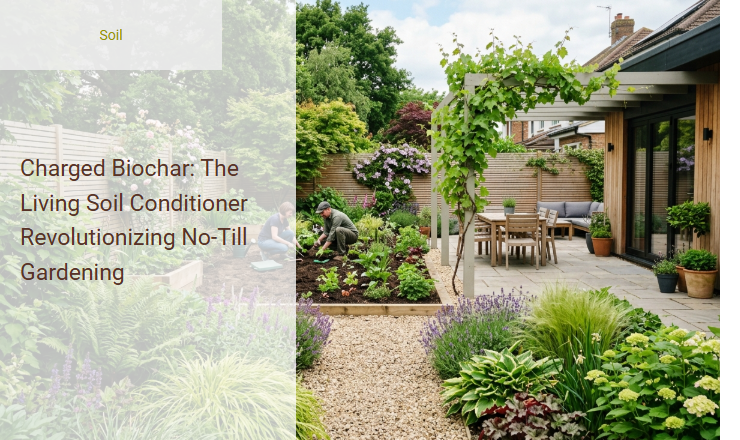
For no-till growers, watching soil vitality plateau despite relentless mulching is a frustrating and common struggle. While traditional organic matter slowly improves soil structure over successive seasons, immediate cultivation success relies on the soil's microscopic architecture. This is where charged biochar excels, granting cultivators a permanent, porous carbon infrastructure that instantly anchors biology and prevents nutrient leaching.
However, an important educational stipulation must be understood: raw biochar is inert and will temporarily strip nutrients from your soil. To be effective, it must first be "charged" through inoculation, such as blending it with active worm castings or soaking it in aerated compost tea.
In this article, we will examine the science behind this pre-charged carbon matrix, outline practical application methods for established no-till beds, and explore how this single amendment fosters a self-sustaining, high-yielding underground ecosystem.
Read also: Biochar vs Humic Acid for Nutrient Retention
Introduction: The Paradigm Shift in Modern Organic Gardening
The modern organic gardening movement is undergoing a profound evolution as growers transition away from disruptive cultivation methods toward systems that mimic intact natural ecosystems. At the forefront of this movement is no-till cultivation, a methodology centered on preserving the complex biological networks beneath our feet. To maximize the potential of these systems, growers are turning to charged biochar-a specialized, highly porous carbon amendment that serves as the definitive bridge between the physical structure of the soil and active microbial life, driving the success of regenerative agriculture and maximizing soil biodiversity.
Understanding Biochar: From Ancient Amazonia to Modern Backyards
The Legacy of Terra Preta
Biochar is not a modern invention, but rather a rediscovery of ancient agricultural wisdom. Thousands of years ago, indigenous populations in the Amazon Basin created "Terra Preta de Índio" (Amazonian Dark Earth) by incorporating charred biomass into the nutrient-poor tropical soils, converting unproductive land into incredibly fertile, self-sustaining growing mediums.
"The dark soils of the Amazon basin represent a historical template for carbon-negative agriculture, demonstrating how stable carbon can permanently alter soil fertility."
At its core, biochar is a highly porous form of elemental carbon produced through pyrolysis-the thermal decomposition of organic material in an oxygen-depleted environment. Its physical structure functions like a permanent, microscopic coral reef for soil biology, providing vast surface areas and microscopic chambers that shelter life from environmental stressors.
The Critical Difference: Raw vs. Charged Biochar
While the physical structure of biochar remains highly beneficial, applying raw, untreated biochar directly to your garden can result in immediate, severe nutrient deficiencies. Raw biochar is a highly efficient, empty carbon sponge with an immense capacity to bind to minerals and organic compounds. When introduced to the soil empty, it triggers a nutrient vacuum effect, aggressively pulling nitrogen, phosphorus, and trace minerals from the surrounding soil matrix to satisfy its electrostatic bonds.
The Science of "Charging": How to Inoculate Carbon
To prevent the nutrient vacuum effect, raw biochar must undergo a process called inoculation or "charging." This step saturates the carbon scaffold, satisfying its high cation exchange capacity (CEC) before it enters the garden. Cation exchange capacity is the measure of how well soil can retain and exchange vital nutrients. By pre-loading these negative electrostatic sites with nutrient-rich compounds and active microbiology, the biochar is transformed from a nutrient sink into a slow-release nutrient reservoir.
High-quality inoculation requires a balanced mixture of biological and chemical inputs to fully colonize the microscopic pores of the carbon structure:
- Active Compost or Worm Castings: Introduces diverse populations of beneficial bacteria, protozoa, and nematodes.
- Liquid Fish Hydrolysate and Kelp Meal: Provides essential nitrogen, trace minerals, and complex carbohydrates to feed the developing microbial colonies.
- Humic and Fulvic Acids: Enhances the nutrient-holding capacity and accelerates biological colonization.
- Mycorrhizal Inoculants: Introduces fungal spores that will form symbiotic partnerships with plant roots.
Synergistic Harmony: Why Charged Biochar is the Perfect Partner for No-Till
No-till gardening relies on the premise that soil should remain undisturbed to protect its natural layering and biological structure. Charged biochar acts as a permanent structural foundation within this system, eliminating the need for mechanical aeration. By maintaining its structural integrity indefinitely, it prevents compaction in the root zone. This structural stability preserves delicate mycorrhizal networks and stabilizes soil aggregates, ensuring that vital pathways for air and water remain open without the disruptive use of a tiller.
Cultivating the Living Soil: Microbes, Mycorrhizae, and the Carbon Sponge
The Microscopic Sanctuary
Beneath the surface, charged biochar functions as a secure microscopic sanctuary. The vast array of micropores, mesopores, and macropores within the carbon scaffold provides safe harbor for beneficial organisms. Inside these microscopic chambers, bacteria and fungal hyphae can thrive, sheltered from larger predatory protozoa and extreme fluctuations in environmental conditions.
Visualizing the pore network: At a microscopic level, biochar resembles a highly organized honeycomb, offering miles of internal surface area per single gram where microbes can feed, reproduce, and exchange nutrients safely.
Water Retention and Nutrient Cycling: The Environmental Benefits
In addition to supporting biology, charged biochar significantly improves soil hydrology. In sandy soils, the carbon sponge acts as a physical barrier that slows down water percolation, keeping moisture in the root zone. In heavy clay soils, it improves aggregation, creating larger pore spaces that facilitate better drainage and root penetration.
This dynamic retention capacity drastically reduces nutrient runoff. Instead of washing away into local watersheds during heavy rains, dissolved minerals remain bound to the biochar's charged surfaces, creating a closed-loop system that reduces irrigation requirements and minimizes the need for supplemental organic fertilizers.
Step-by-Step DIY: Charging Biochar at Home
Inoculating your own biochar at home is a straightforward biological process that can be accomplished over a two-to-four-week period using readily available organic resources.
- Acquire High-Quality Raw Biochar: Ensure your source material is clean, free of chemical contaminants, and crushed into small, pea-sized particles to maximize surface area.
- Blend with Biological Activators: Combine 1 part raw biochar with 4 parts active, high-quality compost or fresh worm castings.
- Moisten with Nutrient Solutions: Hydrate the mixture using dechlorinated water enriched with liquid fish hydrolysate, kelp meal, and humic acids until it reaches the consistency of a wrung-out sponge.
- Allow to Mature: Store the moist mixture in a warm, aerated container or pile for 14 to 30 days, stirring weekly to ensure oxygen distribution and uniform microbial colonization.
Application Strategies: Integrating Charged Biochar into No-Till Beds
Established No-Till Beds
For existing, undisturbed beds, apply a thin top-dressing of charged biochar directly beneath your organic mulch layer. Over time, earthworms, rain, and soil biology will naturally draw the carbon down into the soil profile without disrupting the established root zones.
Establishing New Beds
When constructing new no-till beds, evenly distribute the charged biochar throughout the top 4 to 6 inches of the soil mix. For deeper incorporation without turning the soil, a broadfork can be used to gently create deep fractures in the soil profile, allowing the charged carbon particles to wash down into the lower horizons.
For optimal results, apply charged biochar at a rate of 5% to 10% by volume of your total growing media, or approximately 1 to 2 gallons of inoculated biochar per 10 square feet of garden space.
The Future of Gardening: Building Generative Soil for Generations
By integrating charged biochar into no-till systems, growers are doing more than just feeding their plants for a single season; they are participating in a profound act of planetary stewardship. Unlike standard organic matter that decomposes and returns to the atmosphere as greenhouse gases within a few seasons, the elemental carbon in biochar remains locked in the soil matrix for hundreds of years. Investing in this biological infrastructure creates a legacy of long-term carbon storage, turning garden plots into active carbon sinks that build healthy, regenerative soil for generations to come.
Summary
The article explores the transformative role of charged biochar as a premier soil conditioner in no-till gardening. Biochar, a highly porous form of charcoal, acts as a permanent "reef" for soil life. However, raw biochar can initially strip nutrients from the soil. "Charging" or inoculating the biochar with compost, microbes, and liquid nutrients solves this issue, turning it into a powerhouse of biological activity before it is applied.
In no-till systems, which prioritize minimal soil disturbance to preserve delicate mycorrhizal networks, charged biochar is revolutionary. It permanently improves soil structure, enhances water retention, and boosts cation exchange capacity. By providing a stable, lifetime sanctuary for beneficial microorganisms, charged biochar helps gardeners build a self-sustaining, highly fertile food web that sequesters carbon and yields healthier, more resilient crops.
Leave a comment