
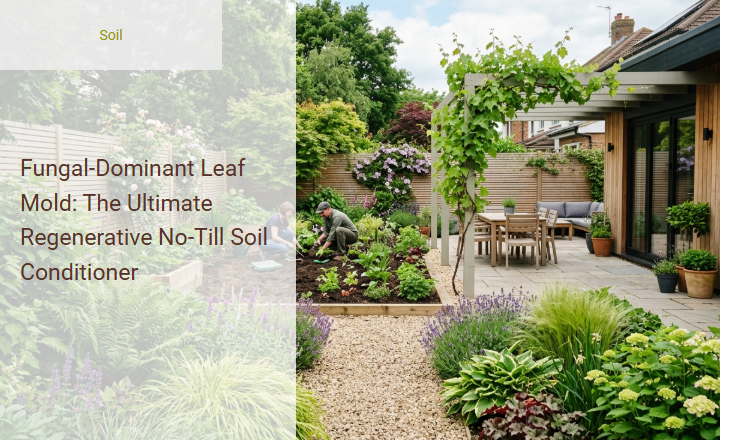
Cultivating a thriving no-till living soil often feels like an uphill battle against stubborn soil compaction, rapid moisture loss, and chronic nutrient lockup. While standard thermophilic composts provide quick nutrient boosts, they often fail to establish the enduring biological infrastructure that true regenerative systems require.
Transitioning your focus to fungal-dominant leaf mold grants your garden the self-sustaining structure of a mature forest floor, dramatically improving water retention and soil aggregation. However, a key stipulation must be made: this is not a rapid, high-heat process, but a patient, cold-fermentation method that requires time to mature. Utilizing specific deciduous feedstocks-such as shredded oak or maple leaves-serves as concrete proof of how targeted organic matter selectively breeds beneficial saprophytic fungi over bacteria.
In this article, we will examine the biological mechanics of fungal dominance, outline a step-by-step harvesting and curing protocol, and demonstrate how to seamlessly integrate this powerful conditioner into your no-till management strategy.
Read also: Leaf Mold vs Straw Mulch for Moisture Retention
Introduction to Fungal-Dominant Leaf Mold
In the realm of regenerative agriculture, the forest floor serves as the supreme blueprint for soil fertility. Fungal-dominant leaf mold is the dark, earthy, crumbly material created by the slow, cold decomposition of autumn leaves. Unlike traditional compost, which relies on thermophilic bacteria to break down diverse green and brown organic matter, leaf mold is decomposed primarily by saprophytic fungi.
For no-till gardeners, this substance represents biological gold. By mimicking the natural woodland floor, leaf mold introduces a rich, complex web of fungal hyphae that transforms standard autumn leaves into a powerful soil conditioner. This process retains the energy of the season's leaf drop, returning it directly to your garden beds to feed the soil food web.
The Biological Shift: Bacteria vs. Fungi in Soil
Agricultural soils exist on a biological spectrum, ranging from highly bacterial to heavily fungal. Disturbed soils, such as those that are frequently tilled or treated with synthetic fertilizers, are dominated by simple bacteria. These bacterial systems promote rapid nutrient cycling, which often favors opportunistic weeds. Ecological succession dictates that as a soil system matures and remains undisturbed, it naturally transitions toward a fungal-dominated state.
"Fungal networks are the true infrastructure of mature, self-sustaining ecosystems, bridging the gap between raw organic minerals and plant root systems."
Perennial plants, shrubs, and trees thrive specifically on the fungal networks established by leaf mold. No-till systems excel when these delicate hyphal pathways remain unbroken. Fungi excel at breaking down complex lignin and cellulose, transforming these tough materials into stable organic compounds that provide a steady, slow-release stream of nutrition directly to plant roots, mimicking the steady state of a pristine forest ecosystem.
Key Benefits of Fungal Leaf Mold for Soil Structure
Integrating fungal leaf mold into your garden beds yields profound physical and chemical transformations within the soil matrix:
- Moisture Retention: Leaf mold acts like a biological sponge, holding up to several times its weight in water, which significantly reduces the need for irrigation.
- Aggregate Stability: Fungal hyphae physically bind soil particles together, creating a crumbly structure that resists compaction while maintaining vital pore space for air and water.
- Carbon Sequestration: Humified organic matter in leaf mold locks carbon into the soil profile for decades, keeping it out of the atmosphere.
- Glomalin Production: As mycorrhizal and saprophytic fungi proliferate, they produce glomalin, a sticky glycoprotein that serves as a primary builder of long-term soil structure and carbon storage.
Sourcing and Selecting the Best Leaves
Not all autumn leaves are created equal when it comes to generating high-quality fungal leaf mold. The speed of decomposition and the final biological profile of your mold depend heavily on the physical properties and chemical makeup of your starting material.
Understanding Tannins and Leaf Quality
Tannins are natural polyphenolic compounds that act as a defense mechanism for trees, resisting rot and deterring pests. Leaves with high tannin levels decompose at a much slower rate. Selecting a diverse mix of leaves allows for a balanced decomposition timeline and a more chemically diverse finished product.
| Leaf Type | Decomposition Speed | Tannin Level | Suitability |
| Maple, Alder, Ash | Fast (under 1 year) | Low | Excellent starter material |
| Oak, Beech, Birch | Moderate (1 to 2 years) | Medium to High | Excellent for structured, long-lasting mold |
| Black Walnut, Chestnut | Very Slow | High (contains juglone) | Avoid or use in highly isolated piles |
| Eucalyptus | Extremely Slow | Very High (antimicrobial oils) | Avoid for fungal propagation |
Step-by-Step Guide to Building a Fungal Pile
Constructing a dedicated leaf mold pile ensures the optimal balance of moisture and oxygen needed to support fungal colonization over an extended period.
- Construct a Wire Enclosure: Create a circular bin using four-foot-tall poultry netting or welded wire mesh. This open-air design allows maximum gas exchange while keeping the leaves contained.
- Shred the Leaves: Run your collected leaves through a shredder or run over them with a lawnmower. Shredding increases the surface area, allowing fungal hyphae to colonize the material much faster.
- Layer and Pack: Add the shredded leaves to your wire enclosure in six-inch layers, packing them down lightly to maximize the volume of your pile.
- Hydrate Thoroughly: Water each layer generously as you build the pile. The leaves should feel as damp as a wrung-out sponge throughout the entire depth of the bin.
Inoculating Your Pile for Fungal Dominance
While wild fungal spores will eventually find your leaf pile, introducing active biological inoculants can significantly accelerate the decomposition process and direct the biological profile toward beneficial saprophytic fungi.
Effective Inoculation Methods
- Active Forest Floor Duff: Collect a few handfuls of white, thread-like mycelium from under decomposing logs in a healthy, local woodland and layer it into your pile.
- Spent Mushroom Substrate: Incorporate leftover substrate from agricultural mushroom production, such as wine cap or oyster mushroom blocks, to jumpstart wood-decaying fungal communities.
- Indigenous Microorganisms (IMO): Apply liquid IMO mixtures cultivated from local forest soils to drench the pile with regionally adapted, diverse biological strains.
Monitoring and Maintaining the Decomposition Process
Unlike thermophilic compost piles, leaf mold decomposition is a slow, cool process that relies on patience and minimal disturbance. Disrupting the pile unnecessarily tears the fragile mycelial networks that you are trying to cultivate.
Ensure the core of the pile remains damp. Check the moisture levels quarterly, especially during dry summer months, and gently hydrate the top of the pile if needed. Keep the pile in a shaded, wind-protected area to maintain stable temperatures and prevent evaporation.
How to Apply Leaf Mold in a No-Till Garden
Once your leaf mold has transformed into a dark, flaky material with a rich forest scent, it is ready to be integrated into your active growing spaces.
Application Strategies
- Top-Dressing Beds: Apply a one- to two-inch layer of finished leaf mold directly to the soil surface as a biological mulch, shielding the soil from sun damage while feeding surface-dwelling organisms.
- Seed Starting Blends: Mix screened leaf mold with equal parts coco coir and perlite to create a highly water-retentive, biologically active, disease-suppressive seed starting medium.
- Transplant Inoculant: Place a handful of rich leaf mold directly into transplant holes to establish immediate fungal contact with the roots of young vegetable starts and perennials.
Troubleshooting Common Leaf Mold Issues
Even simple processes can run into environmental imbalances. Understanding how to read your pile allows you to make corrections without destroying your biological progress.
Addressing Dry Pockets
If your pile is not breaking down after several months, pull back the top layer to check for dry pockets. Wind and lack of rain can dry out the edges of wire bins. Re-hydrate the pile thoroughly and cover the top with a breathable burlap tarp to lock in humidity.
Correcting Anaerobic Conditions
If your pile begins to emit a sour, rotten odor, it has become too wet and compacted, cutting off oxygen. To fix this without destroying the developing mycelium, gently insert a pitchfork or a perforated PVC pipe into the center of the pile to reintroduce passive airflow without fully turning the material.
The Future of Soil: Regenerating the Earth from the Ground Up
Embracing fungal-dominant leaf mold is a powerful step toward localized, closed-loop gardening. By utilizing abundant, free resources like autumn leaves, we divert valuable organic matter from municipal waste streams and transform it into a biological engine for our gardens.
This simple act of stewardship restores the ancient, broken pathways of our soil food web. Building living, fungal-rich soil ecosystems empowers us to grow nutrient-dense food, heal degraded backyard soils, and play an active role in global ecological regeneration.
Summary
The article "Fungal-Dominant Leaf Mold: The Ultimate Regenerative No-Till Soil Conditioner" highlights the transformative power of decomposed deciduous leaves in organic gardening. By mimicking the natural processes of the forest floor, leaf mold serves as a premier soil amendment that is uniquely rich in beneficial fungi rather than bacteria. This fungal dominance is crucial for establishing robust mycelial networks, which are the backbone of successful regenerative, no-till cultivation systems.
Implementing leaf mold dramatically improves soil structure, boosts moisture retention, and enhances nutrient cycling without disrupting delicate soil biology. The guide explains how gardeners can easily convert abundant autumn waste into this valuable resource. Ultimately, utilizing fungal-dominant leaf mold fosters a resilient, self-sustaining soil food web, reducing the need for synthetic fertilizers and cultivating long-term agricultural health.
Leave a comment