
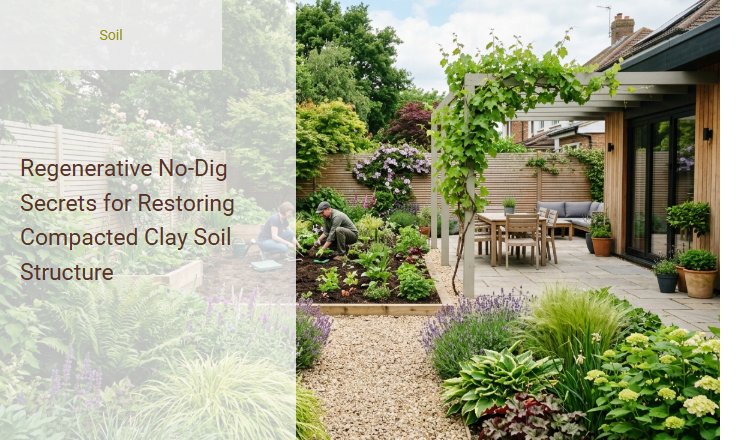
Heavy, compacted clay soil often feels like an impenetrable barrier to gardening success, waterlogging plant roots in the wet winter months and baking into a brick-like concrete during the summer heat. While the instinctive response is to rototill this stubborn earth, mechanical disruption actually destroys the soil's fragile pore networks, compounding compaction issues over time.
Transitioning to a regenerative, no-dig methodology grants growers a self-healing ecosystem that develops a rich, crumbly tilth with minimal physical labor. However, restoring clay is a biological process rather than an overnight chemical fix; it requires a structured commitment to partnering with soil life over several seasons. By utilizing concrete strategies such as sheet mulching with high-carbon organic matter and using a broadfork to gently aerate the subsoil without turning it, you can rapidly accelerate this underground transformation.
In this guide, we will explore the science of clay flocculation, evaluate the best deep-rooting cover crops for biological drilling, and outline a step-by-step roadmap to permanently revive your soil structure.
Read also: Gypsum vs Lime for Soil Conditioning
The Clay Conundrum: Understanding Soil Compaction
Heavy clay soil can feel like a gardener's worst enemy. During wet seasons, it turns into a sticky, anaerobic mire that drowns plant roots; in the heat of summer, it bakes into a concrete-like surface that rejects water and resists penetration. To combat this, many resort to rotary tilling, believing that mechanical force is the only way to break the gridlock. However, traditional tilling fails by causing severe tilling damage. It pulverizes what little natural structure exists, turning the soil into a fine powder that quickly collapses back into an even denser state of soil compaction. The true, permanent solution lies not in mechanical warfare, but in the regenerative no-dig philosophy, which works in harmony with natural processes to gently and permanently transform clay from the top down.
The No-Dig Philosophy: Let Nature Do the Heavy Lifting
The no-dig approach is built on a simple yet profound truth: soil is a living organism that develops its own structural integrity when left undisturbed. When we stop tilling, we preserve delicate mycorrhizal fungal networks that act as biological highway systems, transporting nutrients and binding soil particles together. In clay-heavy environments, these fungi and microscopic organisms secrete sticky substances that clump tiny clay particles into larger, stable aggregates. This natural aggregation creates microscopic channels, allowing plant roots to glide effortlessly through the earth in search of moisture and nutrients rather than fighting against a compacted barrier.
Decompressing Clay: Aeration Without Inversion
While the goal is to leave the soil undisturbed, severely compacted clay often requires an initial intervention to kickstart the biological aeration process. Rather than flipping the soil and burying the vital aerobic microbes living at the surface, we can use a broadfork to open up the soil profile gently.
- Step onto the crossbar of the broadfork, using your body weight to drive the metal tines vertically down into the compacted clay.
- Gently pull the handles back toward your body just enough to crack open and fracture the soil layer beneath. Do not flip or turn the soil over.
- Push the handles forward, lift the tool, step back about a foot, and repeat the process along your planting bed.
- Immediately top the fractured soil with organic compost to fill the newly created pathways, preventing them from sealing shut again.
Sheet Mulching: Building Soil from the Top Down
Sheet mulching, often called lasagna gardening, is a highly effective method for reclaiming compacted clay. By layering organic materials directly over the clay, you mimic the forest floor, using decomposition to build rich, crumbly topsoil while smothering weeds and grass below.
- Base Layer: Thick, overlapping layers of plain, unprinted cardboard or newspaper laid directly over the compacted ground and thoroughly soaked with water.
- Nitrogen (Green) Layer: A 2-inch layer of nitrogen-rich materials such as fresh grass clippings, kitchen scraps, or green manure to fuel microbial activity.
- Carbon (Brown) Layer: A 4-inch layer of carbon-rich materials such as shredded leaves, straw, or pine needles to provide structure and aeration.
- Compost Layer: A 2-to-3-inch layer of finished, weed-free compost to act as the immediate planting medium.
- Surface Mulch: A final protective layer of wood chips or clean straw to retain moisture and prevent surface crusting.
Choosing the Ultimate Organic Amendments for Clay
Not all organic amendments are created equal when it comes to breaking down the dense, sticky nature of clay. To successfully build stable soil aggregates, we must choose materials that feed the soil food web while physically separating tiny clay platelets.
- Finished Compost
- Highly active biological matter that introduces diverse microbial life, which immediately begins gluing fine clay particles into larger, crumbly aggregates.
- Leaf Mold
- Decomposed deciduous leaves that are highly fungal, perfect for retaining moisture while providing a cool, loose texture that clay soils desperately lack.
- Aged Wood Chips
- Carbon-heavy materials that encourage fungal dominance, slowly breaking down over time to create a spongy, aerated surface layer.
Bio-Drilling: Deep-Rooted Cover Crops as Living Tillers
When dealing with deep clay compaction, plants themselves can do the heavy digging. Certain cover crops are equipped with powerful, aggressive root systems specifically adapted to drill through dense subsoil layers, performing biological tillage without disrupting soil ecology. Varieties like the Daikon radish (often called the tillage radish) act as organic jackhammers, driving thick taproots feet deep into the clay. When these cover crops die back during winter frosts, their roots decompose in place, leaving behind massive, vertical drainage channels and rich organic deposits deep within the earth. Other deep-rooted crops like alfalfa and crimson clover further break up the subsoil while fixing essential nitrogen for future crops.
Enlisting Your Underground Army: Microbes and Earthworms
A handful of healthy soil contains more living organisms than there are people on Earth. In a clay-heavy landscape, these organisms are your primary labor force, working around the clock to refine soil structure. As earthworms consume organic top dressings, they migrate downward, digesting dense clay and depositing nutrient-rich castings along their paths.
"The biological secretions of earthworms and mycorrhizal fungi, such as glomalin, act as nature's ultimate soil stabilizers, cementing microscopic clay particles into a resilient, porous crumb structure."
Hydro-Zoning: Managing Water Flow in Clay-Heavy Landscapes
Clay possesses incredible water-holding capacity, but its slow infiltration rate makes it highly prone to waterlogging and erosion. Effective water management is critical to prevent standing water from suffocating plant roots.
Permeable Pathways
Designate permanent walking paths throughout your garden and pack them with coarse wood chips. This channels excess rainwater away from your growing zones while supporting heavy foot traffic without compacting adjacent planting areas.
Raised Mounds and Swales
Create gently sloped raised mounds or hugelkultur beds to elevate plant roots above the saturated water table, pairing them with contour swales that capture, slow, and gently filter runoff through the landscape.
Preventing Re-Compaction: Best Practices for Garden Longevity
Reclaiming clay soil is a progressive journey, and preventing re-compaction is vital to preserving your hard-won soil structure. Implementing strict daily and seasonal habits ensures your soil remains loose and aerated year after year.
- Establish permanent, clearly defined growing beds and utilize designated stepping stones to ensure human weight never presses down on active root zones.
- Never step on, dig, or plant in clay soil when it is wet, as pressure on saturated clay forces out precious air pockets and triggers instant compaction.
- Keep the soil surface continuously covered with a protective blanket of organic mulch or living groundcovers to buffer the impact of heavy rains and scorching sun.
The Clay Transformation: A Living, Sponge-Like Ecosystem
Amending heavy clay is not an overnight fix, but rather a rewarding partnership with ecological succession. By stepping away from the tiller and embracing the no-dig method, you allow nature to slowly transform a dense, anaerobic clay barrier into a dark, crumbly, and highly fertile soil sponge. Within a few seasons, the hard, unforgiving ground will give way to a thriving, self-aerating ecosystem teeming with life, proving that working with nature always yields the most abundant harvest.
Summary
Compacted clay soil is one of the most challenging obstacles for gardeners, often leading to waterlogging, poor aeration, and stunted plant growth. While traditional methods rely on heavy tilling to break up tough ground, this practice actually destroys delicate soil structure and decimates beneficial microbial life. Regenerative, no-dig gardening offers a highly effective, low-effort alternative to restore compacted clay naturally.
By transitioning to a no-dig system, gardeners protect the soil food web, allowing earthworms and mycorrhizal fungi to do the heavy lifting. Key secrets include sheet mulching (lasagna gardening) with diverse organic matter to feed the soil from the top down, and planting deep-rooting cover crops, like daikon radishes, to naturally drill through and fracture tight clay. Over time, these regenerative practices improve water infiltration, boost nutrient cycling, and permanently transform heavy clay into rich, crumbly, and sponge-like loam.
Leave a comment