
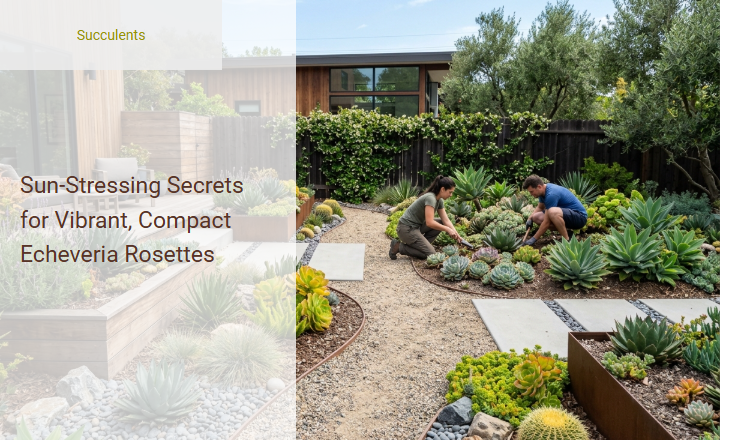
Many succulent enthusiasts struggle to keep their prized Echeverias from etiolating and losing their brilliant hues, leaving them with leggy, washed-out specimens rather than the tight, colorful rosettes they fell in love with. To remedy this, we must first examine how these highland natives adapt to intense solar exposure in their wild habitats.
Mastering the art of "sun-stressing" unlocks these latent genetic defenses, granting you the ability to cultivate incredibly vibrant, geometrically compact rosettes. Crucially, this technique relies on a strict stipulation: scientific sun-stressing is a controlled, healthy physiological response to high light, not destructive sunburn. When applied correctly, cultivars like Echeveria 'Lola' shift from muted green to a delicate lavender-blush, while Echeveria 'Black Prince' deepens to a dramatic, near-black violet.
This guide will detail the precise lighting thresholds, seasonal acclimation schedules, and watering adjustments required to safely trigger this dazzling transformation in your collection.
Read also: Shallow Bowls vs Deep Pots for Echeveria Rosettes
Introduction to Sun-Stressing Echeverias
For succulent enthusiasts, the true magic of cultivation lies in the vivid transformation of their plants. Sun-stressing is not a harmful practice; rather, it is a method of mimicking natural arid environments to coax out brilliant hues. By utilizing controlled light exposure, growers can transform common green succulents into vibrant, compact works of art that showcase striking shades of pink, red, purple, and gold.
The Biological Science Behind the Color Shift
When Echeverias are exposed to high levels of sunlight, their internal chemistry adapts to protect their delicate tissues. This physiological defense mechanism relies on the production of specialized pigments. Anthocyanins and carotenoids act as natural sunscreens, shielding the plant's photosynthetic cells from excess UV radiation. As these protective pigments accumulate, they override the dominant green chlorophyll, resulting in a breathtaking array of warm stress colors.
Calculating the Ideal Light Exposure Time
To achieve the perfect balance of vivid coloration and plant health, timing is everything. Echeverias typically require four to six hours of direct morning sunlight followed by bright, filtered light for the remainder of the day. This schedule ensures the plant receives enough light to stimulate pigment production without suffering cellular damage from the scorching afternoon sun.
Safe Acclimation: The Golden Rules of Transitioning
Moving a shaded or indoor Echeveria directly into intense sunlight can lead to devastating burns. A gradual transition is necessary to build up the plant's natural defenses.
- Place the plant in a spot that receives only bright, indirect light or filtered morning sun for the first three days.
- Expose the succulent to one hour of direct early morning sun, then move it back to the shade for the rest of the week.
- Increase the direct sunlight exposure by one hour every few days, monitoring the leaves closely for signs of stress.
Following this patient process allows the Echeveria to safely develop its protective pigments and adapt to its new, high-light environment.
Strategic Under-Watering to Enhance Rosette Compactness
Sunlight is only one half of the aesthetic equation. Combining intense light with restricted watering schedules forces the succulent to draw upon its stored moisture reserves. This minor drought stress causes the leaves to cup inward, forming tight, sculptural shapes.
"A slightly thirsty Echeveria is a beautiful Echeveria, as the lack of water signals the plant to conserve moisture by tightening its rosette."
By practicing strategic under-watering, you allow the soil to dry out completely and remain dry for several days before watering again, resulting in a much more compact form.
Temperature Fluctuations: The Secret Catalyst
While light and water restriction do heavy lifting, temperature changes act as a powerful accelerator. When warm, sunny days are followed by chilly night temperatures-typically between 40°F and 50°F-the breakdown of chlorophyll accelerates. This environmental shift locks in the brilliant pigments, making the reds and purples appear far more intense than they would under stable, warm indoor conditions.
Nutrient Deprivation: Soil and Fertilizer Limits
To maintain both the compact rosette shape and the rich stress colors, growers must resist the urge to over-feed their plants. High-nitrogen fertilizers encourage rapid, lush green growth, which stretches the rosette and dilutes the desired pigments.
- Use gritty, low-nutrient soil mixes containing high percentages of pumice, perlite, and coarse sand.
- Limit fertilization to once or twice a year, using a highly diluted, low-nitrogen formula.
- Allow the plant to remain slightly root-bound, as this natural restriction helps preserve its miniature, colorful form.
Stress Colors vs. Sunburn: Spotting the Vital Differences
Understanding the distinction between healthy stress colors and destructive sunburn is critical for the survival of your Echeveria. While stress colors are uniform and vibrant, sunburn causes permanent structural damage.
| Characteristic | Healthy Stress Colors | Destructive Sunburn |
|---|---|---|
| Appearance | Vibrant, even shades of pink, red, or orange. | Paper-dry, white, brown, or black scarred patches. |
| Leaf Texture | Firm, smooth, and plump. | Crispy, scarred, or sunken and shriveled. |
| Reversibility | Reversible when light levels decrease. | Irreversible; scars must grow out over time. |
Prime Echeveria Cultivars for Stunning Sun-Stress Displays
While most succulents change color under stress, certain cultivars are prized for their spectacular and reliable transformations.
- Echeveria 'Lola': Transitions from a soft gray-green to a delicate alabaster pink and pale lilac.
- Echeveria 'Afterglow': Amplifies its natural coloration into brilliant neon pink and deep violet edges under intense light.
- Echeveria 'Romeo': Shifts from a dusty green to a dramatic, deep crimson and metallic red.
Long-Term Maintenance: Keeping Your Rosettes Vibrant and Healthy
Maintaining these stunning stress colors requires a mindful balance as the seasons shift. In the peak of summer, you may need to provide light shade cloth during heatwaves to prevent thermal stress. During winter, reducing water to a bare minimum will help preserve the compact shape even when sunlight hours are naturally reduced. By closely observing your plants and adjusting their environment, you can enjoy these living, blushing sculptures year-round without compromising their health.
Summary
The article "Sun-Stressing Secrets for Vibrant, Compact Echeveria Rosettes" provides an essential guide to safely enhancing the colors and structural beauty of Echeveria succulents. "Sun-stressing" is not about damaging the plants, but rather mimicking their natural, arid environments to trigger defensive pigments. Under the right conditions of intense light, this process coaxes Echeverias to produce vivid reds, deep purples, and brilliant pinks instead of standard green foliage.
To achieve these stunning hues while maintaining a tight, compact rosette shape, the guide highlights the necessity of gradual acclimation to bright sunlight, strategic watering schedules, and utilizing cooler nighttime temperatures. Additionally, it offers crucial tips on distinguishing healthy stress coloration from actual sunburn or dehydration damage. Ultimately, by mastering this balance of light, water, and temperature, gardeners can cultivate exceptionally vibrant, structurally perfect, and resilient Echeverias.
Leave a comment