
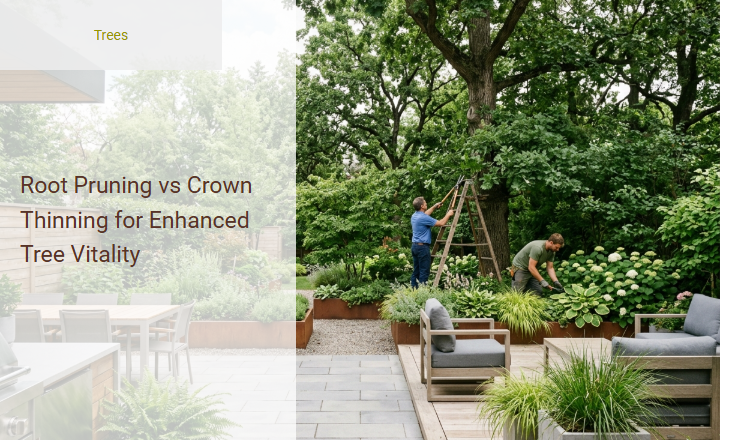
Property owners often struggle to maintain tree health, watching helplessly as once-vibrant canopies thin out or aggressive roots disrupt paved driveways. To restore vitality, we must look beyond basic watering and fertilization. True arboricultural health requires a strategic balance between below-ground root systems and above-ground canopy structures.
Mastering these targeted interventions grants your landscape unmatched longevity and safety. However, a key caveat remains: both techniques are highly situational, and improper execution can easily shock a mature Oak or Maple. For example, while sidewalk lifting requires careful root pruning, crown dieback demands precise canopy thinning.
In this article, we will compare root pruning and crown thinning, exploring their distinct benefits, optimal application windows, and how to choose the right approach for your property's specific needs.
Root Pruning vs Crown Thinning: Two Paths to Tree Vitality
Maintaining the health, structural integrity, and longevity of a tree requires a holistic approach that bridges the gap between what is visible above the soil and what lies hidden beneath it. Professional arboriculture recognizes that a tree is a balanced system, where the *root-to-shoot ratio* must remain in equilibrium to support vital processes. While crown thinning shapes the *phototrophic canopy* to optimize light exposure and air circulation, root pruning manages the *rhizosphere* to mitigate urban conflicts and stimulate fresh growth. Balancing these above-ground and below-ground tree care practices ensures that the vascular network remains functional, preventing decline and fostering decades of resilient growth.
Understanding Root Pruning: Beneath the Surface
Root pruning is the targeted physical removal or cutting of lateral roots to manage growth, resolve structural conflicts, or prepare a tree for transplanting. Physically, the process involves cleanly severing roots using specialized saws or trenching equipment rather than tearing them, which can cause decay. The primary objectives are to halt the advancement of invasive roots threatening sidewalks, foundations, or utility lines, and to stimulate the development of a denser, more fibrous root branch system closer to the trunk. However, because roots anchor the tree and absorb essential moisture, removing them can negatively affect physical stability and water uptake. To prevent structural failure or severe physiological decline, arborists must adhere to a strict rule: never remove more than 25 percent of a tree's total root system at one time, and always maintain a minimum buffer distance of three to five times the trunk diameter (DBH) from the base of the tree.
Understanding Crown Thinning: Light, Air, and Structure
Crown thinning is the selective removal of small, live branches throughout the outer canopy to reduce the overall density of the tree. Unlike topping or severe reduction, this process preserves the natural shape, height, and structural silhouette of the species while systematically opening up the interior. By removing weak, crossing, or competing limbs, crown thinning optimizes the physical mechanics of the canopy and allows resources to be directed to stronger scaffold branches.
- Reduced Wind Resistance: Allows heavy winds to pass through the canopy seamlessly, significantly lowering the risk of limb breakage or uprooting during storms.
- Enhanced Sunlight Penetration: Increases ambient light reaching inner leaves and understory turf, promoting uniform photosynthesis.
- Improved Air Circulation: Accelerates the drying of foliage after rainfall, which dramatically suppresses fungal pathogens and foliar diseases.
- Weight Mitigation: Lightens heavy, overextended limbs to prevent structural stress and splitting at main crotches.
Direct Comparison: Below-Ground vs. Above-Ground Care
| Feature / Aspect | Root Pruning (Below-Ground) | Crown Thinning (Above-Ground) |
|---|---|---|
| Primary Target | Lateral roots, structural anchoring roots, and root tips. | Secondary branches, weak limbs, and dense foliage in the canopy. |
| Physiological Effects | Triggers localized root branching; temporarily reduces water and nutrient absorption capacity. | Improves overall photosynthetic efficiency and redirects energy to dominant branches. |
| Immediate Stressors | Disruption of physical soil anchoring; risk of localized hydraulic failure. | Temporary loss of energy reserves (stored starches) and exposure of inner bark to sunscald. |
| Long-Term Benefits | Prevents infrastructure damage; encourages a compact, highly efficient root matrix. | Enhances resistance to storm winds, reduces disease pressure, and preserves natural structure. |
When to Choose Root Pruning
Root pruning is rarely a default maintenance practice; instead, it is deployed as a precise solution to specific environmental, structural, and civil conflicts. In urban settings, tree roots often clash with hardscaping, requiring intervention to protect both the infrastructure and the tree itself. It is critical to diagnose these issues early before the roots grow so large that cutting them would jeopardize the tree's life.
- Hardscape Damage: Tree roots lifting, cracking, or breaking concrete sidewalks, driveways, or patio installations.
- Foundation Infringement: Lateral roots encroaching on home foundations, retaining walls, or underground utility lines.
- Girdling Roots: Roots that wrap tightly around the base of the trunk, slowly choking the tree's vascular system.
- Transplant Preparation: Pre-cutting roots months in advance of a relocation to force the growth of a dense root ball that will survive the move.
When to Choose Crown Thinning
Recognizing when a tree's canopy is overdue for thinning can prevent storm damage and prevent the spread of opportunistic canopy diseases. When a tree becomes overly dense, it acts like a solid sail in the wind, absorbing kinetic energy rather than letting it pass through safely. Homeowners and land managers should monitor the upper canopy for key indicators that point to a need for professional crown thinning.
- Excessive Canopy Density: An interior canopy so thick that sunlight cannot reach the inner branches, causing interior leaf drop and dieback.
- Wind-Sailing: Visual sway or trunk strain during minor windstorms, indicating the canopy is catching wind rather than shedding it.
- Persistent Foliar Dampness: Inner leaves remaining wet hours after rain has stopped, signaling poor microclimate ventilation.
- Heavy Co-dominant Stems: Overburdened lateral branches showing signs of sagging, stress cracks, or weight-related strain at major attachments.
Biological Impacts on Tree Vitality
Hormonal Shift and Root Regeneration
When roots are pruned, the delicate balance of plant hormones is disrupted. Root tips are the primary synthesis sites for cytokinins, hormones responsible for promoting cell division and shoot growth. Severing these tips temporarily lowers cytokinin levels while allowing auxins-produced in the terminal buds of the canopy-to flow downward. This high ratio of auxin to cytokinin at the cut site stimulates rapid cell division, leading to the generation of numerous fine, fibrous roots. These new roots eventually increase the tree's surface area for water and nutrient absorption, provided the tree survives the initial shock.
Photosynthetic Balance and Canopy Adaptations
Crown thinning removes active leaf area, which temporarily reduces the tree's overall carbohydrate production capacity through photosynthesis. However, the remaining leaves quickly adapt by increasing their photosynthetic efficiency due to enhanced light penetration and better access to water and nutrients supplied by an unchanged root system. Furthermore, opening the canopy improves wind aerodynamics, which reduces the physical flexing of the trunk. This reduction in physical movement decreases the energy the tree must allocate to producing reaction wood, allowing it to spend more energy on defense against pathogens.
Defense Activation and Pathogen compartmentalization
Both pruning methods trigger the tree's natural defense systems. Woody plants do not heal damaged tissue; instead, they wall it off through a process called Compartmentalization of Decay in Trees (CODIT). When a root or branch is cut, the tree uses chemical barriers to plug vascular pathways and prevent the spread of decay-causing fungi. Clean cuts made just outside the branch collar or at correct root angles allow the tree to rapidly form callus tissue, sealing the wound and safeguarding long-term vitality.
Safety Guidelines and Execution Best Practices
To execute either root pruning or crown thinning successfully, practitioners must prioritize tree health and structural safety. Tools such as hand pruners, loppers, and pruning saws must be sharpened to prevent ragged, tearing cuts that invite disease, and disinfected with a 70% isopropyl alcohol solution between trees. Pruning should ideally be performed during the dormant season (late winter or early spring) when the tree's metabolic activity is low, minimizing sap loss and reducing the risk of pest infestation. Furthermore, clean cuts must always be made outside the branch collar or root bark ridge to facilitate proper compartmentalization.
Balancing the Scales: Can You Combine Both?
Performing both root pruning and crown thinning simultaneously is highly discouraged and can prove catastrophic for a tree's health. When you cut roots, you reduce the tree's water and nutrient intake. If you simultaneously remove canopy foliage, you reduce the photosynthetic engine required to generate the carbohydrates needed to repair those damaged roots. This double-deprivation places the tree in a state of severe physiological shock, leaving it highly vulnerable to pests, pathogens, and environmental stressors like drought.
To successfully combine these treatments, implement a phased, multi-year care plan. Begin with one intervention-typically root pruning first if there is an immediate infrastructure hazard-and allow the tree to recover. Maintain a strict recovery interval of at least two to three growing seasons between root and canopy work, ensuring deep, regular watering throughout the dry months to offset the reduced root capacity. This phased approach allows the tree to stabilize its resource allocation, maintaining its internal balance without triggering decline.
Cultivating Long-Term Tree Health
Understanding when to prune roots or thin the canopy ensures that trees can thrive alongside urban infrastructure without compromising their health or safety. By recognizing the physiological connection between the roots and the shoots, land managers can make informed decisions that avoid structural instability and severe shock. Consistent monitoring, correct timing, and adherence to established limits preserve the delicate balance of these magnificent organisms.
Proactive tree care is an investment in the green infrastructure of our communities, fostering a sustainable future where urban developments and majestic, mature canopies coexist in perfect harmony.
| Feature | Root Pruning | Crown Thinning |
|---|---|---|
| Primary Target | Underground root system (structural and feeder roots). | Aboveground canopy (selective branch removal). |
| Main Purpose | Prevents infrastructure damage; manages tree size/encroachment. | Increases light penetration, airflow, and reduces wind resistance. |
| Health Benefits | Stimulates localized new root growth if done correctly. | Reduces disease pressure; improves photosynthesis in inner foliage. |
| Physiological Stress | High; temporarily restricts water and nutrient uptake. | Low to moderate; preserves overall energy-producing capacity. |
| Key Risks | Structural instability, windthrow, and systemic dieback. | Sunscald, epicormic sprouting, and canopy depletion if over-thinned. |
| Maximum Threshold | Never remove more than 25% of the root zone at one time. | Do not remove more than 20-25% of active foliage per season. |
Leave a comment