
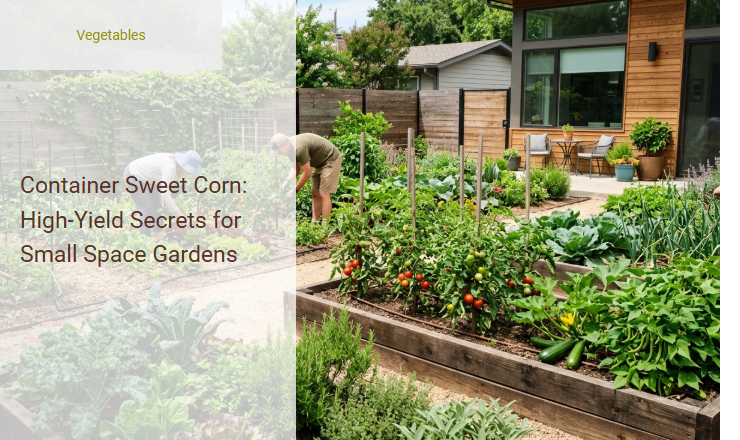
Many urban and suburban gardeners believe that growing sweet corn requires sprawling acres of farmland, leaving those with limited patio, deck, or balcony space feeling entirely excluded from enjoying this classic summer harvest. However, understanding the mechanics of root confinement bridges this spatial gap. Mastering this micro-farming method grants you the unique luxury of harvesting plump, sugary ears just steps from your kitchen door.
To succeed, one must accept certain cultural stipulations: standard field varieties will fail in cramped conditions. Instead, high yields rely on selecting specialized compact cultivars such as 'On Deck' or 'Trinity' and planting them in heavy, 15-gallon containers to ensure proper root anchoring and moisture retention.
In this guide, we will examine the precise steps required to maximize your small-space harvest, analyzing essential soil mixtures, critical hand-pollination techniques, and targeted fertilization schedules.
Read also: Direct vs Transplant for Sweet Corn
Introduction: Can You Really Grow Sweet Corn in Containers?
For generations, the sight of towering sweet corn has been synonymous with vast agricultural fields and sprawling suburban plots. Many gardeners assume that cultivating this golden crop requires endless rows and heavy machinery. However, this is a common myth. You do not need an acre of farmland to enjoy fresh, sun-warmed ears of corn. Container gardening has emerged as a highly viable, high-yield solution for urban and small-space gardeners who want to maximize their patios, balconies, or decks.
By choosing the right inputs and techniques, growing sweet corn in containers is not only possible but incredibly rewarding. With a small footprint, you can cultivate sweet, tender kernels that rival any farm-stand harvest. It is time to rethink small-space productivity and unlock the secrets to raising a successful miniature cornfield right outside your door.
Choosing the Right Dwarf Corn Varieties
Standard sweet corn varieties can easily reach heights of eight feet or more, making them unstable and impractical for pot culture. To succeed in limited spaces, you must select compact cultivars bred specifically for their shorter stature and rapid development.
- 'On Deck' Hybrid: Specifically bred for containers, this variety reaches a manageable height of 4 to 5 feet. It produces bicolor ears with a classic sugary flavor in about 65 to 70 days.
- 'Blue Jade': A rare dwarf heirloom that grows only 3 feet tall. It yields beautiful, sweet steel-blue kernels that turn jade-blue when cooked, ready to harvest in roughly 70 to 75 days.
- 'Golden Midget': This early-season heirloom matures in just 55 to 60 days. It grows to about 3 to 4 feet tall, producing small but exceptionally sweet yellow ears perfect for immediate eating.
Selecting the Perfect Container: Size and Material Matters
Corn plants develop extensive, fibrous root systems that require ample space to support their top-heavy stalks. To prevent your mini-crop from tipping over in summer breezes, you must choose a container with a minimum capacity of 15 gallons, though a 20-gallon vessel is far superior. The container should have a minimum depth of 12 to 14 inches to allow proper anchorage.
Material choice plays a vital role in stability and moisture retention. Heavy terracotta or ceramic pots provide the ballast needed to offset wind resistance, but they dry out quickly. Alternatively, heavy-duty food-grade plastic tubs or thick fabric grow bags work exceptionally well, provided they have superior drainage holes. Adequate drainage prevents the roots from sitting in stagnant water, which leads to rot.
Preparing the Ultimate Soil Mix and Fertilizer Plan
Sweet corn is an exceptionally heavy feeder, demanding a soil structure that is both highly fertile and well-draining. Standard garden soil is too dense and will compact in a container, suffocating the roots. You need a premium custom blend designed to retain moisture while shedding excess water.
- Combine one-third quality organic compost or aged manure, one-third peat moss or coconut coir, and one-third coarse perlite or vermiculite.
- Incorporate a balanced, slow-release organic fertilizer at planting time to establish a steady nutrient baseline.
- Apply a liquid nitrogen-rich fertilizer, such as fish emulsion or feather meal, every two weeks once the plants reach 12 inches tall.
- Increase fertilizer applications during the critical tasseling phase to fuel the formation of healthy ears.
Planting Depth and Grid Spacing Secrets
When planting sweet corn in containers, success hinges on how you arrange the seeds. Plant corn seeds at a precise depth of 1 to 1.5 inches. Lightly firm the soil over the seeds and water thoroughly to ensure proper seed-to-soil contact, which accelerates germination.
Traditional agricultural rows are highly inefficient in containers. To guarantee successful pollination and maximize yields, you must plant your seeds in a dense grid or block pattern. Space seeds approximately 4 to 6 inches apart in all directions within the container, forming a tight square rather than a straight line.
Sun and Water: Hydration Secrets for Juicy Kernels
To fuel their rapid growth, container-grown sweet corn plants require at least six to eight hours of direct, unobstructed sunlight daily. Situate your pots in the sunniest spot on your balcony, patio, or deck to prevent spindly, weak stalks.
Watering is the most critical factor in determining the final quality of your harvest. Because containers dry out rapidly, you must establish a strict watering regimen. Keep the soil consistently damp but never waterlogged. This moisture consistency is absolutely critical during the tasseling and silking stages; dry soil at this juncture will result in missing, shriveled, or poorly developed kernels.
Mastering Hand Pollination in Small Spaces
In traditional fields, corn relies on the wind to blow pollen from the tassels at the top of the stalks down to the female silks below. In a sheltered patio or balcony, wind movement is often insufficient, making hand pollination essential to secure full, plump ears.
The Hand Pollination Process
- Identify the parts: Locate the pollen-producing tassels at the very top of the plant and the silky threads emerging from the embryonic ears lower down on the stalk.
- Collect the pollen: Wait for a dry morning when the tassels open and release visible yellow dust. Gently shake the tassels over a paper bag, or use a soft paintbrush to collect the pollen.
- Apply to silks: Gently brush the collected pollen directly onto every single strand of the fresh silks. Each silk connects to a potential kernel, so thorough coverage is vital.
- Repeat daily: Perform this manual transfer daily for three to five days as new silks continue to emerge and mature.
Companion Planting in Containers: Maximizing Your Space
To make the most of your container real estate, you can grow companion plants alongside your sweet corn. Since corn roots grow relatively deep, shallow-rooted companions will not compete excessively for nutrients and moisture in the upper soil layers.
- Bush beans can be planted at the base of the corn to fix nitrogen in the soil, boosting the corn's heavy nutritional demands.
- Nasturtiums act as an excellent trap crop, deterring aphids and other pests while attracting beneficial pollinators to your container garden.
- Radishes or spinach grow rapidly and can be harvested before the corn develops a dense leaf canopy that shades out the container's surface.
Protecting Your Container Corn from Pests and Diseases
While container cultivation naturally isolates sweet corn from some soil-borne pathogens, urban gardens are still susceptible to insect invaders. Corn earworms are the most notorious pests; their moths lay eggs directly on the newly formed silks. To prevent damage, apply a few drops of organic horticultural oil or organic Bt (Bacillus thuringiensis) directly to the tips of the ears once the silks turn brown.
Fungal issues like common rust or leaf blight can occur if foliage remains damp. Prevent these problems by watering at the base of the plant rather than overhead, and ensure your pots are spaced widely enough to encourage healthy air circulation. If pests like aphids or spider mites appear, treat the leaves immediately with a spray of mild organic insecticidal soap.
Harvesting at the Peak of Sweetness
Timing is everything when it comes to enjoying the sweet, sugary flavors of home-grown corn. As soon as corn is picked, its natural sugars begin converting to bland starches, making immediate consumption ideal. To identify the exact moment of readiness, look closely at the silks. They should turn completely dark brown and dry, while the outer husks remain vibrant green.
To confirm readiness, peel back a small section of the husk to expose the kernels. Perform the classic thumbnail milk test by gently pressing your thumbnail into a plump kernel. If a milky white liquid squirts out, the corn is at its peak of sweetness and ready for harvest. If the liquid is clear, the ear is immature; if it is thick and pasty, the corn is overripe and will be tough to eat.
Summary
Growing sweet corn is no longer restricted to expansive backyard plots. "Container Sweet Corn: High-Yield Secrets for Small Space Gardens" reveals how urban gardeners can successfully harvest delicious, homegrown ears right from their patios, decks, or balconies. The key to success lies in selecting dwarf or short-statured varieties, such as 'On Deck' or 'Trinity', which are specifically bred to thrive in confined spaces.
Since corn is a heavy feeder with a shallow root system, utilizing large containers-at least 15 gallons-filled with nutrient-rich, well-draining soil is essential. Additionally, because corn is wind-pollinated, planting in dense blocks rather than single rows is crucial for proper kernel development. By assisting with hand-pollination, maintaining consistent moisture, and applying regular nitrogen-rich fertilizer, small-space gardeners can maximize their yields and enjoy the unmatched flavor of fresh, homegrown sweet corn.
Leave a comment