
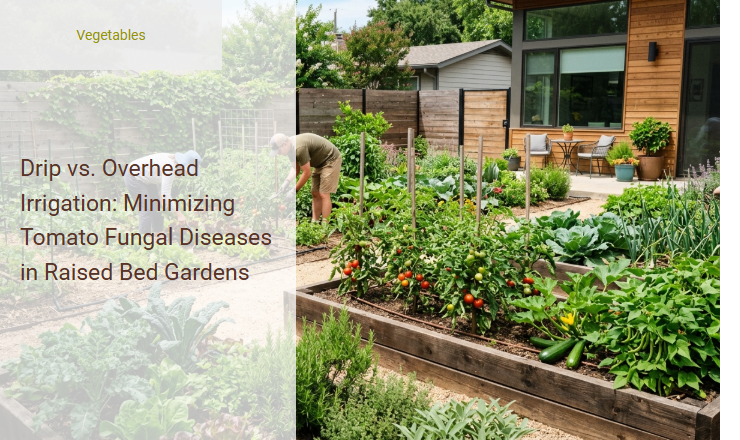
Watching vibrant tomato vines succumb to yellowing, spotted foliage and devastating fruit rot just as the harvest nears is a deeply frustrating experience shared by many raised bed gardeners. Often, this setback is not a failure of soil quality, but rather an unintended consequence of the localized humidity levels and moisture delivery methods within these confined growing spaces.
Optimizing your watering strategy grants growers abundant, disease-free yields and significantly reduced water waste. However, it is important to stipulate that selecting the right irrigation hardware is not a standalone cure; it must be paired with proper plant spacing and airflow management. For example, overhead watering frequently splashes soil-borne fungal spores of pathogens like Septoria leaf spot and Early Blight directly onto lower leaves, where they rapidly multiply.
In this article, we will compare drip and overhead irrigation systems, analyzing how each method impacts canopy moisture, disease transmission, and overall plant health in raised bed environments.
Read also: Drip vs Overhead for Tomato Irrigation
Introduction: The Impact of Irrigation on Raised Bed Tomatoes
For backyard growers, cultivating tomatoes in raised beds represents the pinnacle of home gardening, offering the promise of abundant, flavorful harvests. However, this rewarding pursuit stands constantly threatened by devastating fungal diseases that can decimate entire crops in a matter of days. The difference between a thriving tomato patch and a withered, unproductive garden often comes down to a single daily decision: how you water your plants. Irrigation methods play a direct, decisive role in the outbreak of fungal pathogens. Understanding how water delivery shapes the microclimate of your garden is essential for safeguarding your investments of time, energy, and passion.
Common Tomato Fungal Diseases and Their Triggers
Tomatoes are highly susceptible to several devastating fungal pathogens that thrive when environmental conditions align in their favor. Understanding these diseases is the first step toward preventing them.
- Early Blight: Caused by the fungus Alternaria solani, this disease produces concentric rings on older leaves, resembling targets. It is triggered by moderate temperatures combined with prolonged leaf wetness.
- Late Blight: This highly destructive pathogen, Phytophthora infestans, manifests as dark, water-soaked spots on leaves and fruit. It spreads rapidly during cool, wet weather and high relative humidity.
- Septoria Leaf Spot: Caused by Septoria lycopersici, this disease leads to numerous small, circular spots with dark borders. It flourishes in warm, humid conditions when water droplets splash onto foliage.
Excess moisture is the primary catalyst that awakens dormant spores, allowing them to infect healthy tissues and spread throughout the garden.
Overhead Irrigation: Convenience with a Hidden Cost
Many home gardeners default to overhead irrigation methods, such as oscillating sprinklers or watering with a hand-held hose nozzle from above. While these techniques are highly convenient and require minimal initial setup, they come with a severe, hidden cost to plant health. Overhead systems indiscriminately saturate the entire tomato plant canopy, bathing the leaves, stems, and developing fruit in a heavy mist. This mimicry of rainfall creates a hazardous environment where water clings to every surface, setting the stage for disease.
The Science of Foliar Wetness and Spore Germination
The biological relationship between leaf moisture and fungal infection is direct and rapid. Fungal spores require liquid water on the leaf surface to initiate germination. When foliage remains wet for extended periods, spores absorb moisture, swell, and produce germ tubes that penetrate the plant's cuticle. High relative humidity within the dense tomato canopy further slows down evaporation, keeping leaves damp long after watering has ceased. Microscopic spores can germinate and infect a leaf in as little as two to four hours under optimal conditions. Reducing foliar wetness is therefore the single most effective physical barrier a grower can establish against these pathogens.
Drip Irrigation: Targeted Root-Zone Watering
Drip irrigation systems and soaker hoses offer a highly efficient alternative to overhead watering. By utilizing low-pressure tubing equipped with emitters, these systems deliver water directly to the soil and root zone. This deliberate mechanism bypasses the tomato foliage entirely, ensuring that leaves and stems remain bone-dry during watering cycles. Because water is applied slowly and precisely at the soil level, the root systems receive deep, consistent hydration without creating the humid microclimates that invite fungal spores to multiply.
Preventing Soil Splash-Back and Spore Transmission
Many fungal pathogens spend their life cycles dormant in the soil, waiting for physical transport to a host plant. Overhead watering creates heavy droplets that strike the bare ground with force, splashing soil particles and microscopic spores onto the lower leaves of tomato plants. Drip irrigation entirely eliminates this splash-back effect. By gently releasing water directly onto the soil surface, drip emitters break the transmission cycle, keeping soil-borne fungi grounded and far away from susceptible foliage.
The Raised Bed Advantage: Microclimates, Airflow, and Drainage
The physical design of raised beds provides distinct structural advantages for disease prevention. Elevated beds naturally optimize soil drainage, preventing the waterlogged conditions that stress tomato roots and make them susceptible to soil-borne pathogens. When paired with precise drip irrigation, raised beds help maintain a dry, localized microclimate with excellent airflow. Increased wind circulation around the base of elevated beds ensures that any ambient moisture evaporates quickly, establishing a hostile, dry environment where fungal spores cannot take hold.
Direct Comparison: Drip vs. Overhead Irrigation
| Feature | Drip Irrigation | Overhead Irrigation |
|---|---|---|
| Disease Prevention | High (keeps foliage dry) | Low (saturates canopy) |
| Water Efficiency | Excellent (90%+) | Poor (high run-off) |
| Evaporation Rates | Minimal | High |
| Weed Suppression | High (waters only crop roots) | Low (waters entire surface) |
Step-by-Step: Installing a Drip System in Raised Beds
- Measure and Plan: Calculate the dimensions of your raised beds and sketch a layout mapping where your tomato plants are positioned.
- Gather Materials: Acquire a pressure regulator, a backflow preventer, a main supply line (usually half-inch tubing), quarter-inch distribution tubing, and individual drip emitters or emitter tubing.
- Connect to the Water Source: Attach the backflow preventer and pressure regulator to your outdoor faucet to protect your home water supply and maintain low pressure.
- Lay the Main Line: Run the half-inch main tubing along the center or edge of your raised beds, securing it in place with garden stakes.
- Install the Emitter Tubing: Punch holes into the main line and run quarter-inch tubing directly to the base of each tomato plant, capping the ends of the lines.
- Test and Adjust: Turn on the water to check for leaks, ensuring each emitter gently drips water directly into the soil at the base of your plants.
Best Practices for Disease-Free Tomato Harvests
Switching to drip irrigation is the most impactful step you can take to prevent fungal infections, but combining it with other cultural practices will guarantee success. Implement a strict morning watering schedule so that any accidental moisture dries quickly during the day. Always apply a thick layer of organic mulch to further shield the soil surface and lock in moisture. Finally, prune the lower leaves of your tomato plants up to twelve inches from the ground to maximize airflow under the canopy.
Summary
This article explores the critical impact of watering methods on tomato health within raised bed gardens, specifically comparing drip and overhead irrigation. Tomato plants are highly susceptible to devastating fungal diseases, such as early blight, septoria leaf spot, and powdery mildew, which thrive in moist, humid conditions. Overhead irrigation wets the foliage and causes soil-borne pathogens to splash upward onto lower leaves, creating an ideal environment for fungal spores to germinate. In contrast, drip irrigation delivers water directly to the soil and root zone. By keeping the leaves completely dry, drip systems significantly minimize the risk of disease transmission and reduce water waste through evaporation. For gardeners utilizing raised beds, transitioning to drip irrigation is a highly effective cultural control method that promotes healthier tomato yields and ensures a more sustainable, disease-free growing season.
Leave a comment