
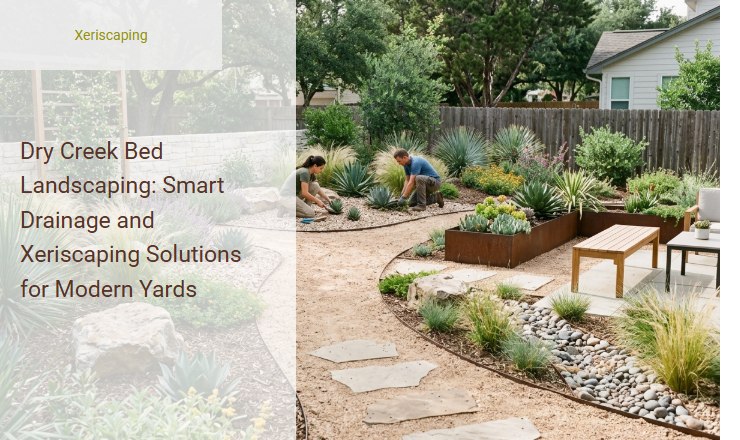
Managing property drainage while maintaining an attractive yard is a persistent challenge for modern homeowners. Too often, heavy rains lead to unsightly pooling and soil erosion, while traditional turf lawns consume excessive, costly water resources in the drier months. Before investing in invasive and expensive underground piping, it is essential to understand how natural topography dictates water flow across your landscape.
Dry creek bed landscaping offers an elegant, dual-purpose solution, seamlessly blending functional runoff control with low-water xeriscaping. This approach turns a utility challenge into an artistic asset that slashes maintenance time and enhances curb appeal. However, successful execution is not merely a matter of scattering gravel; it requires precise grading, durable filter fabrics, and calculated stone graduation to prevent washouts. Utilizing varied river rocks, structural boulders, and drought-tolerant native grasses ensures the feature remains both functional and visually authentic.
In this guide, we will outline the essential engineering principles, material selections, and planting strategies needed to design a dry creek bed that is both resilient and beautiful.
Read also: Dry Creek Beds vs Paved Ditches for Drainage Aesthetics
The Functional Beauty of Dry Creek Beds
Enhancing your yard requires a delicate balance between visual artistry and environmental utility.Dry creek beds have emerged as a premier solution in modern sustainable landscaping. By seamlessly bridging the gap between xeriscaping aesthetics and practical water management, these features channel heavy rainfall away from your home's foundation while mimicking the serene beauty of a natural, dried riverbed during dry spells. Rather than fighting natural water patterns, smart homeowners use these installations to transform erosion-prone drainage problems into striking, low-maintenance design focal points.
Assessing Your Property's Hydrology and Slope
Before moving any dirt, you must understand how water naturally interacts with your land. Designing a dry creek bed requires mapping the topography of your yard to work with gravity, ensuring that routed water flows safely to a designated discharge point without pooling or damaging neighboring properties.
- Observe your yard during a heavy storm to identify exactly where water pools and where the fastest-moving runoff flows.
- Locate the high and low points of your property using a line level or transit level to establish the natural grade.
- Map the path along existing natural slopes, avoiding sharp turns that could cause fast-flowing water to overflow the banks.
- Check for underground utilities by calling local dig-safety hotlines before finalizing your excavation route.
Designing for Natural Aesthetics
A poorly planned dry creek bed can easily look like an artificial trench filled with rocks. To prevent this, your design should mimic the organic imperfections found in nature, ensuring the feature blends seamlessly with your existing yard elements.
Emulating Organic Waterways
In nature, water rarely flows in a straight line. Avoid linear pathways; instead, design sweeping curves and gentle meanders. Vary the width of the creek bed throughout its journey-make it wider at the bends where water naturally slows down, and narrower along straight runs. To truly anchor the feature, integrate the creek bed with existing slopes, trees, or garden beds so it looks like a permanent fixture of the landscape.
Excavation and Foundation Groundwork
The longevity of your dry creek bed depends heavily on the preparation of its foundation. Proper excavation and stabilization prevent the rocks from sinking into the soil and stop fast-moving stormwater from washing away your hard work.
- Excavate the channel: Dig out the path to a depth of 12 to 18 inches, sloping the sides downward at a gentle 45-degree angle to create a natural U-shaped trench.
- Compact the soil: Pack down the loose earth along the bottom and sides of the trench to create a firm, stable base that resists shifting under the weight of heavy rocks.
- Lay heavy-duty landscape fabric: Line the entire excavated channel with commercial-grade, non-woven geotextile fabric to prevent weeds from sprouting and protect the soil from eroding underneath the rocks.
Choosing and Layering Stones for Realistic Texture
Selecting and arranging the right stones is what transforms a simple drainage ditch into an artistic masterpiece. A realistic dry creek bed utilizes a diverse mixture of rock shapes, colors, and sizes to replicate a true river system.
The Art of Stone Selection
- Anchor with large boulders: Place large, weathered boulders along the outer curves and banks of the creek to look like natural obstacles that divert water flow.
- Form the channel with river jacks: Use medium-sized smooth stones, such as river jacks, to line the bed of the channel and hold the landscape fabric firmly in place.
- Fill in gaps with pea gravel: Spread smaller river rocks and pea gravel to fill the voids between larger stones, securing the structure and completing the natural look.
Integrating Drought-Tolerant Xeriscape Plants
Softening the hard edges of stone with lush, drought-resistant vegetation is the key to a cohesive landscape design. Strategically placed plants not only add texture and color but also anchor the soil surrounding your dry creek bed with their roots.
- Ornamental Grasses: Species like Blue Fescue or Maiden Grass sway beautifully in the wind and mimic natural streamside vegetation.
- Durable Groundcovers: Low-growing sedum or creeping thyme can spill gracefully over rock edges, softening the stone-to-soil transition.
- Hardy Perennials: Coneflowers, Russian Sage, and Yarrow provide vibrant bursts of color while requiring minimal water.
For the most realistic look, plant your selections in organic drifts rather than symmetrical rows, clustering them tightly around the bends and outer banks where wild seeds would naturally gather and sprout.
Incorporating Advanced Drainage Solutions
While a dry creek bed is excellent for managing moderate runoff, extreme storms require heavier drainage capabilities. Incorporating engineering elements beneath your rocks ensures your yard can handle severe cloudbursts without flooding.
Subsurface Utility Integration
To maximize efficiency, you can install a perforated French drain beneath the center of the creek bed to carry excess water underground. Route the end of your creek bed into a catch basin or a dedicated rain garden designed to slowly absorb the deluge back into the water table. This dual-layer approach keeps your property safe during unprecedented downpours.
By marrying surface beauty with subsurface drainage engineering, your yard remains resilient in any weather.Long-Term Maintenance and Upkeep
Although dry creek beds are exceptionally low-maintenance compared to traditional turf lawns, they are not completely maintenance-free. Simple seasonal upkeep will keep your stone channel looking pristine and functioning efficiently for years to come.
- Clear away fallen leaves, twigs, and organic debris each autumn to prevent organic material from rotting and creating soil beds for weeds.
- Monitor the creek bed after major storms to reposition any smaller stones that may have shifted during high-velocity water flows.
- Rake out silt and sediment buildup that accumulates in the deep channels to maintain optimal water flow capacity.
- Spot-treat any stubborn weeds that manage to take root in accumulated organic dust along the edges of the fabric.
Ecological and Cost-Saving Benefits
Opting for a dry creek bed offers significant advantages that extend far beyond your property lines. These features serve as an eco-friendly alternative to high-maintenance lawns, saving you money while supporting the local ecosystem.
A Win for Your Wallet and the Planet
By replacing resource-heavy grass with stones and native plants, you dramatically reduce your monthly water bill and eliminate the need for chemical fertilizers. Furthermore, dry creek beds filter pollutants out of rainwater runoff before it reaches municipal storm drains.
Creating these rock channels also establishes valuable micro-habitats, offering shelter and drinking pools for local birds, beneficial insects, and pollinators.Elevating Your Modern Landscape Design
Embracing a dry creek bed is more than just solving a wet yard problem; it is an opportunity to elevate your entire property's aesthetic and value. By blending the organic textures of river stone with resilient xeriscape plantings, you turn challenging slopes and muddy patches into striking, intentional design features. Investing in this sustainable hardscape solution ensures your yard remains beautiful, dry, and ecologically responsible for decades to come.
Transform your outdoor space today by turning water management into a stunning work of living art.Summary
Dry creek beds offer a harmonious blend of aesthetic appeal and practical functionality for modern landscapes, serving as an innovative solution for both stormwater drainage and xeriscaping. By mimicking the natural pathway of a stream using strategically placed river rocks, gravel, and native plantings, homeowners can effectively channel excess rainwater runoff away from home foundations, preventing soil erosion and pooling water. Beyond its hydrological benefits, this landscaping technique is a cornerstone of sustainable design. It significantly reduces outdoor water consumption by replacing thirsty turf lawns with drought-tolerant, low-maintenance elements. Perfect for sloped yards or areas prone to heavy rainfall, a dry creek bed creates a visually striking focal point that enhances biodiversity and curb appeal. Ultimately, it provides an eco-friendly, resilient solution that adapts beautifully to changing climates while transforming problematic yard areas into scenic, naturalistic retreats.
Leave a comment