
Dry-climate homeowners often struggle to maintain a vibrant landscape without facing astronomical water bills or dealing with sudden, erosive downpours that wash away precious topsoil. Before investing in expensive automated irrigation, it is crucial to first understand the principles of passive rainwater harvesting, which utilizes gravity and terrain to capture and distribute natural precipitation.
Mastering this approach grants you a highly resilient, self-sustaining xeriscape that minimizes utility costs. However, effective implementation stipulates that you must match the infrastructure to your specific soil drainage capacity, as the wrong system can lead to soil oversaturation or foundation damage. For instance, directing rapid driveway runoff to deep-rooted desert willow trees requires a fundamentally different mechanism than slowly dispersing subsurface water through a gravel-filled trench.
This article compares the two premier solutions-French drains and swales-examining their mechanics, installation costs, and ideal applications to help you choose the perfect water-harvesting strategy for your property.
Introduction to Passive Water Harvesting in Xeriscaping
In arid and semi-arid regions, water conservation is not just an environmental choice but a foundational pillar of sustainable landscaping. Xeriscaping, the practice of designing landscapes to reduce or eliminate the need for supplemental irrigation, thrives on maximizing every drop of natural precipitation. To achieve this, modern gardeners rely on passive water harvesting, a method that captures and redirects rainwater without mechanical assistance. Among the premier solutions for passive water harvesting are French drains and swales, two distinct systems that redirect, capture, and distribute runoff to sustain drought-tolerant plants while protecting the structural integrity of your home.
Understanding French Drains: Subsurface Water Redirection
French drains operate entirely beneath the surface of your landscape, functioning as a hidden gravity-fed channel to evacuate excess water. This system is designed to intercept saturated groundwater or surface runoff and quickly carry it away from vulnerable areas, such as home foundations, retaining walls, or low-lying garden beds. By utilizing gravity, French drains ensure that water finds the path of least resistance through a carefully engineered underground trench.
The success of a French drain lies in its specific structural layers:
- Geotextile fabric: Heavy-duty liners that prevent fine soil particles from clogging the drainage system.
- Washed gravel: A thick layer of coarse stone that allows water to percolate rapidly downward.
- Perforated pipe: A buried PVC or flexible pipe with holes facing downward to collect and channel the water away.
Deciphering Swales: Nature-Inspired Surface Absorption
Unlike subsurface drainage networks, swales are surface-level features that work in harmony with natural topography to manage rainwater. Swales are gently sloped, shallow basins accompanied by raised mounds of earth on the downhill side. Their primary ecological function is to slow down the velocity of stormwater runoff, spread it across a wider surface area, and sink it deep into the water table, essentially acting as a natural sponge for xeriscapes.
By mimicking natural riverine patterns, swales provide several ecological benefits:
- Slowing: Friction from rocks, vegetation, and mulch decelerates fast-moving stormwater.
- Spreading: Water is distributed evenly along the contour of the landscape rather than carving deep erosion gullies.
- Sinking: Retained water percolates downward, recharging local groundwater reserves and nourishing nearby root zones.
Subsurface vs. Surface Flow: The Hydrological Comparison
The fundamental difference between French drains and swales lies in their hydrological intent. French drains focus on rapid evacuation, moving water away from a site as quickly as possible. Swales, conversely, prioritize retention, holding water on-site to enrich the soil. This structural divergence creates contrasting soil moisture profiles within the surrounding landscape.
| Feature | French Drain (Subsurface) | Swale (Surface) |
|---|---|---|
| Primary Hydraulic Goal | Rapid evacuation of excess water | Slow infiltration and retention |
| Water Movement | Underground gravity flow via pipes | Surface sheet flow and pooling |
| Soil Moisture Impact | Dries out saturated soil quickly | Maintains long-term, deep-root moisture |
| Erosion Control | Prevents underground soil shifting | Prevents surface topsoil washing away |
Water Harvesting Efficiency: Which Feeds Your Xeriscape Better?
When assessing passive water harvesting efficiency, the ideal system depends heavily on your primary landscape objective. In xeriscaping, the goal is often to sustain plants with minimal municipal water inputs. From this perspective, swales represent the superior water harvesting mechanism because they actively capture rainfall and keep it within the landscape boundary, charging the soil with moisture that low-water plants can access for weeks after a storm.
Nourishing Plant Communities vs. Directing Runoff
French drains, while incredibly efficient, are not designed to harvest water for plant consumption; rather, they are structural safety mechanisms. They collect runoff and discharge it into storm sewers, dry wells, or street gutters, effectively removing precious moisture from your xeriscape's immediate ecosystem.
"Swales act as localized storage reservoirs, turning sudden downpours into slow-release irrigation systems for neighboring drought-tolerant vegetation, whereas French drains function primarily as flood mitigation safeguards."
Aesthetic Integration: Blending Infrastructure with Drought-Tolerant Plants
Integrating stormwater infrastructure into your xeriscape requires balancing functionality with visual appeal. French drains offer an invisible solution. Because the entire system is buried underground, the surface can be covered with turf, decorative gravel, flagstone, or mulch, maintaining a clean, uninterrupted landscape design that hides the engineering underneath.
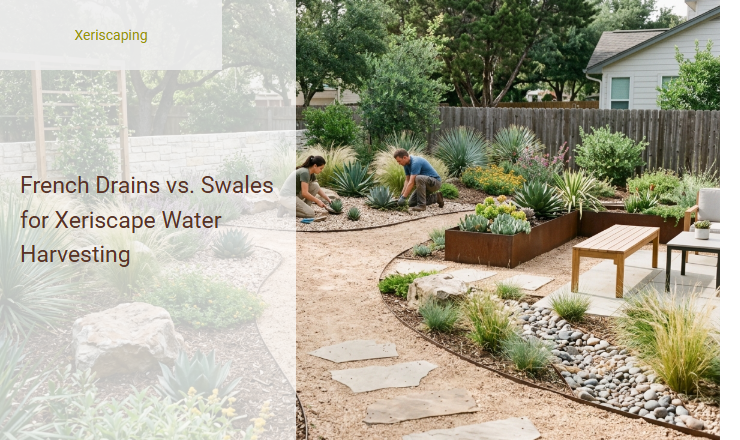
On the other hand, swales are prominent, highly visible features that can be transformed into beautiful design elements. Often styled as dry creek beds, swales use a mix of river rock, boulders, and organic mulch to mimic natural stream beds. These channels can be bordered with native, drought-tolerant grasses, wildflowers, and shrubs that thrive on occasional deep watering, creating a vibrant microclimate within the garden.
Cost, Labor, and Installation Complexity
Choosing between these two systems requires weighing the direct material costs against the physical labor involved during the installation process. Both projects can be done as DIY projects, but they require very different types of investment.
- French Drain Installation: This process requires significant material expenses, including purchasing high-quality geotextile fabric, perforated PVC drainage pipes, and yards of washed drainage gravel. While digging a narrow trench is necessary, the mechanical components represent the bulk of the budget.
- Swale Construction: This approach is highly labor-intensive, requiring extensive excavation, grading, and soil movement to establish the correct slope, depth, and downhill berm. However, the material costs are incredibly low, often requiring only mulch, rocks, and plants.
Long-Term Maintenance and Durability
Every passive water harvesting system requires routine upkeep to maintain its hydraulic efficiency and ensure long-term durability over seasons of heavy rain and dry spells.
French Drain Upkeep: Preventing Underground Blockages
Because French drains are buried, identifying and repairing a clog can be difficult and costly. Keeping the system functional requires proactive prevention:
- Flushing the pipes annually through clean-out ports to clear out fine silt.
- Ensuring the geotextile fabric remains intact to block root intrusion from nearby trees.
- Clearing debris and leaves from the surface catch basins or inlet grates.
Swale Upkeep: Managing Surface Growth and Sediment
Swales are exposed to the elements, making their maintenance more visible and straightforward, though more frequent:
- Removing accumulated sediment and leaves from the bottom of the basin to prevent clogging.
- Weeding the swale channel to ensure vegetation does not choke out the water flow path.
- Replenishing mulch and repositioning stones shifted by heavy rainfall events.
Site-Specific Selection: Soil, Slope, and Rainfall Factors
Selecting the ideal water management system depends heavily on your property's unique environmental conditions. Factors like soil composition, slope steepness, and local rainfall intensity will dictate which solution protects your property while optimizing water usage.
If your property has heavy clay soil, water infiltrates very slowly. In this scenario, a French drain is often necessary to prevent prolonged ponding near foundations, whereas a swale constructed in clay must be carefully designed with a gravel base or high-absorption plantings to avoid stagnant water. On steep slopes, rapid runoff can cause severe erosion; here, a swale built along the contours of the hill can break the water's speed and promote absorption, while a French drain might be used at the base of the slope to intercept and redirect the gathered water.
Additionally, local precipitation patterns play a vital role. Regions prone to sudden, torrential downpours benefit from the quick discharge capabilities of French drains, whereas areas characterized by moderate, seasonal rains can easily capture and utilize almost all runoff using a well-graded swale network.
The Hybrid Approach: Combining Swales and French Drains
Instead of viewing these two systems as mutually exclusive, many savvy landscape designers combine them into a single, high-performing hydrologic network. By integrating French drains and swales, you can maximize both water harvesting efficiency and flood protection, creating a resilient, self-sustaining xeriscape that thrives in any weather condition.
For example, you can design a dry creek bed swale to handle the first flush of moderate rain, allowing water to sink naturally into the soil to nourish your drought-tolerant plants. To handle overflow during extreme storms, a French drain can be installed directly beneath or at the terminal end of the swale. This setup ensures that excess water is safely evacuated once the swale reaches its maximum holding capacity, protecting your home while preserving valuable moisture for your garden. Implementing this layered, dual-action system provides an exceptional balance of beauty, conservation, and structural security for your modern xeriscape.
| Feature | French Drains | Swales |
|---|---|---|
| Primary Mechanism | Subsurface drainage. Redirects gravity-fed water underground via perforated pipe and gravel trench. | Surface detention. Captures, slows, and spreads runoff along landscape contours. |
| Water Harvesting Style | Active/Off-site storage. Channels water to cisterns, rain barrels, or dry wells. | Passive/In-situ storage. Promotes direct soil infiltration, recharging local groundwater. |
| Best Use Case | Protecting foundations, soggy lawns, and high-traffic areas from standing water. | Irrigating agricultural land, sloped orchards, and permaculture food forests. |
| Installation & Cost | Higher cost. Requires excavation, geotextile fabric, gravel backfill, and piping. | Lower cost. Primarily involves earthworks, mound shaping (berms), and planting. |
| Maintenance Profile | Low frequency, but high difficulty. Hard to clear if silted up or compromised by root intrusion. | Regular frequency, low difficulty. Needs occasional silt removal, mowing, or plant care. |
Leave a comment