
Designing a low-water xeriscape often leaves property owners struggling to manage sudden, destructive stormwater runoff on dry, compacted soil. Before selecting a surface material, however, one must first understand how municipal impervious cover limits and local drainage patterns impact a site's hydrology. Making the correct choice not only safeguards your property from erosion but also grants valuable municipal utility rebates and long-term infrastructure protection.
While traditional poured concrete offers exceptional load-bearing durability, its absolute impermeability requires precise grading and secondary drainage systems to prevent localized flooding. Conversely, installing interlocking permeable pavers allows rainwater to filter directly into the ground, neutralizing runoff at the source. In this analysis, we will evaluate the cost, maintenance, and hydrological performance of both permeable pavers and concrete to determine the optimal solution for your xeriscape.
The Challenge of Stormwater Runoff in Xeriscaping
Xeriscaping is a sustainable landscaping philosophy designed specifically for arid and semi-arid regions. By utilizing drought-tolerant vegetation, efficient irrigation systems, and organic mulches, this method significantly reduces the need for supplemental watering. While the primary goal of xeriscaping is water conservation, managing the occasional but intense rainfall events common in dry climates is equally critical.
In arid climates, soil is often compacted, dry, and unable to absorb sudden downpours quickly. When heavy storms strike, the lack of vegetative ground cover can lead to severe soil erosion and rapid stormwater runoff. Without proper management, this water sweeps away precious topsoil and overwhelms municipal storm drains, underscoring the vital need for smart hardscaping choices.
Permeable Pavers: Mechanism and Materials
Permeable pavers represent a sophisticated engineering solution to stormwater management. Unlike solid slabs, these systems are composed of individual units separated by joints filled with small, unscreened aggregate. When rain falls, the water flows through these joints, traveling down through specialized subbase layers of gravel and stone before gradually recharging the natural aquifer below.
The materials utilized in permeable paving systems are carefully selected to ensure structural integrity while facilitating rapid drainage. Common choices include:
- Interlocking concrete pavers designed with wide, aggregate-filled joints.
- Porous asphalt mixes that lack the fine aggregate found in standard paving.
- Permeable clay bricks manufactured to allow deep water penetration.
- Open-cell concrete grids filled with aggregate or drought-resistant turf grass.
Traditional Concrete: The Impervious Barrier
Traditional concrete is a staple of suburban construction, yet its structural density creates an impervious barrier over the earth. When rain falls on a standard concrete driveway or patio, it cannot sink into the ground. Instead, the water is forced to flow outward, gathering speed and volume as it moves off the hardscape, leading to localized flooding and soil erosion at the margins of the yard.
Beyond water management issues, traditional concrete contributes significantly to the heat island effect in dry climates. These solid, light-reflecting mass surfaces absorb intense solar radiation during the day and slowly radiate that thermal energy back into the surrounding microclimate overnight, keeping dry landscapes hotter for longer periods.
Direct Comparison: Water Infiltration Rates
| Surface Material | Infiltration Rate (Inches per Hour) | Runoff Potential |
|---|---|---|
| Permeable Pavers | 80 to 500 inches per hour | Extremely Low |
| Traditional Concrete | 0 to 0.05 inches per hour | Extremely High |
Durability and Lifespan in Arid Climates
Permeable Paver Resilience
In environments characterized by extreme temperature swings and high UV exposure, permeable pavers offer exceptional durability. Because the system consists of independent interlocking pieces, the joints allow for natural thermal expansion and contraction without cracking. If a subgrade shift occurs, individual pavers can adjust slightly, maintaining surface integrity over a lifespan that often exceeds thirty to fifty years.
Traditional Concrete Under Stress
Standard concrete slabs are highly susceptible to the intense thermal stress of arid regions. The rapid cycle of hot daytime temperatures and cool nights causes the rigid material to expand and contract, leading to inevitable hairline fractures and eventual deep cracks. Without regular expansion joints and expensive reinforcement, traditional concrete surfaces typically exhibit noticeable degradation within fifteen to twenty years.
Maintenance Requirements for Optimal Runoff Performance
To preserve the functionality of your hardscaping over time, customized maintenance routines must be established for each material type.
- For permeable pavers, regular sweeping or vacuuming is required to prevent fine sediment and organic debris from clogging the aggregate-filled joints.
- Every few years, the joint aggregate in permeable pavers may need to be replenished or topped off to maintain structural stability and filtration speed.
- Traditional concrete requires routine pressure washing and the application of chemical sealants to guard against moisture penetration and UV damage.
- Any cracks that develop in solid concrete must be quickly patched and sealed to prevent water from entering and eroding the underlying subgrade.
Aesthetic Synergy with Low-Water Plants
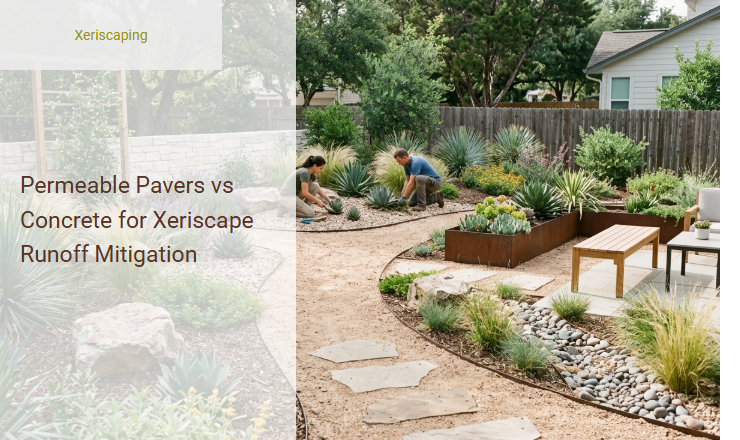
The visual relationship between hardscaping and low-water flora is a foundational element of modern xeriscaping. Permeable pavers offer an organic, textured appearance that mimics natural stone paths, effortlessly complementing the sculptural forms of agaves, yuccas, and native ornamental grasses. This visual integration softens the landscape, turning functional drainage surfaces into beautiful design focal points.
A xeriscape pathway utilizing warm-toned permeable pavers bordered by drought-tolerant desert lavender and structural stone accents.
Cost Analysis: Upfront Installation vs. Long-Term Value
Initial Capital Expenditures
When planning a landscape, the upfront costs of permeable pavers are generally higher than those of standard poured concrete. This price difference stems from the specialized multi-layered gravel subbase preparation and the manual labor required to lay individual interlocking units. Standard concrete relies on a simpler, faster installation process that keeps initial labor expenses lower.
Long-Term Financial Return
Despite the initial expense, permeable systems deliver substantial long-term value. By mitigating runoff, they eliminate the need for costly secondary drainage infrastructure like French drains, catch basins, or retaining walls. Additionally, because individual pavers can be replaced if damaged, repair costs are significantly lower than tearing out and repouring a cracked concrete slab.
Environmental Footprint and Local Ecosystem Benefits
Choosing permeable surfaces over solid alternatives yields profound environmental benefits that extend far beyond the property boundaries. By allowing rainwater to seep directly into the ground, permeable pavers actively support localized groundwater recharge, sustaining aquifers that are crucial to dry regions. They also filter out oil, heavy metals, and other pollutants, keeping them from washing into fragile local waterways.
"The transition from impervious surfaces to permeable hardscapes is one of the most effective strategies for restoring natural hydrological cycles in urbanized desert environments."
Selecting the Ideal Surface for Your Xeriscape
Choosing the right material for your low-water landscape depends on several key environmental and financial factors. Homeowners on a tight budget with flat terrain may opt for traditional concrete, provided they implement peripheral bio-swales to capture overflow water. However, for properties located on slopes or in areas prone to sudden, violent downpours, permeable pavers are the superior technical choice.
Carefully analyze your local rainfall patterns, soil type, and aesthetic goals. Investing in permeable infrastructure protects your xeriscape from erosion while ensuring that every drop of precious rain is retained to nourish the local ecosystem.
| Runoff Metric | Permeable Pavers | Standard Concrete |
|---|---|---|
| Infiltration Rate | High (70% to 100% of rainwater absorbed directly) | 0% (100% impervious; causes total runoff) |
| Peak Flow Mitigation | Delays and reduces peak volume via sub-base storage | Instantaneous runoff; accelerates flooding risks |
| Water Filtration | Natural biological/mechanical filtering of pollutants | None; washes surface pollutants directly to waterways |
| Drainage Infrastructure | Self-draining; eliminates need for retention ponds | Requires sloped grading, curbs, and storm sewers |
| Long-Term Maintenance | Requires vacuum sweeping to prevent joint clogging | Requires crack sealing; prone to surface pooling |
Leave a comment