
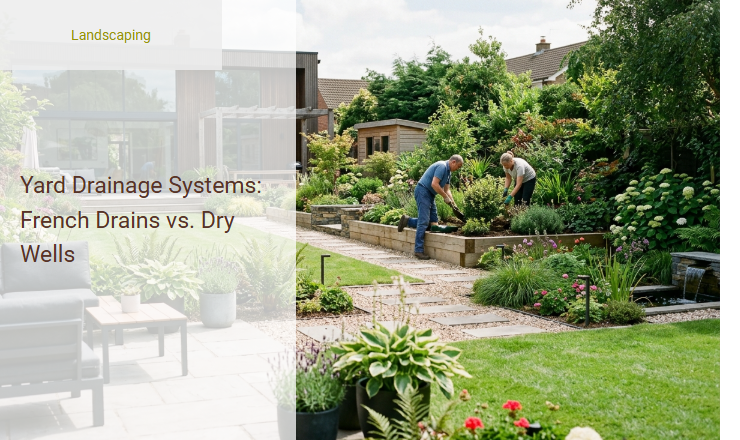
Every rainy season, many homeowners face the frustrating reality of waterlogged lawns, ruined landscaping, and the looming threat of basement flooding. Before investing in a solution, however, one must first examine how local soil composition and property topography dictate surface runoff. Ignoring these natural factors when dealing with concrete examples of drainage failure-such as pooling water near foundations or persistent marshy patches in the turf-can lead to compounding structural damage.
By implementing a targeted drainage strategy, you not only protect your home's foundational equity but also reclaim the full utility of your outdoor living spaces. Importantly, successful water mitigation is not a one-size-fits-all endeavor; optimal performance requires balancing your property's specific hydrological load with local municipal runoff regulations.
To help you navigate this project, this guide compares the two leading residential solutions-French drains and dry wells-evaluating their mechanics, ideal use cases, and installation costs so you can select the right system for your landscape.
Understanding Yard Drainage: French Drains vs. Dry Wells
A beautiful backyard can quickly turn into a stressful bog after a heavy downpour. Homeowners frequently struggle with standing water, which not only ruins landscaping and creates breeding grounds for mosquitoes but can also threaten the structural integrity of home foundations. Excess surface water and soggy turf are common headaches that require smart, permanent solutions rather than temporary fixes.
Fortunately, managing excess water does not require damaging your local ecosystem. French drains and dry wells represent the two primary eco-friendly drainage systems designed to handle stormwater naturally. By leveraging gravity and natural filtration, these systems redirect water safely, replenishing the local water table without sending chemical-laden runoff into municipal sewer systems.
What is a French Drain and How Does It Work?
A French drain is a highly effective subsurface drainage system designed to redirect groundwater and surface water away from a specific area, such as a home's foundation or a low-lying garden bed. Rather than letting water pool, this system acts as an underground gutter, capturing water along its entire length and channeling it to a safe discharge point.
The anatomy of a standard French drain relies on a few simple but crucial components:
- Perforated Pipe: A flexible or rigid plastic pipe with small holes that allow water to enter from the bottom and sides.
- Gravel or Crushed Stone: Surrounds the pipe, acting as a natural filter and creating a high-void space for water to flow through easily.
- Filter Fabric: A water-permeable landscape fabric wrapped around the gravel and pipe to prevent dirt, sand, and roots from clogging the system.
Using the natural force of gravity, water flows into the gravel-filled trench, enters the perforated pipe, and is safely carried downhill to an appropriate exit point, such as a storm drain, dry creek bed, or street gutter.
What is a Dry Well and How Does It Work?
Unlike a channel that moves water from one point to another, a dry well is an underground holding chamber designed to manage stormwater runoff on-site. It collects water from concentrated sources, such as roof downspouts or paved driveways, and stores it temporarily before dispersing it back into the earth.
The mechanics of a dry well rely on holding capacity and natural soil infiltration:
- Underground Chamber: A large, perforated plastic tub or a gravel-filled pit buried deep beneath the yard's surface.
- Inflow Pipe: A solid pipe that directly connects gutter downspouts, catch basins, or patio drains to the holding chamber.
- Soil Infiltration: Once the chamber fills, water slowly seeps out through the perforations and surrounding gravel into the deep soil layers.
This method prevents surface erosion and helps recharge the local aquifer directly beneath your property, making it an incredibly sustainable way to handle heavy downpours.
Core Differences: Mechanics, Flow, and Water Direction
While both systems handle excess stormwater, their core operations are fundamentally different. A French drain is designed for linear transport, pulling water along a path and moving it horizontally to a lower elevation. In contrast, a dry well functions as a point-source storage basin, accepting large volumes of water at once and directing it vertically downward into the deep subsoil.
| Feature | French Drain | Dry Well |
|---|---|---|
| Primary Direction of Flow | Horizontal (lateral redirection) | Vertical (downward infiltration) |
| Water Storage Capacity | Low (continuous movement) | High (temporary storage chamber) |
| Common Water Sources | Subsurface groundwater and surface pooling | Direct roof runoff, gutters, and downspouts |
| Discharge Point | Daylight exit, street curb, or storm sewer | Surrounding deep subsoil |
When to Choose a French Drain: Ideal Scenarios
Soggy Lawns and Squishy Turf
If your lawn remains saturated days after a rainstorm, a French drain can lower the local water table. By intercepting rising groundwater, it dries out the soil and restores usability to your outdoor spaces.
Protecting Your Home Foundation
Water pooling against a basement wall or crawlspace can lead to structural damage, mold growth, and wet basements. Installing a French drain around the perimeter of your home intercepts this water and carries it safely away.
Sloped Yards and Erosion Control
Hillside properties often suffer from runoff that washes away topsoil and ruins lower-elevation landscaping. A French drain cut across the slope intercepts the surface sheet flow, stabilizing the hillside.
When to Choose a Dry Well: Ideal Scenarios
Handling Roof Gutter Downspouts
When heavy rains fall, roof gutters discharge an immense volume of water in a concentrated spot. Directing these downspouts into a dry well prevents the water from pooling next to your home or carving trenches in your landscaping.
Localized Deep Pooling on Flat Ground
On flat yards where there is no natural slope to run a gravity-based French drain, a dry well provides a vertical destination for water to collect and naturally dissipate directly into the ground.
Meeting Municipal Stormwater Codes
Many modern building codes and municipal guidelines forbid homeowners from directing stormwater runoff onto neighboring properties or public streets. A dry well allows you to manage all stormwater within the boundaries of your own lot.
Installation Complexity and Cost Comparison
Installing these systems requires distinct levels of physical labor, excavation, and material costs. French drains require digging a long, sloped trench. While this excavation is shallow-typically 12 to 24 inches deep-it is highly labor-intensive due to the overall length of the run. Materials such as perforated PVC pipes, landscaping fabric, and bulk gravel are relatively inexpensive, making French drains highly feasible for DIYers who are willing to put in the physical labor.
A dry well installation involves a different type of labor: deep excavation. You must dig a hole deep enough to fit a large holding tank, usually 4 to 6 feet deep, surrounded by heavy gravel. While the footprint is smaller, the depth can make digging by hand difficult, often requiring a mini-excavator. Prefabricated plastic dry well kits are affordable, but professional installation costs can rise if heavy machinery is needed to navigate tight spaces or rocky soils.
Maintenance and Lifespan: Keeping Your System Functional
To ensure your drainage system operates efficiently for decades, occasional maintenance is necessary. Both systems are highly reliable, but they can fail if fine soil particles block the flow of water.
- To prevent French drain clogging, always use high-quality non-woven filter fabric to wrap the gravel trench, keeping silt out of the pipe.
- Flush the French drain pipe annually with a garden hose through cleanout ports to remove any interior sediment build-up.
- Incorporate a leaf strainer or debris filter at the gutter downspout level before water enters a dry well to capture leaves and twigs.
- Inspect the dry well chamber periodically and vacuum out any settled silt or sediment from the bottom of the basin to maintain optimal percolation rates.
The Hybrid Approach: Combining French Drains and Dry Wells
For properties dealing with complex, severe drainage challenges, choosing just one system might not be enough. A highly effective, sustainable yard drainage solution is to combine both systems into a single, cohesive network. In this setup, a French drain runs along a saturated lawn or foundation wall, collecting groundwater and surface runoff along its path.
Instead of routing the French drain to a street curb or an open ditch, the pipe connects directly into a buried dry well chamber. The French drain acts as the collection and transport mechanism, while the dry well serves as the disposal site, storing the collected water and letting it naturally filter back into the earth.
Final Verdict: Which System is Right for Your Property?
Choosing the best drainage system depends on the specific layout and environmental conditions of your land. By assessing a few critical factors, you can make an informed decision that protects your property investment while respecting the natural environment.
Keep these primary considerations in mind:
- Soil Permeability: If your soil has high clay content, a dry well may struggle to drain quickly; a French drain that routes water to a lower point is often better in heavy clay soils.
- Yard Slope: French drains require a minimum slope (typically 1 percent grade) to move water via gravity, whereas dry wells can be installed on perfectly flat land.
- Water Source: Choose a French drain for widespread ground dampness and sheet flow. Choose a dry well for concentrated point sources like downspouts and patio drains.
- Project Budget: Simple French drains are highly cost-effective for DIY projects, whereas deep dry wells requiring machinery can demand a larger initial investment.
| Feature | French Drain | Dry Well |
|---|---|---|
| Primary Function | Channels and redirects water flow away from an area. | Collects, holds, and slowly disperses water on-site. |
| Structural Design | Sloped, gravel-filled trench containing a perforated pipe. | Deep, buried plastic or concrete holding chamber. |
| Water Source | Saturated soil, high water tables, and wide-area surface runoff. | Concentrated point-source runoff (gutters, downspouts, driveways). |
| Discharge Outlet | Gravity-fed surface exit (daylight), storm sewer, or dry well. | Downward infiltration/percolation into surrounding subsoil. |
| Physical Footprint | Shallow (1.5–2 ft deep), long, and linear. | Deep (4–10 ft deep), compact, and localized. |
Leave a comment