
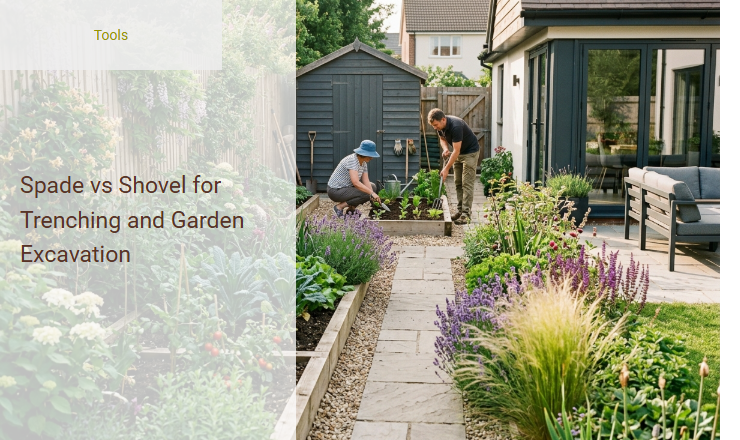
Anyone who has spent an afternoon battling compacted clay knows how quickly the wrong tool can turn a simple landscaping project into exhausting, back-breaking labor. Before selecting an implement, however, one must first understand how varying soil densities and root networks dictate the physics of manual excavation.
Matching the correct blade geometry to your specific task not only halves your working time but also prevents unnecessary physical strain. While both tools often appear interchangeable, it is important to stipulate that their designs serve fundamentally distinct mechanical purposes. For instance, a square, flat-edged spade excels at slicing through tough sod and cutting clean, straight trench walls, whereas a dished, pointed shovel is engineered for scooping and shifting loose soil or gravel.
This comparative analysis will examine the structural differences between spades and shovels, evaluate their performance in both trenching and general garden excavation, and guide you in selecting the optimal tool for your project's demands.
Spade vs Shovel: Choosing the Right Tool for Your Yard
Walk into any garden center, and you will find rows of long-handled tools that look remarkably similar at a glance. However, using the wrong tool can quickly lead to exhaustion, ruined landscaping, or sore muscles. The common confusion between spades and shovels often results in homeowners attempting to scoop loose mulch with a heavy flat blade or slice crisp turf with a curved scoop. Understanding the fundamental differences is the key to effortless landscaping. Spades are engineered for precise trenching and slicing, whereas shovels are optimized for high-volume garden excavation and material movement.
Anatomy of a Garden Spade: Built for Precision
A garden spade is a specialized instrument characterized by its compact, architectural design. Unlike other digging tools, its primary purpose is not to move large mounds of earth, but to slice through roots, sod, and soil with surgical accuracy. The unique build allows the gardener to exert direct downward pressure, utilizing the body's weight to slice clean borders.
- Flat, Rectangular Blade: Designed to slice straight down without displacing surrounding soil.
- Straight Cutting Edge: Acts like a knife blade to shear cleanly through tough roots and sod.
- Short, Stiff Shaft: Often paired with a D-grip handle to maximize close-up control and precision.
- Flat Treads: Reinforced steps on top of the blade that provide a secure foot placement for extra driving force.
Anatomy of a Shovel: Designed for Scooping
A classic shovel is the ultimate utility tool for bulk material transport and deep digging. Its design maximizes carrying capacity and ground penetration, making it indispensable for moving loose piles of soil, gravel, or compost. By combining a curved face with a pointed tip, it transforms physical effort into efficient soil displacement.
- Curved, Concave Blade: Features raised edges that form a shallow bowl to prevent loose material from spilling over the sides.
- Pointed or Rounded Tip: Concentrates force at a single point to break apart compacted earth or gravel.
- Angled Shaft: Positioned at an offset angle to the blade, which allows the user to scoop and lift material without bending too deeply.
- High Capacity Reservoir: Optimized to cradle bulk piles of mulch, sand, or stones during transport.
Blade Design: Cutting vs. Scooping Power
The core difference between these two tools lies in the physics of soil interaction. A flat spade blade operates on the principle of a chisel. When forced downward, the straight edge distributes weight evenly across a flat plane, resulting in a perfect shearing action. This makes it incredibly efficient at slicing sod or severing stubborn roots beneath the surface.
Conversely, a shovel blade utilizes a curved, pointed geometry to wedge its way into the ground. The pointed tip concentrates all the physical force onto a tiny surface area, allowing it to penetrate hard-packed or rocky soils with ease. Once the blade has broken the crust, the curved profile acts as a scoop, using mechanical leverage to lift and throw loose material away from the excavation site.
Best Tool for Trenching: Digging Clean Channels
When installing irrigation pipes, laying down garden borders, or burying utility lines, creating a neat channel is essential. The spade is the superior tool for this task because its flat blade produces sharp, vertical walls. Using a curved shovel for trenching often results in sloppy, collapsed edges and an unnecessarily wide trench that requires extra backfilling.
To execute a flawless trench, position the spade vertically and step firmly onto the tread. This straight-down slicing technique cuts a crisp line through the turf. Rock the handle slightly forward and backward to loosen the soil column, then lift the intact block out. This method ensures that the trench walls remain stable, allowing you to create deep, narrow channels with minimal disruption to the surrounding lawn.
Best Tool for Garden Excavation: Shifting Soil and Bulk Materials
For large-scale landscaping projects, a shovel is absolutely indispensable. If you are digging a wide hole to plant a new fruit tree, you need a tool that can pierce the earth, break up compacted clay, and clear out the debris quickly. The shovel's pointed blade is engineered to slice through dense ground layers, while its deep bowl allows you to scoop out large mounds of dirt with every pass.
This tool also excels at moving stockpiles of loose yard materials. Whether you are transferring organic compost into raised beds, spreading decorative gravel along a pathway, or loading wood chips into a wheelbarrow, the scoop-shaped blade carries far more material than a spade ever could. It minimizes spillage and accelerates your workflow, saving valuable time and energy during heavy excavation tasks.
Ergonomics, Shaft Handles, and Leverage
The structural geometry of a tool handle plays a crucial role in how much strain is placed on your body during long hours of yard work. Matching the right handle style to the task can prevent lower back pain and hand fatigue.
- D-Grip Handles: Typically found on shorter spade shafts, this design allows you to grip the tool firmly with both hands, providing maximum control and downward pushing power for vertical slicing.
- Long, Straight Shafts: Commonly featured on shovels, these long handles provide immense leverage for lifting heavy loads and allow you to work from a more upright posture, reducing lower back strain.
- Fiberglass vs. Wood: Fiberglass shafts offer lightweight durability and weather resistance, while traditional ash wood provides excellent shock absorption and a classic feel.
Spade vs. Shovel: Quick Decision Matrix
| Metric | Garden Spade | Garden Shovel |
|---|---|---|
| Blade Shape | Flat and rectangular | Curved, concave, and pointed |
| Primary Function | Edging, slicing, and trenching | Scooping, digging, and shifting bulk materials |
| Ideal Soil Types | Loamy, root-dense, or sodded soil | Compacted, rocky, or loose earth |
| Edge Type | Straight and sharp | Pointed or rounded |
| Average Shaft Length | Shorter (often with D-grip) | Longer (often straight) |
Maintenance Tips for Longevity and Performance
High-quality yard tools are an investment that can last for decades if properly maintained. Neglecting your spade or shovel leads to rusted steel, dull edges, and splintered handles that make physical labor much harder than it needs to be.
- Clean thoroughly: Hose off all mud, soil, and organic debris after every use, drying the metal parts with a clean rag to prevent rust.
- Sharpen the edges: Use a flat mill file at a thirty-degree angle to keep the cutting edges sharp, ensuring effortless soil penetration.
- Condition wooden handles: Rub linseed oil into wooden shafts once or twice a year to prevent the wood from drying out and splintering.
- Lubricate the metal: Apply a thin coat of multi-purpose oil or penetrating spray to the blade before storing it for the winter season.
Matching the Tool to Your Garden Project
Selecting the perfect tool comes down to identifying the specific physical actions your landscaping project demands. If your upcoming weekend involves cutting clean borders along flower beds, installing straight trenches for drainage pipes, or removing stubborn sod, a garden spade is the precise instrument you need. Its flat blade will save you time and preserve the neatness of your lawn.
For tasks focused on digging deep planting holes, relocating piles of topsoil, or spreading mulch across your yard, a heavy-duty shovel is the correct choice. Its curved scoop and pointed tip are engineered to handle volume and pierce tough ground. Possessing both tools in your garden shed ensures you are always prepared to work efficiently, protect your body from unnecessary strain, and achieve professional-grade results in your outdoor space.
| Trenching Feature | Spade | Shovel |
|---|---|---|
| Blade Geometry | Flat, rectangular blade with a straight, sharp cutting edge. | Concave, curved blade with a pointed or rounded tip. |
| Trenching Role | Slicing turf, cutting straight/vertical walls, and edging. | Scooping, lifting, and clearing loose soil from the trench. |
| Efficiency Profile | High precision; optimal for defining narrow trench boundaries. | High volume; optimal for rapid excavation and bulk material removal. |
Leave a comment