
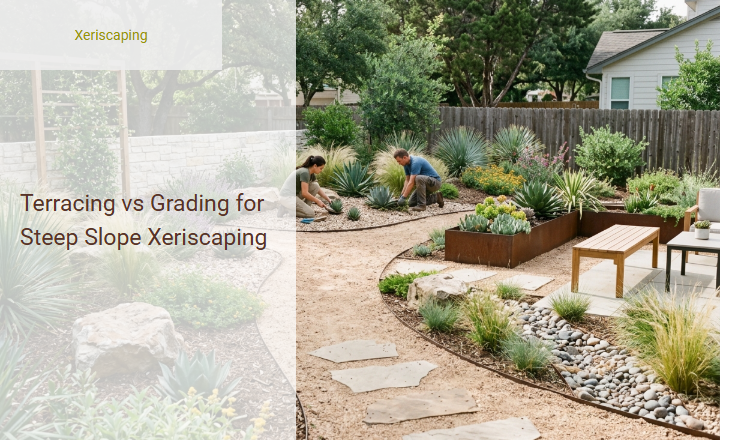
Managing a steep hillside property often feels like a losing battle against severe soil erosion, unstable terrain, and skyrocketing water bills. Before diving into plant selection, however, one must first understand how gravity and hydrology interact on inclined surfaces. Masterfully manipulating this topography grants homeowners absolute control over water runoff, transforming a barren hazard into a thriving, low-maintenance asset.
Note: While both earth-shaping methods are highly effective, slopes exceeding a 30% grade typically require structural engineering assessments and local municipal permits to ensure safety. Depending on your site, solutions can range from utilizing heavy machinery for smooth grading to constructing timber retaining walls for tiered terracing backfilled with drought-tolerant agave and native grasses.
Below, we will analyze the critical differences between terracing and grading, comparing their costs, installation complexities, and overall suitability for your xeriscaping project.
The Challenge of Steep Slope Xeriscaping
Landscaping on a steep incline presents severe logistical and ecological challenges, transforming standard gardening into an engineering puzzle. Gravity constantly pulls topsoil, moisture, and vital nutrients downhill, leaving slopes dry, depleted, and highly susceptible to erosion. Implementing the principles of xeriscaping-a water-conserving landscaping philosophy tailored to arid climates-on a hillside requires careful structural planning before the first plant ever enters the ground.
The foundational decision of whether to use terracing or grading determines both your property's long-term soil stability and its overall irrigation efficiency. Choosing incorrectly can lead to catastrophic mudslides, wasted water resources, and failed plant installations. This initial structural choice dictates how rainwater behaves on your hill, how roots anchor into the slope, and how much labor and financial resources you must commit to the project over its lifetime.
Understanding Terracing: Structure, Benefits, and Drawbacks
What is Terracing?
Terracing is the process of converting a steep, continuous slope into a series of flat, step-like platforms. These horizontal beds are carved out of the hillside and held in place by sturdy, vertical retaining walls built from stone, concrete blocks, bricks, or heavy timber. By breaking the continuous drop into distinct shelves, terracing changes the physical mechanics of gravity and water movement on your property.
The Advantages of Terraced Slopes
- Dramatically reduces water runoff speed, allowing moisture to sink deeply into the flat soil beds.
- Eliminates soil erosion by locking earth behind durable physical barriers.
- Creates highly accessible, flat planting zones that are easy to walk on and maintain.
- Maximizes usable yard space on properties that were previously too steep to enjoy.
The Disadvantages of Terraced Slopes
- Requires a high initial investment for structural building materials like stone or concrete.
- Demands heavy physical labor and precise engineering to prevent wall collapses.
- Can disrupt natural subsurface water drainage patterns if weep holes are not installed correctly.
Understanding Grading: Reshaping the Slope for Stability
What is Grading?
Slope grading is the process of physically reshaping a hillside by cutting away high spots and filling in low spots to create a gentle, continuous incline. Instead of using retaining walls to divide the hill, grading relies on heavy earthmoving equipment to smooth out the severe angles of the land. The goal is to reduce the slope to an angle that can support healthy plant life and resist gravity-driven soil movement naturally.
The Advantages of Graded Slopes
- Requires far fewer structural building materials, reducing upfront hardscape costs.
- Maintains a seamless, open, and natural topography that blends into the surrounding landscape.
- Simplifies initial earth prep work by utilizing large machinery to reshape massive areas quickly.
- Allows for flexible, sweeping planting designs without the rigid borders of walls.
The Disadvantages of Graded Slopes
- Retains a continuous path for water runoff, increasing the risk of surface washing during intense rains.
- Demands highly specialized plant selection with deep-rooting habits to physically bind the soil.
- Can be difficult to navigate safely for hand-weeding and seasonal plant maintenance.
Water Efficiency and Runoff Management Comparison
Managing water on a sloped property requires a deep understanding of gravity and soil absorption. When rainwater hits an untreated steep incline, it gains velocity, washing away precious topsoil and flowing off the property before plants can drink. Designing a xeriscape means turning this runoff challenge into an efficient, self-sustaining irrigation asset.
Terracing works by capturing water where it falls, transforming high-speed runoff into slow, vertical infiltration.
On a terraced slope, each flat step behaves like an individual catchment basin. Heavy rains sink straight down into the flat garden beds, recharging the deep root zones of your low-water plants. On the other hand, graded slopes rely on continuous, gentle slopes that still encourage water to travel downward. To manage heavy, infrequent rainfall events on a grade, you must rely on contour swales and dense, structural vegetative cover to slow down the sheet flow of water and prevent destructive soil gullies from forming.
Financial Investment and Installation Complexity
| Factor | Terracing Method | Grading Method |
|---|---|---|
| Primary Cost Drivers | Retaining wall blocks, timber, gravel backfill, and structural engineering fees. | Heavy machinery rental, operator labor, and bulk soil amendments. |
| Installation Labor | Extremely high manual labor for leveling beds, carrying blocks, and masonry work. | High mechanical operation labor, requiring skilled equipment operators. |
| Permit Requirements | Often required by local municipalities for any retaining walls exceeding three feet in height. | Required if grading alters natural watersheds or moves significant volumes of earth. |
| DIY Feasibility | Moderate for small, low-tier timber systems; very low for tall, engineered structural walls. | Low, as operating excavators and skid-steers on inclines requires professional training. |
Aesthetic Impact and Landscape Design Styles
The Structured Geometry of Terracing
Terracing creates a highly structured, architectural aesthetic that brings formal elegance to a hillside. The clean, defined lines of stone or timber retaining walls establish distinct garden compartments, transforming a wild slope into a series of curated outdoor rooms. This method allows you to showcase prized specimens individually, offering a look that ranges from classic Mediterranean hillside estates to crisp, modern multi-level courtyards. The vertical elements of the walls add architectural depth and contrasting textures to the soft green tones of your xeriscape plants.
The Naturalistic Flow of Grading
Grading emphasizes a seamless, naturalistic aesthetic that mimics undisturbed wild landscapes. Rather than fighting the natural contours of the earth, grading softens them, allowing the eye to sweep across a flowing canvas of native grasses and shrubs. This approach is ideal for homeowners who prefer a wild, meadow-like appearance or a native woodland look. The lack of rigid borders creates a feeling of infinite space and movement, where plants blend into one another rather than being confined to structural pockets.
Best Xeriscape Plants for Terraced Slopes
- Rosemary (Salvia rosmarinus)
- A tough, drought-tolerant woody herb that cascades beautifully over retaining wall blocks, thriving in the sharp, fast drainage found at the edges of terraced beds.
- Trailing Ice Plant (Delosperma cooperi)
- A low-water succulent groundcover that forms a dense, vibrant carpet, cascading down vertical walls to soften harsh structural lines with bright summer blooms.
- Agave (Agave americana)
- A dramatic architectural succulent that thrives in the flat, deep-soil pockets of a terrace, serving as a striking focal point while utilizing the stable soil levels.
- Red Yucca (Hesperaloe parviflora)
- An exceptionally drought-resistant plant with grass-like foliage and tall coral flower spikes that handles the hot, dry microclimates of terraced steps with ease.
Best Xeriscape Plants for Graded Slopes
- Vetiver Grass (Chrysopogon zizanioides)
- A deep-rooting ornamental grass with a massive, vertical root system that grows up to ten feet deep, acting as a living anchor to hold graded soil in place.
- California Sagebrush (Artemisia californica)
- A resilient, native shrub that establishes rapidly on open slopes, binding the top layer of earth together while requiring zero summer water once established.
- Prostrate Juniper (Juniperus horizontalis)
- A low-growing evergreen conifer that spreads wide across graded slopes, forming a dense evergreen blanket that intercepts heavy rain and shields soil from wind erosion.
- Deer Grass (Muhlenbergia rigens)
- A hardy, warm-season bunchgrass that grows in dense mounds, slowing down surface runoff as it sheets down a graded incline while adding graceful motion to the landscape.
Long-Term Maintenance and Structural Durability
Every sloped landscape requires long-term vigilance, but the nature of that maintenance depends on whether you choose to terrace or grade your hillside. Both methods have specific points of vulnerability that can lead to failure if left unchecked over the years.
Terraced properties face structural risks associated with physical building materials:
- Hydrostatic Pressure: Water pooling behind retaining walls can cause them to bow, crack, or collapse if weep holes are allowed to clog with dirt and debris.
- Material Degradation: Wooden timbers will rot over a decade, and mortar joints in stone walls can fail under seasonal freeze-thaw cycles, requiring tedious masonry repairs.
Graded properties face biological and erosional risks associated with exposed earth:
- Gully Formation: If a key plant dies or bare patches of earth are left open, concentrated runoff can quickly cut deep, destructive rills into the slope.
- Weed Invasion: Because graded slopes lack structural boundaries, invasive weeds can spread rapidly across the continuous terrain, making manual clearing difficult on steep footing.
- Organic Matter Slide: Wood chips and organic mulches tend to slowly migrate downhill during heavy winds or rain, requiring periodic replenishment at the top of the grade.
Decision Guide: Selecting the Right Method for Your Property
To choose the best approach for your specific property, you must weigh several intersecting factors including your budget, the severity of your slope, and your personal design goals.
Evaluate the Slope Angle: If your hillside features a steep incline of thirty degrees or more, terracing is the safest option because grading such a steep hill can create an unstable incline prone to sliding. For gentle slopes under twenty degrees, grading is highly effective and far more practical.
Consider Your Initial Budget: Building retaining walls requires significant capital for heavy materials like stone, concrete, and structural backfill. If your budget is modest, grading allows you to cover a vast hillside area with a lower initial structural cost, leaving more funds available for drought-tolerant plants and drip irrigation systems.
Assess Soil Composition: Loose, sandy soils do not hold their shape well on continuous graded slopes and are highly susceptible to wind and water erosion, making terraced retaining walls a safer choice. Conversely, dense clay soils can support a graded incline well, provided you install swales to redirect slow-moving water.
Determine Your Maintenance Ability: If you prefer easy, level walking paths for pruning, weeding, and harvesting low-water crops, terracing provides a highly functional workspace. If you prefer a hands-off, self-sustaining ecosystem of native plants that you rarely need to access, a graded slope planted with deep-rooting groundcovers will serve your needs beautifully.
| Feature | Terracing | Grading |
|---|---|---|
| Method | Creates a series of flat, stepped platforms supported by retaining walls. | Reshapes and smooths the earth to create a uniform, gentler incline. |
| Slope Suitability | Highly effective for very steep slopes (typically > 15-20% grade). | Best for gentle to moderate slopes (typically < 15% grade). |
| Erosion Control | Excellent; disrupts water flow velocity and captures runoff on flat tiers. | Moderate; relies heavily on immediate revegetation and drainage systems. |
| Land Usability | Maximizes usable flat space for gardening, pathways, or outdoor living. | Maintains a slope, keeping the area mostly decorative or passive. |
| Cost & Complexity | High; requires structural materials, engineering, and manual labor. | Lower; primarily utilizes heavy machinery for bulk earthmoving. |
Leave a comment